

[비즈한국] The Supreme Court has once again ruled that if a worker performed duties at a POSCO steel mill under the company's instructions, POSCO must directly employ them, even if the company named on their employment contract is a subcontractor. Notably, this instance marks the first time that workers from a second-tier subcontracting firm—who did not have a direct contract with POSCO—have been recognized as POSCO employees.
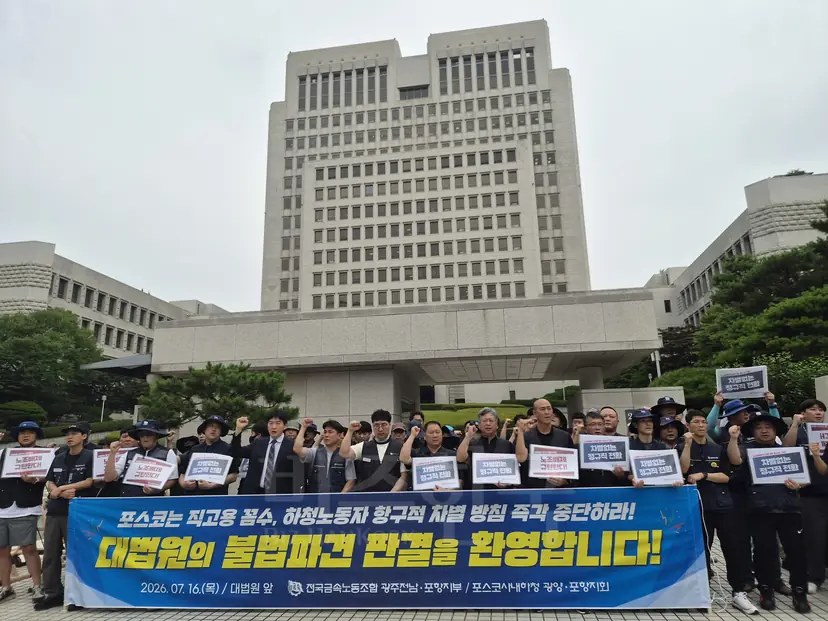
On the 16th, the Second Division of the Supreme Court upheld the lower court's ruling in favor of the plaintiffs in two separate lawsuits filed by 379 workers at POSCO’s in-house subcontracting firms seeking confirmation of their employee status. The court determined that 374 of these workers, excluding five individuals including those past retirement age or those in specific cold-rolled product packaging roles, should be directly employed by POSCO.
The core of this ruling is that, regardless of the affiliation stated in the contract, one must examine who actually directed and controlled the work on-site. Although the workers received their salaries from subcontractors, they were deployed into POSCO’s steel production processes—such as crane operation, roll processing, steelmaking, and facility maintenance—at the Pohang and Gwangyang steel mills. They argued that the content, sequence, and deployment of their work were, in fact, dictated by POSCO.
The Supreme Court concluded that the lower court correctly determined that since these workers were employed by subcontractors but worked for POSCO under its command and orders, they were in a substantial dispatch relationship. The court held that even if a subcontracting agreement exists, if the principal contractor issues direct and specific work instructions to the workers, it can be viewed as illegal dispatch rather than a legitimate subcontract.
The industry is particularly focused on the recognition of 18 workers from COMTECH, a second-tier subcontractor, as POSCO employees. COMTECH is a sub-subcontractor that was hired by a first-tier contractor—which had a direct contract with POSCO—to handle maintenance for heating furnaces that produce coke. The Supreme Court clarified that POSCO cannot evade employer responsibility simply because an additional layer of subcontracting exists. This analysis suggests that the criteria for identifying illegal dispatch could now expand beyond first-tier subcontractors to the entire multi-level subcontracting structure.
However, not all subcontracting workers at the steel mills were recognized as POSCO employees. The employee status of four workers related to POSCO M-TECH, which mainly handles steel product packaging, was not recognized. The reason provided was that POSCO had never directly performed cold-rolled packaging work itself, and it was difficult to conclude that the company had provided specific direction and orders to those workers.
In April, the Supreme Court had already overturned and remanded a lower court decision regarding seven POSCO M-TECH workers with similar reasoning. The legal judgments have varied depending on how closely the work was integrated into POSCO’s production processes.
Lawsuits by POSCO’s in-house subcontracted workers began in 2011. The first Supreme Court ruling came in July 2022, when 55 workers won their case, marking the first time POSCO’s obligation to directly hire these workers was confirmed. To date, 314 additional members of the Metal Workers' Union have been recognized as employees, and the total number of participants in related lawsuits, including 1,177 currently in the first trial, has reached 2,667.
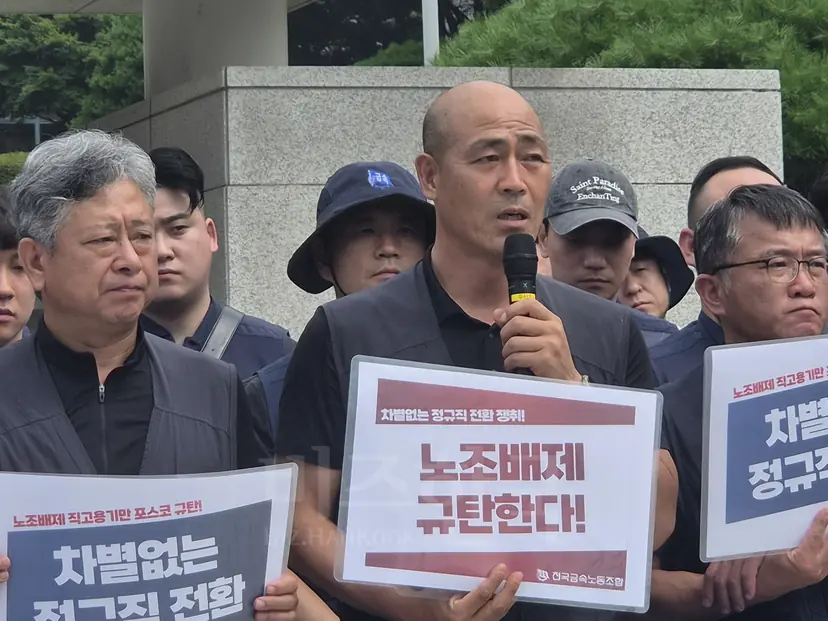
Immediately following the Supreme Court’s verdict, the Metal Workers' Union held a press conference in front of the court to express their welcome. Jung Jun-young, an attorney for the union who represented the plaintiffs, stated, “This is a natural conclusion reached after workers fought POSCO in court for 7 to 8 years with evidence. It confirms that illegal dispatch has occurred in all processes necessary for POSCO to produce steel products.”
However, the union heavily criticized POSCO’s announcement in April regarding the creation of a separate “Operational Synergy (S)” job category aimed at directly hiring approximately 7,000 subcontracted workers. The S-category is reportedly subject to a wage system that is, on average, only 70% or less of that of existing field staff.
The Metal Workers' Union and the POSCO in-house subcontracting branch strongly protested, calling it a “half-measure” for direct hiring. They pointed out that the company’s unilaterally pushed S-category recruitment is a scheme to solidify another form of status discrimination and dual structures within the workplace.
During the press conference, Park Geun-seo, head of the Gwangju-Jeonnam branch of the Metal Workers' Union, raised his voice, saying, “Despite today’s Supreme Court ruling, the workers subject to direct hiring are not actually happy. We cannot accept this half-baked direct hiring. Withdraw the S-category immediately and implement normal direct employment.”
Kim Seung-pil, head of the Pohang branch of POSCO in-house subcontractors, added, “The S-category scheme is a cowardly evasion tactic intended to trap subcontracted workers in a second-class regular employee framework forever. We will never stop until we achieve a complete, discrimination-free workplace.”
The union criticized POSCO for pushing the system unilaterally without any dialogue or procedural discussion with the involved labor unions. Jung Sang-man, deputy chairman of the Metal Workers' Union, urged the management to engage in responsible dialogue, stating, “Legal battles are now just a war of attrition. Chairman Jang In-hwa must come to the negotiating table himself to discuss working conditions and methods for direct employment.”
POSCO stated that it respects the court’s decision and will faithfully follow the subsequent procedures. A POSCO official said, “We decided to directly hire on-site employees of subcontractors who perform support duties directly related to operations in the steel production process to achieve a breakthrough improvement in the prime-subcontractor structure and innovate the field safety management system.” They added, “We will proceed with the follow-up steps for the winning plaintiffs in a sequential manner, comprehensively considering the safety of the steel mills and smooth integration with existing operational systems.”