

[비즈한국] LIG D&A has proposed a "Missile Total Package" designed to integrate and manage the KF-21’s core weaponry while also driving exports. The concept involves LIG D&A taking charge of system integration for a wide range of munitions—from KGGB guided bombs to short-range air-to-air missiles (SRAAM), long-range air-to-ground missiles (ALCM), and long-range air-to-air missiles (LRAAM)—to challenge the export market. LIG argues that by having a single entity manage the major armaments for the KF-21, they can reduce development and mass-production costs while establishing a unified Maintenance, Repair, and Overhaul (MRO) system.
On July 15, 2026, about 250 representatives from the military, government, and private sectors—including the Army Logistics Command, the Defense Acquisition Program Administration (DAPA), and the Agency for Defense Development (ADD)—attended LIG D&A’s 6th Aviation Guided Weapon and Avionics Development Seminar at the OSCO Convention Center in Cheongju, North Chungcheong Province. The most highlighted presentation at the event, held under the theme "The Last Puzzle Piece of K-Defense," focused on how to develop long-range air-to-air missiles and why LIG D&A should be the entity to lead the project.
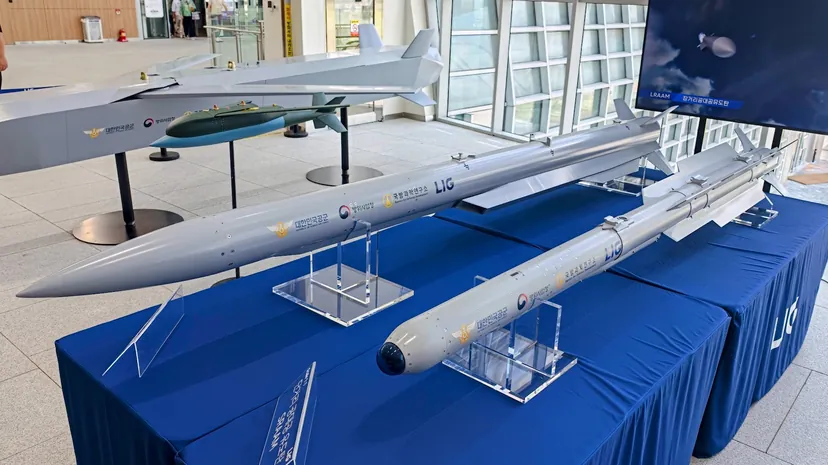
So, why is LIG emphasizing the long-range air-to-air missile as "the last puzzle piece of K-Defense"? Currently, the KF-21 is scheduled to carry the Meteor missile from the UK-European consortium MBDA and the IRIS-T from Germany’s Diehl Defence. Furthermore, some have suggested that the Taurus missile, in which MBDA is involved, should be introduced instead of the long-range air-to-ground missile currently being developed domestically. The need to integrate domestic weaponry to secure the KF-21's export competitiveness and operational autonomy has become greater than ever.
Against this backdrop, competition between Hanwha and LIG to seize the initiative in the long-range air-to-air missile project is intensifying. The long-range air-to-air missile project is being promoted under government leadership, with the ADD leading development and selecting the prototype manufacturer. Although some YouTube videos have claimed that a specific company has already been chosen as the prototype manufacturer, it has been confirmed that this is not true.
Why does LIG D&A argue that they should be selected as the prototype manufacturer for the long-range air-to-air missile? Their first argument is their proven track record in system integration. LIG has already begun system development for short-range air-to-air missiles (SRAAM-II), building on the know-how accumulated from the development of the KGGB (Korean GPS-Guided Bomb) and the "Cheonryong" long-range air-to-ground missile. LIG contends that by also taking on the long-range air-to-air missile project—which is expected to require approximately 753.5 billion won in R&D costs—they can connect the entire KF-21 weapon system into a single, cohesive framework.
This is the core of the "KF-21 Missile Total Package" presented by LIG at the seminar. The KF-21 cannot perform aerial combat without air-to-air missiles, nor can it attack ground targets without air-to-ground missiles. LIG is already handling system integration for guided bombs, air-to-ground missiles, and short-range air-to-air missiles developed under the leadership of the ADD. Their logic is that if LIG plays a key role in developing the final remaining piece, the long-range air-to-air missile, it will create significant synergy.
Of course, air-to-air and air-to-ground missiles serve different concepts and roles, and there are significant differences in the technologies and operational characteristics required for short-range versus long-range air-to-air missiles. In particular, the long-range air-to-air missile to be developed under the ADD must possess flight performance equal to the Meteor, which is considered world-class. It will also require an Active Electronically Scanned Array (AESA) radar seeker—a feature not present in the Meteor—making the performance requirements extremely high. The task of connecting and integrating the missile with the KF-21 through a complex interface is also a daunting challenge.
The essence of the total package proposed by LIG D&A is that having one company lead the system integration of both air-to-air and air-to-ground missiles reduces development complexity and costs, while providing significant advantages in future maintenance, repair, and overhaul. LIG is already integrating three types of missiles and guided bombs into the KF-21. By utilizing common parts and technologies during this process, they explain that system integration can be done more easily and cheaply compared to having multiple companies develop them separately, and it can also lower the unit price of the missiles.
LIG's accumulation of more experience than its competitors, specifically through the ongoing testing of integrating the Cheonryong missile into the KF-21, is also considered a strength. The argument that integrating short-range air-to-air missiles before long-range ones can reduce trial and error also carries significant weight.
In the long term, if the parts and maintenance systems of different missiles mounted on the KF-21 are standardized, there will be major benefits for maintenance and repair. The South Korean Air Force previously faced difficulties with the maintenance of AGM-84H SLAM-ER missiles. Controversy also arose regarding the Taurus missile when the manufacturer notified the Air Force of an extension of the regular depot maintenance cycle from the original 7 years to 15 years, citing a lack of parts and maintenance capabilities.
However, competitors such as Hanwha Aerospace and Hanwha Systems are also in charge of developing key components for the KF-21, including the AESA radar. Given their significant technology and experience in missile development fields such as propulsion and seekers, it is difficult to definitively state that LIG has an advantage in the long-range air-to-air missile project.
One of the most difficult stages in missile development is system integration—the actual mounting and stable firing of the missile from a fighter jet. When a long-range air-to-ground missile crashed during tests earlier this year, the research team carefully analyzed the cause and eventually succeeded in a test launch on June 25. The long-range air-to-ground missile launched at that time hit a point target the size of the missile's diameter, demonstrating an accuracy of around 1 meter. This proved both the necessity of developing domestic missiles and the technical prowess of the ADD and LIG through actual results.
Whether the system integration experience accumulated from the long-range air-to-ground missile can carry over into the development of the long-range air-to-air missile is expected to be a key variable that will determine future project selection and the level of completion of the KF-21's domestic weapon system.