

[비즈한국] Apartment transaction volume in adjusted target areas has decreased by approximately 20% in the month following the end of the grace period for capital gains tax surcharges on multi-homeowners. Although apartment transactions surged by 65% compared to the previous year during the final month before the grace period ended, they declined once it expired. The drop in transactions was concentrated in apartments valued under 2 billion won.
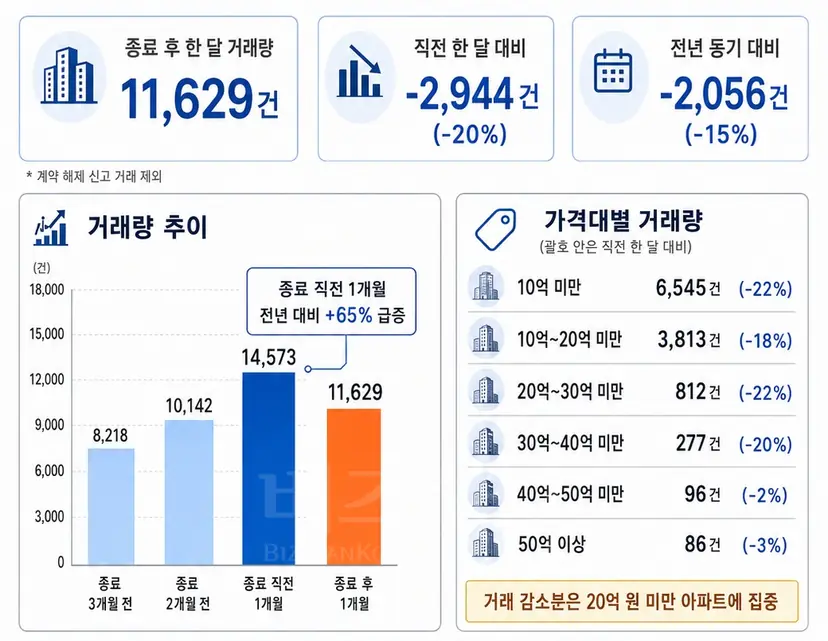
According to an exhaustive analysis of actual apartment transaction records by Bizhankook from May 10 to June 9—the first month after the capital gains tax surcharge grace period ended—the volume of transactions in adjusted target areas totaled 11,629, a decrease of 2,944 (20%) compared to the month immediately preceding the expiration. This is a 2,056 (15%) decrease compared to the same period last year. The deadline for reporting real estate transactions is 30 days from the contract date, and the final transactions analyzed were reported by the 9th.
The decline in transaction volume in adjusted target areas was particularly notable for apartments priced under 2 billion won. Transaction volumes by price range for the month following the end of the grace period were as follows: △under 1 billion won, 6,545 cases (-22%); △1 billion won or more and under 2 billion won, 3,813 cases (-18%); △2 billion won or more and under 3 billion won, 812 cases (-22%); △3 billion won or more and under 4 billion won, 277 cases (-20%); △4 billion won or more and under 5 billion won, 96 cases (-2%); and △5 billion won or more, 86 cases (-3%).
By region, transactions decreased in 34 out of the 37 adjusted target areas. The transaction volumes in the month after the grace period ended were as follows: △Uiwang-si, 217 cases (-41%); △Gangdong-gu, Seoul, 326 cases (-38%); △Yeongdeungpo-gu, 259 cases (-36%); △Songpa-gu, 454 cases (-31%); △Yeongtong-gu, Suwon-si, 557 cases (-30%); and △Nowon-gu, 815 cases (-22%). Conversely, transactions increased in Guro-gu, Seoul, with 617 cases (+28%), Gwangjin-gu with 168 cases (+27%), and Gwanak-gu with 327 cases (+4%).
In February, the government decided to end the capital gains tax surcharge grace period for multi-homeowners on May 9 as scheduled. The scope of the grace period was expanded from cases where sales contracts were signed by May 9 to include cases where applications for land transaction permits were submitted by the same date, following supplementary measures in April. The capital gains tax surcharge for multi-homeowners refers to a system that imposes heavy taxes when multi-homeowners in adjusted target areas sell their homes.
The maximum tax rate applied when a multi-homeowner sells a house reaches 82.5%. While the current basic capital gains tax rate ranges from 6% to 45% based on the tax base, an additional 20%p is added for those who own two homes, and 30%p for those who own three or more. Specifically, for those owning three or more homes, the maximum rate reaches 82.5%, combining the 75% surcharged capital gains tax with a 10% local income tax. When the surcharge is applied, the "long-term holding special deduction," which deducts capital gains based on the holding period, is also excluded.
Apartment transactions in adjusted target areas increased significantly just before the end of the grace period. Apartment transaction volume, which stood at 8,218 cases in the month three months before the end, surged to 10,142 cases two months before, and to 14,573 cases in the final month before the expiration. The transaction volume in the final month before the end was an increase of 5,726 cases (65%) compared to the same period the previous year. Although the cumulative transaction volume for the three months prior to the end reached 32,933, which was only a 1% increase compared to the same period last year, transactions for apartments under 1 billion won amounted to 20,023 cases, an increase of 2,581 (15%) compared to the same period the previous year.
Lee Eun-hyung, a research fellow at the Construction & Economy Research Institute of Korea, stated, "The end of the capital gains tax surcharge grace period is a measure limited to properties held by multi-homeowners, so its impact on shifting the overall market's transaction flow is limited." She added, "The increase in listings or transactions before the end should also be considered in light of seasonal factors, such as the spring moving season, and the impact of the expanded scope of the grace period in April."