

[비즈한국] The company received investment. Not a single penny of that money has been spent; it remains untouched in the company's bank account. Yet, the lawsuit demanding repayment was not filed against the company, but against the founder personally. The court ruled that the founder must pay.
This is the story of Shin Chul-ho, CEO and founder of OGQ, Korea's largest creator content platform. In a statement released on social media on the 15th, CEO Shin revealed the process by which he came to owe 12 billion won in personal debt and expressed his grievance. Claiming that the interest alone increases by 100 million won each month, he argued, "This is not just my personal problem, but a question directed at the entire Korean venture investment system."
OGQ, founded in 2011, is a creator content platform that operates services like the 'Naver OGQ Market,' where users buy and sell emojis, images, and fonts. It is the largest IP market in Korea, with 17 million users and 1.3 million creators.
Company Has 40 Billion Won, Yet Founder Faces Bankruptcy—Why?
The incident dates back to 2021. OGQ received a 9-billion-won investment from a venture capital firm, referred to as 'A', with the premise of acquiring Getty Images Korea. It was a conditional investment with no specific deadline for the acquisition completion. Nowhere in the contract did the expression 'joint surety' regarding CEO Shin appear. However, the parties to the contract consisted of the investor, OGQ, and the 'interested party' Shin Chul-ho.
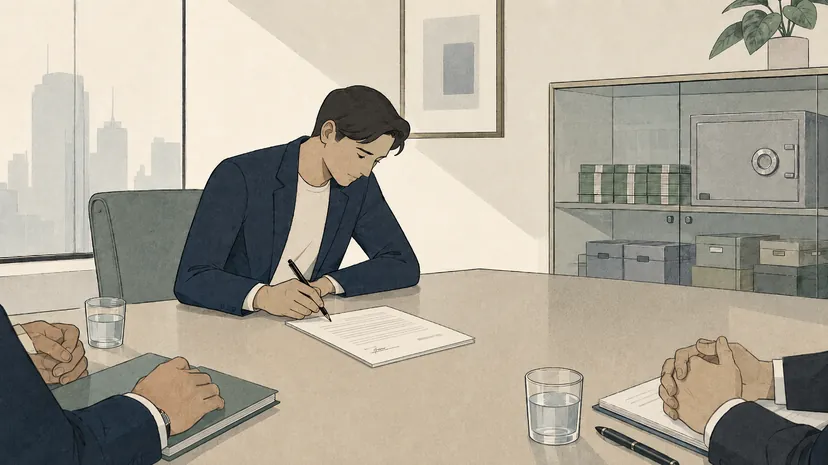
In 2023, Investment Firm A requested repayment of the investment on the grounds that the acquisition of Getty Images Korea had effectively fallen through, and they filed the lawsuit against CEO Shin personally rather than the company. Following the lower courts, the Supreme Court dismissed the appeal in April 2026, making the approximately 12-billion-won debt—consisting of the 9 billion won principal plus 12% annual interest—CEO Shin's fixed personal liability.
Why did they sue the individual instead of the company that received the massive investment? According to CEO Shin, the 9 billion won investment remains in the company's account "without a difference of even one won," and the company holds approximately 40 billion won in cashable assets. Even the interest accrued on the 9 billion won has piled up within the company. Effectively, the individual, who cannot easily raise 12 billion won in cash, has become the debtor while leaving behind a company fully capable of paying.
CEO Shin laments that not only is he burdened with debt, but he has no viable way to pay it. According to Shin, his OGQ shares are subject to disposal restrictions and shareholder consent procedures under the investment contract, making it difficult for him to sell them alone. Other shareholders are also opposing a sale, fearing changes in management control and setbacks to the IPO. Even though he holds a significant stake on paper, he cannot liquidate it in time, leaving him without the liquidity to repay the fixed debt.
Ultimately, following the court ruling, compulsory enforcement procedures are underway for CEO Shin's salary, real estate, and shares. Depending on the scope of the sale, there is a possibility that even his management stake, which far exceeds the debt amount, could be taken away. He is in a situation where he could potentially lose the management control of the company he has built for 15 years.
While CEO Shin states he respects the court's ruling, he declared he would file petitions with the Financial Services Commission, the Financial Supervisory Service, and the Ministry of SMEs and Startups, stating, "Supervisory authorities must look into whether this structure is normal."
The government has been working to abolish personal joint surety for founders to prevent business failure from leading to personal bankruptcy. The Venture Investment Promotion Act also prohibits venture capital firms from requiring joint surety from founders during the investment process.
Yet, how did the investment received by the company become the founder's personal debt? The answer lies in the five letters written in the contract: 'Interested Party' (이해관계인).
The 'Interested Party' Practice: Results Similar to Joint Surety
There is an old practice in the venture investment industry: listing not only the company but also the founder personally as a party to the investment contract under the title of 'interested party.' While the term seems neutral on the surface, the reality is different. As an interested party, the founder is personally responsible for the company's representations and warranties, faces restrictions on stock disposal, and is constrained from leaving the company. Crucially, they share the financial burden if the company fails to keep its promises. It is a method of placing an individual's name directly alongside the obligations the company should bear.
A representative mechanism that gives this practice its power is the put option, or 'stock purchase claim.' This is a clause stipulating that if promised conditions are not met, the founder, as an interested party, must buy back the investor's shares at the principal amount plus interest of around 10% per year.
The OGQ contract differs slightly from a typical put option. It stipulated that if certain conditions were met, the company and the interested party would repay the investment. However, the structure is similar in that it imposes liability equivalent to the investment on the founder personally. The moment the conditions deviate, the founder can become liable for the entire investment and interest received by the company.
The economic outcome for the founder can be similar to joint surety. An individual becomes responsible for the full amount of the company's investment and interest; if they cannot pay, there is a possibility they will lose their personal assets and management rights. Jung Yang-hoon, a partner lawyer at the law firm Barun, pointed out, "Although the trend is toward banning joint surety for interested parties through recent regulations and guidelines, there are cases where people seek to achieve the effect of joint surety through interested party clauses without explicitly using the term 'joint surety'."
For founders desperate for investment, it is not easy to reject such clauses. At the time of the contract, they may be so confident in the business's success that they do not fully grasp the weight of the clauses.
Why, then, do investors drag the founder personally into the contract instead of placing the recovery mechanism only on the company? This is because there are various legal constraints on mechanisms that directly demand repayment from the company.
First, according to Supreme Court precedents, agreements where a company guarantees investment principal and profit only to specific shareholders can be deemed invalid as they violate the 'principle of shareholder equality.' If a put option is placed against the company, the contract itself risks losing its validity.
It is also not easy for a company to voluntarily buy back its own shares. Under commercial law, for a company to acquire treasury shares or redeem redeemable preferred shares, it must have 'distributable profits.' Even if there are tens of billions of won in the bank, if the company has accumulated accounting losses, it is difficult for the company to return that money to investors. Most startups, for whom reporting losses during growth stages is common, fall into this category.
The problem is that the primary situations where put options are triggered—business stagnation or failure to go public—are exactly the times when there are no distributable profits. A mechanism against the company is, in effect, a safety pin that fails to work when it is needed most. This legal constraint is the background to why the individual became the debtor even though OGQ has 40 billion won.
A former venture capital industry official noted, "Joint surety is banned, and there are constraints on guarantee agreements against companies and the acquisition of treasury shares. Therefore, in practice, there are cases of using a dual mechanism that secures personal liability by including the founder as an interested party," adding, "It is kept as a final recovery measure for the founder from the beginning in preparation for situations where mechanisms against the company are neutralized."
Not the First Time... Another Founder Receives a Final Ruling of 1.3 Billion Won
OGQ is not the first case where this structure has materialized. Ha Jin-woo, former CEO and founder of the proptech startup Urbanbase, signed a contract as an 'interested party' when receiving 500 million won in investment from Shinhan Capital in 2017. The contract included a clause stating that if 'the company's normal business pursuit becomes impossible,' the investment must be repaid with 15% annual interest. Later, as the company entered rehabilitation procedures in early 2024 amid a cold investment climate, Shinhan Capital filed a claim against Ha personally rather than the company and placed an attachment on the house where he lived with his family. Of the 18 investment firms that invested in Urbanbase, Shinhan Capital was the only one to file a lawsuit against the founder personally.
The result was a total defeat for the founder. In April of this year, the Supreme Court confirmed a debt of approximately 1.3 billion won—the 500 million won principal plus 15% annual compound interest—as Ha's personal liability. The appellate court ruled, "As a founder gains the opportunity to enjoy massive profits when the business succeeds, it is also reasonable to compensate for the investment when it fails." This means the current judiciary's view is that the founder bears the risk of the business failure itself, even if there is no misconduct such as embezzlement or breach of trust.
There is one more commonality between the two cases. The investment entities were not venture investment associations under the Venture Investment Promotion Act, but rather 'new technology business investment associations' under the Specialized Credit Finance Business Act, so-called 'new tech associations.' The 'Regulations on Registration and Management of Venture Investment Associations' introduced in 2023 prevent holding interested parties jointly liable without fault such as embezzlement or breach of trust, but this regulation only applies to venture investment associations. In new tech association investments, contracts that hold the founder personally liable for the company's obligations are still possible. Both contracts were signed before the regulations were introduced, so they cannot be applied retroactively, and the type of investor itself remains in a double blind spot outside the regulations.
“Risk Allocation” vs. “Circumventing Regulation”... A Homework Task for Supervisory Authorities
The legal community's general view is that such contracts are difficult for founders to win in court. Courts consider contracts signed voluntarily by adults with business experience to be valid as written. The effectiveness of stock purchase or repayment agreements against an individual CEO has been recognized in several precedents. The conditions for an argument that a contract is excessively unfair to be accepted are also very strict. It is difficult to invalidate the effect of a contract simply because the investment was desperate or the bargaining power was weak.
There is also the investor logic. They argue that the abolition of joint surety regulates the realm of loans and guarantees, but does not prohibit contract terms in equity investments. Put options are not meant to punish for business failure, but are a mechanism to guarantee the implementation of promised conditions; without such safety devices, large conditional investments themselves would be difficult to conclude. They argue that it is a fair contract where the founder and the investor share the risk. In fact, if there is a recovery clause in the contract but it is not exercised, the investment firm could face the dilemma of potential violations of fiduciary duty or breach of trust toward the fund's investors.
However, fundamental counterarguments arise regarding whether such a contract structure aligns with the essence of equity investment. Lawyer Jung Yang-hoon stated his opinion, "Equity investment is risk capital where one accepts the risk of principal loss if it fails in exchange for huge profits if it succeeds," and added, "Clauses that shift management risk to the founder personally in cases of business failure without intent or gross negligence are a form of evasive contract structure, so it is appropriate to interpret their effect narrowly."
Of course, since CEO Shin signed the contract in his personal capacity, it is difficult to see him as completely free from legal responsibility. However, the point of contention in this case is not just whether a founder read the contract properly. The core issue is whether the practice of permitting personal liability of the same scale under the guise of an 'interested party' contract—while prohibiting joint surety—is acceptable, and whether allowing personal enforcement to take precedence even when the company has sufficient funds aligns with the purpose of the policy.
From the founder's perspective, this is no different from joint surety under a different name. Almost no founder has personal assets on the scale of the investment. The moment the clause is triggered, the founder's options narrow down to either personal bankruptcy or the loss of management rights. If the policy promise that 'you can challenge again even if you fail' is neutralized by a single contract clause, the meaning of the regulation fades.
While institutional improvements limiting the founder's personal liability have been made, the blind spot of new tech associations and the responsibilities arising from past contracts remain. The OGQ case is a prime example of a practice that current regulations intended to stop being realized through these gaps. This is why demands are being made that supervisory authorities examine closely whether the intent of the regulations is operating across the entire field of actual investment, regardless of the investment entity.
CEO Shin stated, "It might be easier for me to just give up. But if I back down in front of this injustice, one day another founder will stand in the same spot," adding, "I want to correct this wrong structure so that no one else has to go through the same thing in the future. That is the reason I am starting this long fight."