

[비즈한국] The SBS drama 'Mr. Kim' has silenced those who blamed the decline of domestic dramas on global online streaming platforms. In a situation where local OTT services cannot compete with global giants like Netflix, terrestrial TV dramas were considered to be in an even more difficult position. However, after surpassing 20% domestic viewership, SBS's 'Mr. Kim' has gone on to surpass the Netflix original series 'True Education' to claim the global number one spot.
Ultimately, it proved that the most local of content can become global content, and that Korean production companies and broadcasters are capable of achieving this. It is easy to see why SBS lamented that 'Mr. Kim' was only 10 episodes long.
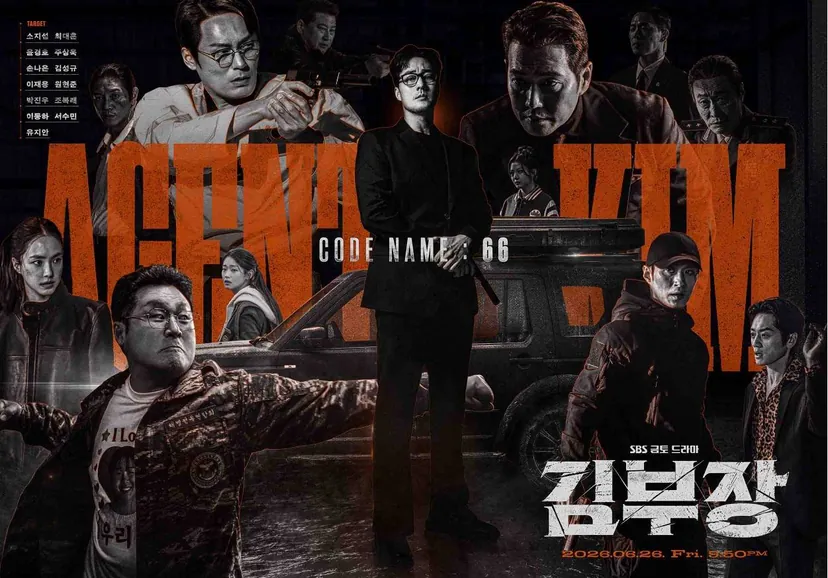
It has also earned the nickname 'K-Taken.' This is because its high-concept premise—rescuing a kidnapped daughter—is similar to the movie 'Taken,' starring Liam Neeson. However, this plot is not unique to 'Taken.' Many works feature a father rescuing his daughter, so it can be considered a cliché.
At this point, it is necessary to summarize why 'Mr. Kim' is 'Mr. Kim' and not just a 'K-Taken.' First of all, the drama 'Mr. Kim' goes beyond the binary structure of a story about villains kidnapping a daughter. It introduces a "hidden master" (him-sum-jin) character and setting, which aligns with current K-content trends. It moves beyond simply repeating this "hidden master" trope by structuring it further. Specifically, the secret that the father is a North Korean spy comes into play. Being a spy, rather than a former intelligence agent or special forces soldier, makes it even more absurd and confusing for his daughter.
This evokes a very specific type of wound, anxiety, and fear for Koreans. The father, Mr. Kim, is a spy from the North, giving him a complex identity. This is a very Korean element that transcends movies like 'The Man from Nowhere' or 'Taken.' It is because the specific situation of Korea—the division between North and South—is applied. It appears to be a dramatic device to intensify the action scenes and conflict structure.

Moreover, the character of Mr. Kim is different from previous inter-Korean espionage dramas. The structure of being pursued by both North and South Korean forces deepens the conflict and enhances immersion, as it builds another storyline involving North Korean spies. Furthermore, the setting of a former North Korean special forces operative settling down in South Korea as the father of a high school girl and an ordinary savings bank employee is a step forward compared to the movie 'Shiri.'
In addition, the support and cooperation from those around him add a sense of humanity. Sung Han-soo (Choi Dae-hoon) and Park Jin-chul (Yoon Kyung-ho), both former South Korean intelligence agents, put themselves in danger to join forces with Mr. Kim (So Ji-sub) to save Min-ji (Seo Soo-min). Mr. Im, an intelligence agent disguised as a laundry owner, and Sang-ah (Son Na-eun), disguised as an office coworker, also help Mr. Kim in their own ways.
Furthermore, the main culprit who assaulted and kidnapped Min-ji is linked to school violence. Gangsters are an essential element in Korean action works, and Joo Kang-chan (Joo Sang-wook)—a cold-blooded character with distorted paternal love who rose to the position of chairman of Joo-hak Construction after starting as a sociopathic hired thug—attempts to eliminate Min-ji for the sake of his daughter, who is a school bully. The final confrontation between Mr. Kim and Joo Kang-chan, both driven by paternal love, exposes the raw reality of South Korean class and power structures, inducing dramatic tension and immersion.

One might say this drama is unrealistic. Does a person like Mr. Kim actually exist? The action direction is cartoonish. The premise of a former North Korean special forces agent as the protagonist seems absurd. But the reality might be different. North Korea remains a real entity, and recently it was announced that the "Reconnaissance General Bureau," an organization responsible for intelligence collection and operations against South Korea and overseas, would expand its missions.
Given this situation, there is no choice but for more "No. 66s" like Mr. Kim to be cultivated in reality. Even if the content seems absurd, K-content is grounded in reality. The same goes for the drama 'Mr. Kim.' Applying a sense of realism to cartoonish imagination is the essence of K-content.
Objectively, there may be limits to how well South Korean terrestrial, cable, and general programming channels can compete with global streaming platforms like Netflix. However, if universal formats and storylines are combined with Korean sensibilities, structures, and settings like those in 'Mr. Kim,' they can capture the attention of overseas viewers as well as domestic ones. In particular, it is important to establish a seasonal system for dramas, as SBS has done with its Friday-Saturday lineup through various attempts. Following 'Dr. Romantic,' 'Taxi Driver,' and 'The Fiery Priest,' dramas like 'Flex x Cop' and 'Good Partner' are also returning for season 2. The same is fully possible for 'Mr. Kim.'
The author Kim Heon-sik has been walking and exploring the forest of pop culture phenomena since his 20s, driven by the belief that there is a way to make the world a better place through culture. He continues on this path with the same belief even in the 21st century, where artificial intelligence and quantum computers are at play.