

[비즈한국] Recently, a ultra-high-resolution image of the center of the Milky Way, captured by the Euclid space telescope, was released. It is one of the most extensive and detailed images of the galactic center ever taken in visible light. The released high-resolution file size is approximately 27,000 × 22,500 pixels, totaling about 600 megapixels. The area of the sky it covers is also wider than the combined size of 20 full moons as seen from Earth.

This single photograph contains more than 60 million stars. Hidden throughout are nebulae, star clusters, dark dust clouds, and stellar nurseries where blue stars are newly born. It is a scene that shows how vast a structure, comprised of so many stars, dust, and gas, the faint band we commonly call the Milky Way truly is.
The Euclid space telescope was not originally built to observe our galaxy. It was designed to observe galaxies in the distant universe beyond our own to search for traces of dark matter and dark energy. However, this time, it turned its gaze toward the nearby universe, looking at the center of the Milky Way, where stars are most densely packed.
This image collects data observed over approximately 26 hours across nine sessions starting on March 23. A massive mosaic image was completed by stitching together the individual photographs. Even each individual photograph captures a patch of the sky wider than a full moon.
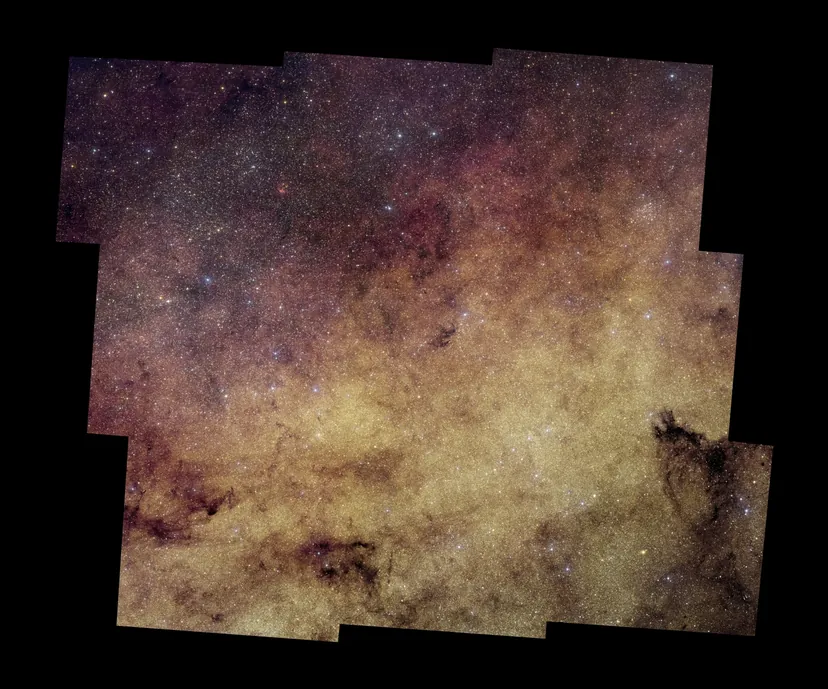
Euclid's visible-light camera has a resolution similar to that of the Hubble Space Telescope’s wide-field camera, yet the area of the sky it can capture at once is about 270 times larger than Hubble. Observing the same area with a large ground-based telescope could take nearly 2,000 hours.
The image of the galactic center captured by Euclid also serves as important preliminary data for other space telescopes to be launched in the future. The Nancy Grace Roman Space Telescope is scheduled to perform a large-scale search for microlensing events caused by exoplanets in the center of the Milky Way.
Microlensing is a phenomenon that occurs when a celestial body, such as an exoplanet or a star, passes in front of a distant background star. The gravity of the foreground object bends the surrounding spacetime, magnifying the light of the background star, and as a result, the brightness of the star changes temporarily. Analyzing this brightness change allows for the estimation of not only the existence of an exoplanet but also its mass.
The image captured by Euclid includes over 50 already-known exoplanetary systems. This image becomes a baseline record of the positions and brightness of background stars before microlensing events occur. By comparing this with future observations by the Roman Space Telescope, we can measure the proper motion of the stars and more accurately distinguish between the celestial body acting as the lens and the distant background stars.
In microlensing observations, the more background stars there are, the better, as the probability of a lens-acting body passing in front of a background star increases accordingly. In fact, exoplanet searches using microlensing primarily target the center of the Milky Way, where stars are densely packed.
However, hidden in the direction of the galactic center are secrets far older than exoplanets. Inside the bulge, the central concentration of the Milky Way, lies an object called Terzan 5. At first glance, it looks like an ordinary globular cluster with countless stars gathered in a spherical shape, but recent precision observations suggest that Terzan 5 may have a history completely different from typical globular clusters.
Globular clusters are generally groups of very old stars gathered in a spherical shape. Hundreds of thousands to even millions of stars are packed into a very narrow space. Most of these stars were born approximately 10 to 13 billion years ago. For this reason, globular clusters are called fossils of galaxies formed in the early universe.
Traditionally, stars within a globular cluster were considered "sibling" stars born almost simultaneously from a single giant gas cloud. Recently, the concept of "multiple stellar populations" has taken root as stars of two or more generations have been discovered together in many globular clusters. Regardless, globular clusters have been perceived as groups of stars that are much simpler than galaxies.
Terzan 5 was also long considered one such globular cluster. This object was discovered in 1968 by Agop Terzan, an Armenian-French astronomer. Given that it is a bright and massive cluster, it was discovered quite late.
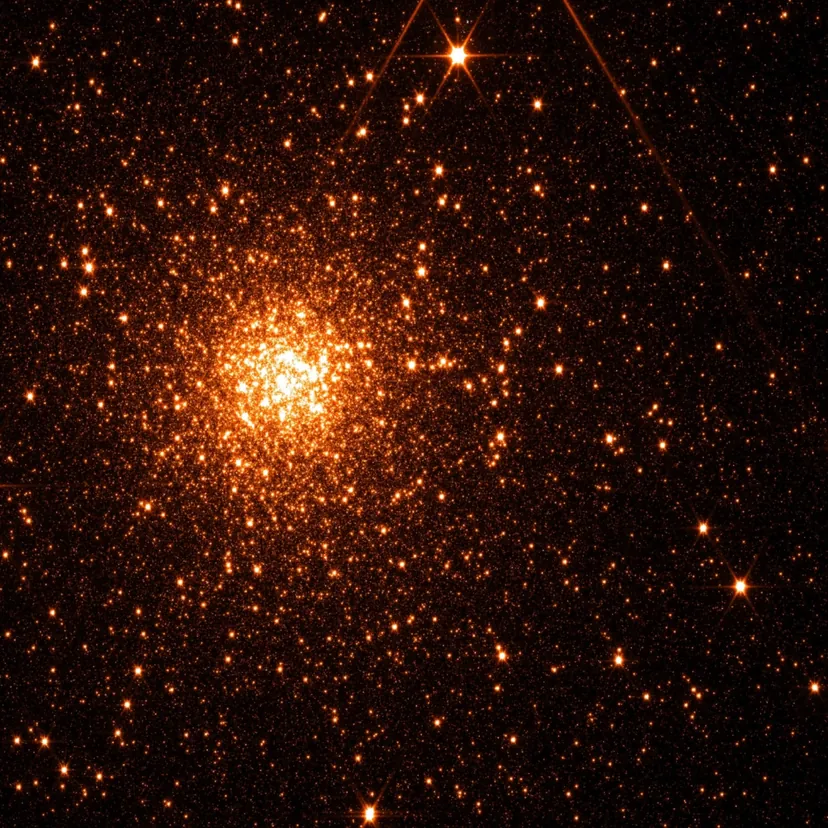
The biggest reason for the late discovery is its location. Terzan 5 is located in the direction of the bulge, only about 2 kiloparsecs away from the center of the Milky Way. In this direction, there are far too many background stars, and thick clouds of gas and dust block starlight. It is a difficult region to observe because of severe interstellar extinction, where starlight is absorbed by dust, becoming dim and reddened.
The mass of Terzan 5 is estimated to exceed 2 million solar masses. It is quite heavy even among the globular clusters existing in the Milky Way. What is even more surprising is the fact that the number of millisecond pulsars discovered in this object has reached nearly 50, with over 40 identified so far. It is one of the celestial bodies harboring the largest number of millisecond pulsars among known globular clusters.
A millisecond pulsar is a neutron star that rotates hundreds of times per second. It is interpreted as an old neutron star that has been spun up to rotate rapidly as it siphons matter from a companion star. In globular clusters where stellar density is high, stars frequently graze past each other or swap companion systems. The unusually high number of millisecond pulsars in Terzan 5 shows that this was a very massive and high-density environment.
However, the true uniqueness of Terzan 5 is revealed in the chemical composition of its stars. In typical globular clusters, the iron content of the stars is relatively uniform. Because they are stars born from the same gas cloud at a similar time, they generally have similar metallicities.
Terzan 5 is not like that. Its [Fe/H], an index indicating the iron content of stars, is distributed over a wide range from about -0.8 to +0.3. Moreover, the distribution of iron content does not form a single gentle peak; instead, the number of stars increases in specific intervals, resulting in multiple peaks.
A distribution of metallicities that is this broad and complex is a trait rarely seen in typical globular clusters. This means that the stars of Terzan 5 are not peers born almost simultaneously within a small cluster. Instead, it seems to have undergone a chemical evolution history similar to the Milky Way's bulge itself.
The same clue appears in the color-magnitude diagram, which shows both the color and brightness of stars. Stars spend most of their lives on the main sequence and leave it as they age. Therefore, if stars born at different times exist together, the main-sequence turnoff point, where stars deviate from the main sequence, will appear differently for each generation.
Previous observations using the Hubble Space Telescope and the European Southern Observatory's Very Large Telescope (VLT) confirmed that at least two generations of stars exist in Terzan 5. One generation consisted of stars with low metallicity born about 12 billion years ago, while the other generation consisted of stars with high metallicity born about 4 to 5 billion years ago. Stars born with a time gap of about 7 billion years existed together in one celestial body.
Recent observations by the James Webb Space Telescope have shown that the stellar population of Terzan 5 is much more complex than this. The James Webb Space Telescope’s Near-Infrared Camera (NIRCam) observed Terzan 5 in near-infrared light. Near-infrared is particularly advantageous for studying dust-heavy regions like the galactic center because it is less affected by dust than visible light.
This was combined with over 20 years of accumulated observation data from the Hubble Space Telescope. Observations with long time intervals are advantageous for measuring the proper motion of stars as they move through the sky. Through this, it is possible to distinguish between stars that actually belong to Terzan 5 and background stars in the bulge that happen to be positioned in the same direction.
This process is very important in galactic center research. Because there are so many background stars in the direction where Terzan 5 is placed, the color-magnitude diagram could be greatly distorted if cluster members are not accurately identified. If stars not belonging to the cluster are mixed in, it might appear as if generations of stars that do not actually exist are present.
The influence of dust clouds also varies by location. Even within the same observation area, stars placed in dusty areas look darker and redder. If this differential extinction is not properly corrected, even stars with the same age and chemical composition can appear as if they are different groups.
The research team selected members belonging to Terzan 5 using proper motion and corrected for the effect of dust on each star using the James Webb Space Telescope's precise near-infrared observations. As a result, the most precise color-magnitude diagram of Terzan 5 to date was completed.
The analysis results suggest that Terzan 5 likely contains a history of at least four star-formation events. The oldest generation with the lowest metallicity consists of stars born about 12.5 billion years ago. A younger generation with higher metallicity was born about 4.7 billion years ago. In addition, another generation formed about 3.8 billion years ago exists, and the possibility has been raised that new stars may have been formed even until about 2.5 billion years ago.
In other words, Terzan 5 was not an ordinary globular cluster where all stars were born at once. After the first stars were born about 12.5 billion years ago, new stars were created 4.7 billion and 3.8 billion years ago, and possibly even up to 2.5 billion years ago. Star formation was repeated several times with intervals of billions of years.
It is difficult to expect such a history in an ordinary globular cluster. When massive stars of the first generation explode as supernovae, the remaining gas is pushed out of the cluster. If it is a low-mass cluster, most of the gas is blown out of the gravitational reach with just a few supernova explosions. After that, the material to create new stars disappears, and only the first-generation stars remain and slowly age.
Terzan 5 seems to have been different. It is highly likely that its initial mass was large enough and its gravity strong enough to hold onto the gas and chemical elements released by the stars. The iron and heavy elements produced by existing stars may have remained without escaping completely, becoming material for the next generation of stars. It appears closer to a massive star system that performed independent chemical evolution rather than a small globular cluster.
For this reason, astronomers interpret Terzan 5 not as a simple globular cluster, but as a fossil fragment of the Milky Way's bulge. This means it is possible that Terzan 5 was one of the primitive building blocks that formed the Milky Way's bulge.
The center of the Milky Way that we see today may not have been formed as a smooth, single structure from the beginning. In the early universe, the galactic disk was rich in gas and had strong turbulence. As this disk became gravitationally unstable, massive gas clumps reaching 100 million to 1 billion times the mass of the Sun may have been formed.
These clumps likely moved toward the galactic center while interacting gravitationally with each other. The clumps that reached the center were likely merged and mixed together, creating the bulge. However, it is possible that not all clumps were completely destroyed and mixed. Some may have survived to this day as independent celestial bodies.
It is possible that Terzan 5 is just such a survivor. It may be a fossil that survived for billions of years without being completely merged with other clumps, even though it was a primitive piece formed when the Milky Way's bulge was being created. The multiple generations of stars and complex metallicities remaining within Terzan 5 essentially preserve a part of the early history when the Milky Way's center was being formed.
One can also consider the possibility that Terzan 5 is the remnant of a dwarf galaxy that drifted in from outside the Milky Way. This is because it has been revealed that several globular clusters in the Milky Way were actually the cores or remnants of dwarf galaxies that were absorbed by our galaxy in the past.
However, the orbit of Terzan 5 supports an internal origin rather than an external one. According to the reconstructed orbit, Terzan 5 stays within about 2.8 kiloparsecs even at its furthest from the galactic center. It draws a small orbit tightly attached to the galactic center without straying far from the galactic plane. This supports the possibility that Terzan 5 was formed inside the Milky Way from the beginning rather than coming in from the outside.
The reason why Terzan 5 has an unusually large number of millisecond pulsars can also be understood in connection with this origin. For many millisecond pulsars to be created, there must first be many neutron stars. For this to happen, a large number of massive stars must have been born in the early Terzan 5, causing supernova explosions.
Gravity must also be strong enough to hold the neutron stars created by supernova explosions within the cluster. Afterward, if the exchange of companion stars and close interactions are repeated in an environment where stars are dense, the neutron star can be supplied with matter from a new companion star for a long time. In this process, the neutron star, whose rotation speed has increased, is reborn as a millisecond pulsar.
In the end, Terzan 5 is not just one slightly heavy globular cluster. It is an important fossil showing what process the Milky Way's central bulge went through to form.
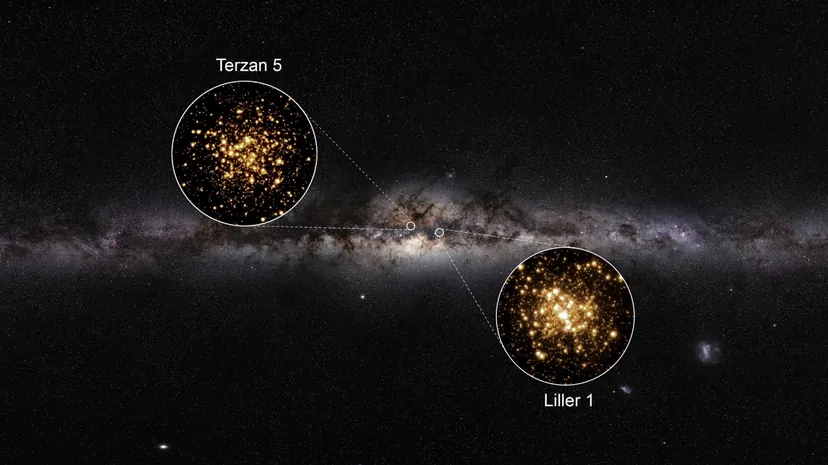
Currently, astronomers are looking for other bulge fossil fragment candidates similar to Terzan 5. A representative object is Liller 1, located about 800 parsecs from the center of the Milky Way. In this object, too, old stars about 12 billion years old and young stars born about 1 to 3 billion years ago were found together.
Some of the celestial bodies present in the Milky Way's bulge have been classified as globular clusters until now, but there is a possibility that they are actually primitive fragments that were not completely dismantled after forming the bulge. Although they appear to be groups of stars gathered in a circle, a history of complex star formation and chemical evolution that is difficult to explain with a single globular cluster may remain within them.
Recent research is changing the traditional perception of globular clusters in various ways. In the past, globular clusters were thought to be simple groups of stars born all at once in the early universe. However, some globular clusters are remnants of dwarf galaxies that flowed in from outside the Milky Way, and some, like Terzan 5, may be primitive fossils that survived when the Milky Way's bulge was created.
The possibility that intermediate-mass black holes are hidden at the centers of some globular clusters is also being raised. Research is also continuing to uncover what role dark matter played in the formation and evolution process of globular clusters. Globular clusters have become celestial bodies that can no longer be explained merely as simple groups of old stars.
The view of the center of the Milky Way, filled with over 60 million stars as shown by Euclid, is spectacular in itself. However, if you look closely at that sea of stars, you can see that traces of the time when the Milky Way was formed remain in many places.
The secrets of the oldest universe are not always found only at the farthest ends of the universe. Sometimes they are hidden in the center of our Milky Way, obscured by countless starlight and dust clouds. Terzan 5 is a fossil fragment that has survived until now, harboring the childhood of the Milky Way. That we look at those stars means we are looking at the remnants from the time when the Milky Way first took its shape.
Reference
https://science.nasa.gov/asset/webb/bulge-fossil-fragment-terzan-5-webb-and-hubble-image/