

[비즈한국] The inclusive finance performance of the top 5 financial holding companies (KB, Shinhan, Hana, Woori, and NH NongHyup) has been disclosed. Following the government's inclusive finance policy, the top 5 groups supplied over 11 trillion won in the first half of this year and significantly expanded debt restructuring for delinquent assets of vulnerable groups, as well as the write-off of delinquent debt. However, concerns regarding the sustainability of inclusive finance are emerging as delinquency rates for loans to SMEs and low-to-mid-credit borrowers rise amidst an economic slowdown.
On the 10th, the Financial Services Commission (FSC) revealed the first-half inclusive finance performance of the top 5 financial groups at a meeting to review the progress of inclusive finance. This serves as an interim check on the implementation of the "Inclusive Finance Expansion Plan" announced by each financial group last January. At the time, the top 5 groups announced plans to supply a total of 70 trillion won in inclusive finance by 2030.
In the first half of 2026, the amount supplied by the top 5 financial holding companies reached 11.3 trillion won. Inclusive finance supply includes loans to ordinary people and vulnerable groups such as "New Hope Spore" (Saehimang Holssi) and mid-interest rate loans, loans to small business owners and self-employed individuals, debt restructuring for delinquent assets (a system that modifies debt considering actual repayment potential), and the write-off of long-term delinquent assets.
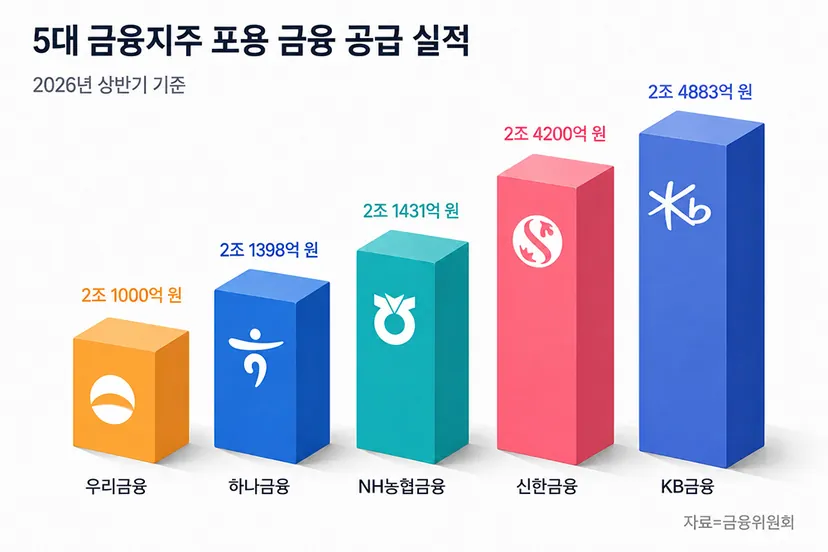
First-half supply performance by financial group was: KB (2.4883 trillion won), Shinhan (2.42 trillion won), NongHyup (2.1431 trillion won), Hana (2.1398 trillion won), and Woori (2.1 trillion won). While KB Financial had the highest performance in the first half, Shinhan Financial has the highest annual target for 2026 at 4.5 trillion won. The inclusive finance supply targets by financial group through 2030 are set as: KB (17 trillion won), Hana (16.0029 trillion won), NongHyup (15.3643 trillion won), Shinhan (15 trillion won), and Woori Financial (7.4 trillion won). Based on first-half performance, the top 5 financial groups have achieved 16% of their goal.
Shinhan Financial's performance in managing delinquent assets was overwhelming. In the first half of this year, Shinhan Financial processed 1.533 trillion won in delinquent assets, including 813.6 billion won in debt restructuring and 719.4 billion won in write-offs and completion of statute of limitations for assets before their expiration. Following were KB (656.4 billion won), Hana (541.5 billion won), NongHyup (541 billion won), and Woori Financial (514.6 billion won).
Additional support measures not included in the original plan were also introduced. KB Financial announced plans to implement an additional 3.5 trillion won in private mid-interest rate loans and 50 million won in delinquent asset write-offs. Woori Financial raised its 2026 annual target from 1.2 trillion won to 3.5 trillion won and launched "36.5°" in May, a platform consolidating inclusive finance products from Woori Financial affiliates.
Regarding the first-half performance, the FSC evaluated that "the top 5 financial groups are implementing their inclusive finance expansion plans without a hitch," adding that "they are increasing accessibility for low-to-mid-credit borrowers and small business owners through group-specific specialized products, and supporting the recovery of delinquent debtors through debt restructuring."

The authorities plan to continuously monitor the implementation of the expansion plans by each group. Additionally, through an inclusive finance strategy task force, they announced plans to redesign the private financial system, including: introducing a comprehensive inclusive finance evaluation system, designating dedicated chief officers, rationalizing soundness regulations, and improving credit rating systems.
As the government accelerates its inclusive finance policy, it has ordered internet-only banks and regional banks to participate as well. At the 6th Inclusive Finance Transformation Meeting held on July 9, the FSC announced that it would establish joint loan products for SMEs and individual business owners, developed and operated jointly by regional and internet banks, as a model for regional financial revitalization.
As financial companies embark on tens of trillions of won in inclusive finance support in line with government policy, concerns about asset soundness and delinquency rates persist. This is because the loan balances and delinquency rates of SMEs and low-to-mid-credit borrowers are on an upward trend. According to the Korea SMEs and Startups Institute, the delinquency rate for loans to individual business owners at banks rose from 0.71% at the end of March to 0.78% at the end of April. For individual business owners, the outstanding loan balance also showed an increasing trend, from 459.8 trillion won in March to 460.6 trillion won in April and 461.2 trillion won in May.
The delinquency rate for loans to SMEs, including small business owners and the self-employed, has also soared. At the end of May, the SME loan delinquency rate at the top 5 commercial banks (KB Kookmin, Shinhan, Hana, Woori, NH NongHyup Bank) reached 0.73%, the highest level since January 2020, when the COVID-19 pandemic began. During the same period, the ratio of substandard or below loans for SMEs also hit a record high of 0.68%. The substandard or below ratio, which includes long-term delinquent or irrecoverable debts, is used as an indicator of asset soundness.
In particular, it is pointed out that regional banks should be cautious about expanding mid-interest rate loans, as their soundness is deteriorating faster than that of commercial banks. As of the first quarter of this year, the average loan delinquency rate for five regional banks (Busan, Gyeongnam, Gwangju, Jeonbuk, Jeju) was 1.3%, nearly three times higher than that of the top 5 commercial banks (0.4%). During the same period, the delinquency rate for low-to-mid-credit borrowers at the five regional banks was 5.38%, more than double the 2.41% for all banks.
For this reason, the authorities are looking for ways to ensure the sustainable supply of inclusive finance. On July 7, the Financial Industry Division of the Inclusive Finance Strategy Task Force held a kickoff meeting to discuss measures such as rationalizing soundness regulations and reforming the evaluation system for financial companies. An industry official pointed out, "It will be difficult to achieve sustainability if inclusive finance results are evaluated solely by the amount provided," adding, "Soundness must also be managed simultaneously."