

[비즈한국] The value of instant ramen lies in its long shelf life. It can survive for months in the corner of a pantry, serves as a versatile emergency food during wars or disasters, and is always a reliable meal for students living alone. Ramen is a food originally designed not to need to be fresh.
In Gumi, North Gyeongsang Province, there are people who directly overturn this universal perception. They believe that even ramen has a level of freshness, and that noodles fried just a few days ago have a distinct, nuttier flavor compared to standard retail products. Every November, hundreds of thousands of people line up in front of Gumi Station to verify this difference. Last year, 350,000 people visited over three days.
This past January, a CNN crew also visited Gumi. CNN covered the Gumi Ramen Festival and the Nongshim Gumi factory, introducing them to the world on May 12. The core of the report was that Gumi is attempting to shed its image as a boring industrial city and transform into a cultural city through ramen.
Recently, another piece of good news followed: Ottogi Ramen signed an investment memorandum of understanding (MOU) with North Gyeongsang Province and Gumi City to invest 200 billion won to build a ramen factory for export. How did Gumi, the city of electronics, come to be reborn as the city of ramen?
Mass-producing ramen in a holy land of electronics
In 1991, the Gumi National Industrial Complex was the heart of South Korea's electronics industry. In the era when televisions, cathode-ray tubes (CRTs), and printed circuit boards (PCBs) symbolized the city, a ramen factory moved in. For a food company to enter an industrial complex focused on electronics was an uncommon sight at the time.
Nongshim’s plan went beyond simple factory relocation or site selection. Having risen to the top of the ramen market in 1985, Nongshim planned a different kind of factory with an eye toward entering the global market. In 1991, they invested 17 billion won on a 12,700-pyeong site in Gumi Industrial Complex 1 to build an unmanned, automated factory where everything from production to logistics was computer-controlled. The idea was to produce ramen in the city of electronics just as they would produce electronics. The way ramen, a deeply analog food, took root in Gumi was paradoxically the most cutting-edge production method of the time.
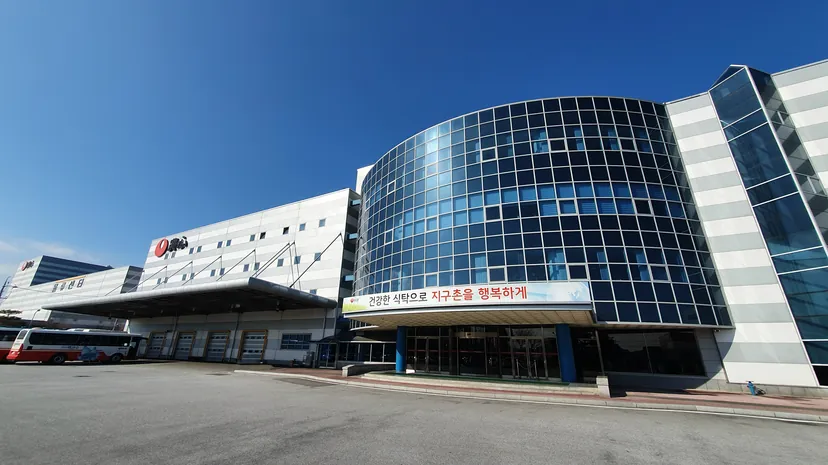
The factory continued to evolve. In 1999, Nongshim expanded the Gumi plant into an advanced production facility and introduced high-speed lines capable of producing 600 units per minute. Currently, industrial robots and AI technology developed in-house are applied to dozens of processes.
It takes only 35 minutes from the time flour becomes dough, is pressed into sheets, cut into wavy strands, steamed, and fried into a finished product. Artificial intelligence detects packaging defects and weight deviations. 80% of Shin Ramyun and 90% of Chapagetti distributed in Korea are produced at this factory.
The factory’s daily production capacity is about 6 million bags of ramen. Including all types—bagged, cup, and snacks—the maximum daily output reaches 6.65 million units. Last year, it produced 1.23 billion units of ramen, recording 884 billion won in production value. This is more than enough for every resident in North Gyeongsang Province to eat one bag every day for a whole year.
CNN cameras captured these aspects intensively: 600 employees operating highly sophisticated automated lines equipped with AI sensors and smart cameras, and the scene where ramen produced in the factory expands into the city's cultural focal point.
However, for a long time, the factory remained literally just a factory. Inside the fence, ramen was produced; outside the fence, the city laughed and cried depending on the semiconductor and electronics industry climate. What broke down the fence between the factory and the city was a single unexpected idea from a civil servant in 2022.
A 10-page proposal changes the city's destiny
In 2022, a civil servant at Gumi City Hall submitted a business proposal. It was 10 pages long. The core idea was "a festival where you can taste freshly fried ramen, produced in the factory less than 2-3 days ago." It wasn't a multi-billion won service report or a proposal from a famous planning agency, but a plan from an ordinary public servant.
Simply put, it applied a kind of "direct from the farm" concept to instant food. This idea, which might sound ridiculous at first, became a great, unique piece of content for Gumi that other cities couldn't easily replicate. In reality, you don't need a factory nearby to sell freshly fried ramen—especially in a country like Korea where land is small enough to drive across in a day. Even so, this eccentric idea held a strange persuasive power.
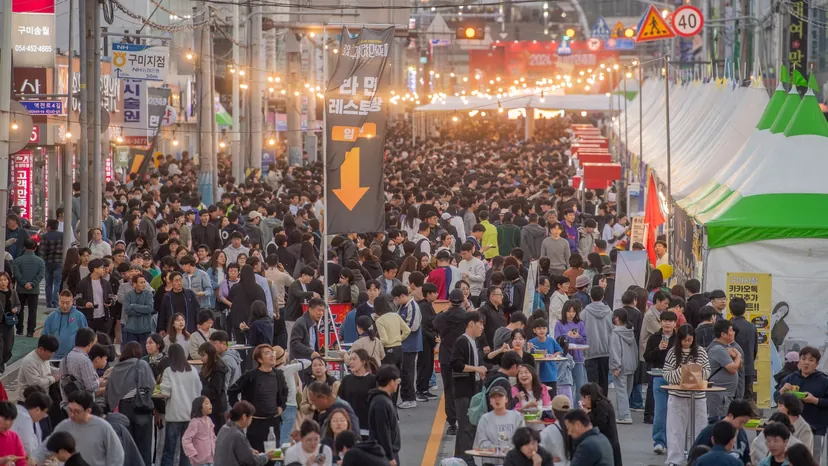
The number of visitors in the first year, 2022, was about 10,000. In 2025, according to the final count, 350,000 people visited. In four years, the number of visitors increased 35-fold. Looking just at the numbers, it is evaluated as having grown beyond a simple local festival into a large-scale consumption and distribution experiment using ramen.
On the first day of the opening on November 7 last year alone, about 90,000 people crowded in. In the 475m-long ramen cooking zone, dozens of chefs presented various ramen dishes. Over the three days, 54,000 bowls of unique ramen and 480,000 bags of freshly fried ramen were sold.
The number of visitors isn't the only indicator of how successful the festival was. So-called "knock-offs" emerged. A private operator, piggybacking on the reputation of the Gumi Ramen Festival, held the "2025 World Ramen Festival" in Gijang-gun, Busan, last May. The result was disastrous. It was mocked as a "Ramen Jamboree" due to shoddy operations and the heat, and the company that claimed to be the organizer disappeared without paying the bills. As the venue became flooded due to heavy rain, demands for refunds poured in from visitors, and the operator was arrested after fleeing.
Why did one ramen festival attract 350,000 people while the other became a subject of investigation? The answer lies in "systematic operation comparable to a factory." The Gumi Ramen Festival eliminated lines with a QR code and kiosk ordering system, and operated dining spaces tailored to user needs. They introduced a "half-and-half menu" to enjoy multiple flavors at once, and even the most expensive menu does not exceed 9,000 won. It is a design that directly targets the price-gouging controversies that repeat in local festivals every year. As of last year, 48% of visitors were from outside the city, and local restaurants and small business owners participated, creating a consumption effect worth about 1.5 billion won.
Transportation infrastructure also played a role. Accessibility improved with the Daegyeong Line metropolitan railway reaching Gumi Station at the end of 2024, and in last year's festival, more than half of the previous year's total visitors attended on the first day alone. The "Global Ramen King" competition, in which 10 foreign teams participated, featured pork soup ramen and Southeast Asian-style stir-fried ramen, and there was even a Swedish exchange student who had come to Korea for K-pop, heard the news of the festival, and took a two-hour bus ride to attend. Nongshim unveiled its "Shin Ramyun Kimchi Stir-fried Noodles," which was being developed for the global market, for the first time at this festival. It took only four years for a local festival to become a debut stage for a multinational food company's new product.
Ottogi’s 200 billion won investment, the start of a ‘Ramen Cluster’
This summer, Gumi's ramen industry reached another turning point. Ottogi Ramen and Gumi City signed an agreement on the 13th to invest 200 billion won to build an export-oriented ramen factory in the Okgye area of Gumi National Industrial Complex 2. The scale of new hiring is about 120 people. Ottogi needed a production base to handle the rapidly increasing volume of K-Ramen exports, and it chose Gumi—the major production hub of its competitor, Nongshim—as the site for its new factory. Using modern terminology, it is enough to see it as the starting point of a so-called "Ramen Cluster."
Gumi City evaluated this investment as a case where the city's increased awareness and industrial base, elevated through the ramen festival, led to corporate investment. The explanation is that a virtuous cycle has been created where industry creates a festival, the festival grows the city brand, and the increased brand value attracts industry back to it.
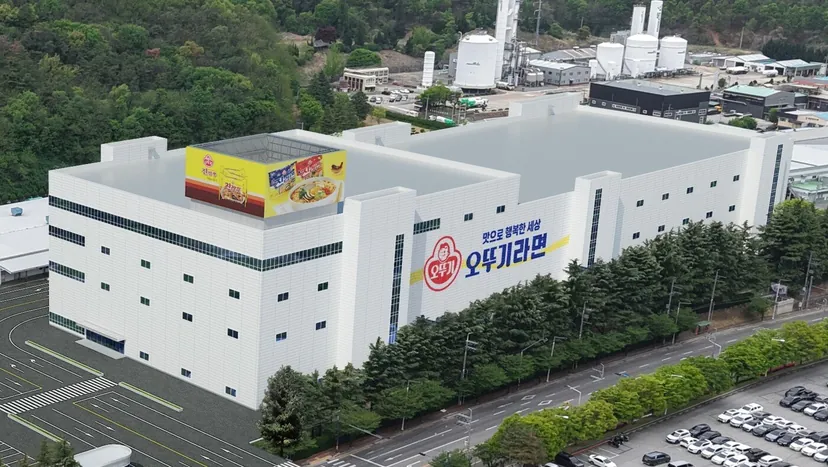
Of course, it cannot be concluded that Ottogi chose Gumi solely because of the ramen festival. Factory sites are determined by comprehensively reviewing transportation, logistics, water, electricity, labor supply, and industrial complex support conditions. The ramen festival is interpreted not as the direct cause of the investment decision, but as a symbol that shows Gumi’s food industry base and urban awareness.
Gumi City is now pushing to elevate ramen from a seasonal event to a permanent identity for the city. A promotion hall equipped with ramen experience content has been opened at Gumi Station, and this year's festival, which will be held for three days starting November 6, is scheduled to be held as an international event by expanding global ramen zones and content for foreigners.
Gumi, once the city of Park Chung-hee, exports, and CRTs, has thus become the city of ramen. The start was a 10-page proposal from a public servant. The counter-intuitive idea of adding the value of "freshly fried" to a food made for long-term storage transformed the city more distinctively than a multi-billion won consulting report.