

[비즈한국] SK Hynix has successfully debuted on the U.S. stock market. Its American Depositary Receipts (ADRs) finished their first day of trading about 13% higher than the offering price of $149. Orders far exceeded the number of shares offered, confirming strong interest from U.S. investors.
However, domestic investors should be cautious about interpreting these figures as a direct indicator of the potential upside for the underlying shares in Korea. The ADR price reflects not only Hynix’s earnings outlook and HBM competitiveness but also the convenience of trading directly in the U.S. market, limited initial circulating supply, exchange rates, and differences in trading hours.
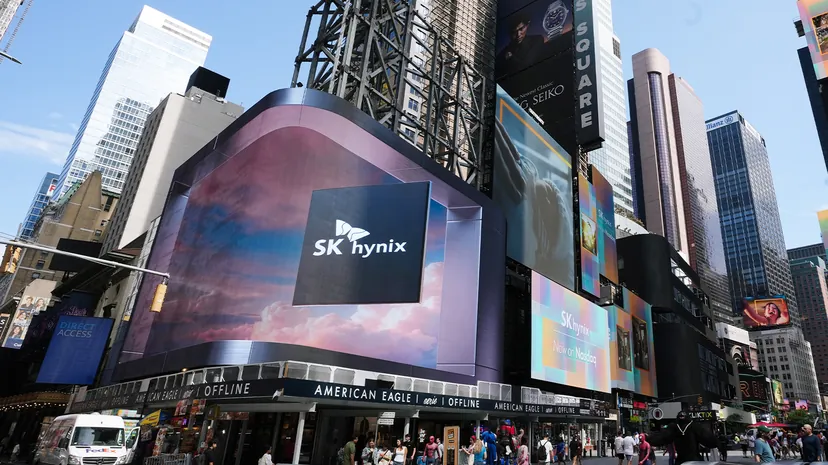
The gap widened further after the first day of trading. The ADRs closed at $168.49, while the underlying shares in the domestic market fell more than 9% on the 13th, sliding to the 1.9 million won range. If the New York closing price on the first day were converted based on one underlying share, it would be double-digits higher than the previous Seoul closing price. As the price of the underlying shares fell in the domestic market on the 13th, the price gap—based on a simple comparison of different timeframes—expanded to the 20% range during intraday trading.
Of course, this cannot be called an accurate premium at the same point in time. The domestic stock market closed before the New York market opened, and in the interim, movements in U.S. tech and semiconductor stocks, along with exchange rate fluctuations, were additionally reflected. Nevertheless, it has become clear that the New York gain does not immediately equate to the target return for the underlying shares in Seoul.
What needs to be distinguished here is the strong demand from U.S. investors versus the rise in corporate value. The fact that many investors in the U.S. want to buy Hynix is a positive sign. However, just because the ADR price rose above the offering price does not mean Hynix’s intrinsic corporate value increased by that much in a single day. Part of the gain may be an "accessibility premium" attached to a certificate that can be traded directly in the U.S.
When the price difference between two securities based on the same company widens, arbitrage generally narrows it. The principle is that prices converge as trading—buying in the cheaper market and selling in the more expensive one—is repeated. However, this process is difficult to execute immediately or without limits between Hynix’s underlying shares and its ADRs.
It is possible to cancel ADRs and convert them into domestic underlying shares. Conversely, to issue additional ADRs by depositing newly acquired domestic shares, the company's prior consent is required, and in some cases, regulatory approval or notification procedures as required by relevant laws must be followed. While exceptions exist for existing ADRs being converted to underlying shares and then back to ADRs, conditions are attached to increasing the total volume of ADRs in the New York market.
For this reason, even if demand for ADRs surges, it is difficult for domestic shares to immediately move to the U.S. market to increase supply. One foreign investment bank projected that if there is insufficient capacity for conversion, Hynix ADRs could consistently trade at a higher price than the underlying shares. The case of TSMC ADRs, which have often traded at a double-digit premium over local Taiwanese shares, illustrates this possibility.
It is also not easy for individual investors to directly profit from this gap. While converting underlying shares to ADRs is not legally prohibited for individuals, it is not a task that can be handled directly through a brokerage app like regular stock trading. It must go through domestic brokerage firms, the Korea Securities Depository, and a custodian bank, and one must separately verify whether the specific brokerage firm actually supports conversion services for individual clients. Realistically, it is difficult for small-scale investors to engage in arbitrage based on short-term price differences.
There is one more variable that could increase the short-term volatility of the ADRs. Several U.S. asset managers are scheduled to sequentially launch leveraged and inverse ETFs linked to Hynix ADRs starting on the 13th. These products adjust their derivative positions daily to maintain target multiples. If a large amount of capital flows into these products, the short-term supply and demand for ADRs and the price difference compared to the underlying shares could become more sensitive. However, if the assets under management and trading volume are small at launch, the impact may be limited, so it is not yet time to conclude that the ETF launch alone will cause a surge in volatility.
Accordingly, the most important question for individual investors is not how to exploit the price gap, but rather which market to buy in and how much to pay. Buying ADRs has the advantage of trading during U.S. market hours and holding assets in dollars. On the other hand, you must bear exchange fees and the risk of won-dollar exchange rate fluctuations. If there is an added premium higher than the underlying stock, it results in buying the same economic stake in the company at a higher price than in Korea.
Existing holders of the underlying stock should also not treat the first-day ADR surge as a target price for the domestic stock. The price gap could narrow as the underlying stock rises, but it could also resolve as the ADR price falls. The direction of convergence depends on U.S. investor demand, foreign buying in Korea, semiconductor market conditions, and exchange rates.
The number of indicators to watch for the time being has increased. In addition to the won-converted price of 10 ADRs, the domestic underlying share price, the won-dollar exchange rate, and the trading volume in both markets, it is also necessary to keep an eye on the trading scale of U.S. leveraged ETFs. However, one should avoid taking a figure derived from a simple comparison of closing prices at different times as an exact premium. This is because it includes new U.S. market information reflected after the domestic stock market has already closed.
The greatest significance of this listing is that a new channel has opened for U.S. investors to buy Hynix. However, the fact that accessibility has increased is not the same as the company’s intrinsic value having risen by that same amount. Rather than transcribing the ADR surge as a confirmed signal for a rise in domestic shares, it is necessary to weigh how much of that price reflects corporate value versus the accessibility premium. At the very least, one should avoid treating the ADR’s rate of return as the target return for the underlying domestic shares.