

[비즈한국] Behind the tightly closed doors of pharmaceutical and biotech laboratories, a massive number of lives vanish every year. According to the "2024 Animal Experiment Ethics Committee Operation Data" compiled by the Life Science Research Ethics Library, a total of 4,592,958 animals were used in various experiments in South Korea throughout 2024.
Of these, rodents suffered the most, accounting for over 88% of the total with 4,067,518 animals. They were followed by 3,961 primates—often used due to their biological similarity to humans—and 15,934 dogs, which frequently become targets for toxicity tests due to their docile nature, all ending their lives within narrow iron cages.
This is not a problem unique to South Korea. Every year, over 100 million animals worldwide are sacrificed for the development of medicines and chemicals under the pretext of human safety. Global regulatory authorities have finally begun to apply the brakes to this massive "animal testing" treadmill that has sustained the pharmaceutical industry for decades. With the rapid development of AI, 3D printing, and organoids (organ-like structures), calls to replace animal testing are gaining momentum.
Changing Principles After 80 Years… The FDA Modernization Act and Large-Scale NIH Investment
The move to reduce animal testing was ignited by the United States, the world's largest pharmaceutical market.
In late 2022, the U.S. Congress unanimously passed the "FDA Modernization Act 2.0," which removed the mandatory requirement for animal testing before submitting a new drug application. This marked the first such change in 84 years since the Federal Food, Drug, and Cosmetic Act was enacted in 1938, establishing a process to approve new drugs based solely on data from New Approach Methodologies (NAMs) that do not use animals. The FDA has also issued a series of roadmaps to phase out animal testing requirements for the development of new drugs, including monoclonal antibodies.
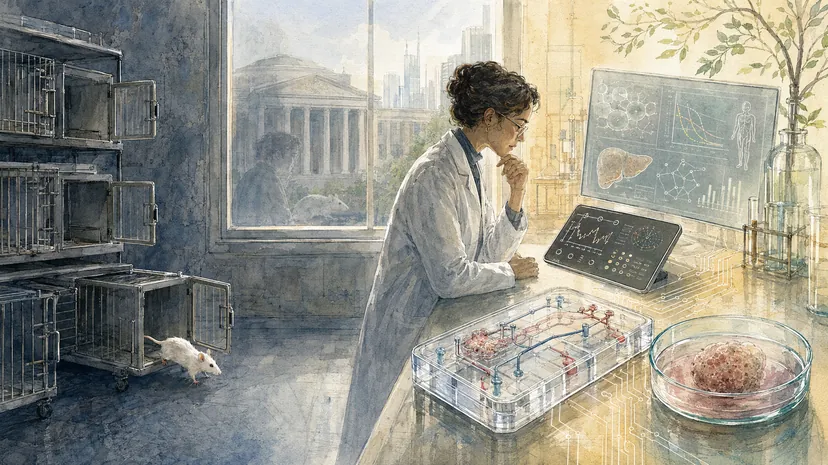
Furthermore, the "FDA Modernization Act 3.0" was introduced in 2024, further accelerating the timeline for institutional reform. While the 2.0 version removed the legal obligation for animal testing, the 3.0 version mandates that the FDA establish clear, formal procedures for evaluating and approving non-animal alternative test methods. This reflects a commitment to overcome the structural inefficiency—where 90% of new drug candidates fail in human clinical trials despite passing animal tests—by addressing the biological differences between species through scientific advancement.
The U.S. is not stopping at deregulation; it is strengthening its role as a catalyst to open up new markets.
The U.S. National Institutes of Health (NIH) is pouring hundreds of millions of dollars into research on alternative testing methods such as organoids, organ-on-a-chip, and computer simulations. The National Center for Advancing Translational Sciences (NCATS) under the NIH has led the "Tissue Chip for Drug Screening" project, investing over $250 million (375.5 billion KRW) into the development and commercialization of organ-on-a-chip technology over the past decade. Recently, they have allocated tens of millions of dollars in annual funding for the development of organoid models for rare and intractable diseases like Alzheimer's and cancer, as well as the construction of AI-based toxicity prediction platforms.
EU's Phase-Out Plan… The Winds of Alternative Testing Blow Across Asia
The signal flare launched by the U.S. is causing a domino effect among major regulatory agencies worldwide.
The European Union (EU), which has led the way in ethical consumption by banning animal testing for cosmetics early on, is currently executing a roadmap to phase out animal testing across all industry sectors, including pharmaceuticals. In 2021, the European Parliament adopted a resolution calling for an action plan to end the use of animals for all research, regulatory, and educational purposes, prioritizing non-animal science in its policy. Furthermore, through "Horizon Europe," the EU's largest research and innovation program, it is focusing on technology commercialization by allocating over 6 million euros (10.3 billion KRW) to projects for the practical application of innovative non-animal alternative testing methods.
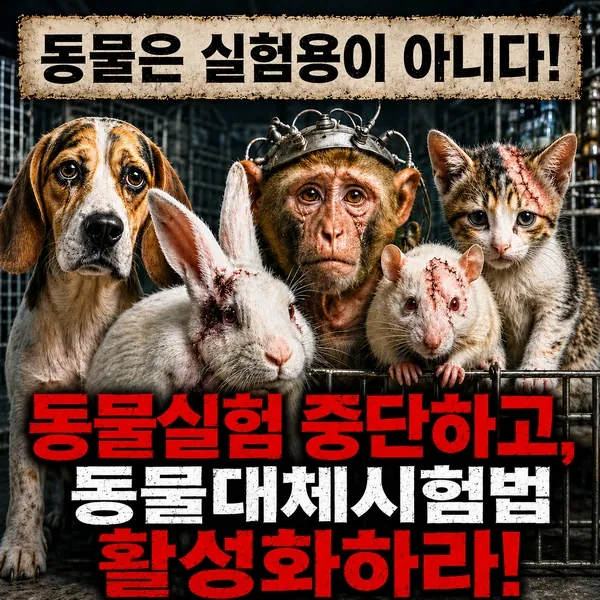
Beyond the West, Asia is also actively seeking alternatives to animal testing. Japan is accelerating the establishment of guidelines and the commercialization of alternative test methods, led by the Pharmaceuticals and Medical Devices Agency (PMDA) and the Japan Agency for Medical Research and Development (AMED). Notably, toxicity evaluation models utilizing induced pluripotent stem cell (iPSC) technology are gaining prominence.
Even China, considered one of the most conservative nations, has embraced this wave of change. The National Medical Products Administration (NMPA) effectively abolished the mandatory animal testing requirement for imported general cosmetics in 2021. Regulations were changed so that if a producing company submits a Good Manufacturing Practice (GMP) certificate officially issued by the government of their country and sufficiently proves the product's safety with their own safety assessment report, they are exempt from animal toxicity tests, except for products intended for infants and children or those containing new raw materials currently under monitoring.
China is also showing moves to expand the application of alternative testing methods to the new drug approval process. Since the 7th, the Center for Drug Evaluation (CDE) under the NMPA has begun collecting public opinions on a pilot project (Pioneer Program) for NAMs research and application, moving to expand the use of organoids and AI-based prediction technologies. This five-year pilot project focuses on regulatory shifts that allow animal-alternative test data to be applied to preclinical evaluations of new drug candidates and used as supporting evidence for drug approval applications. The decision was made based on the judgment that it is no longer possible to secure competitiveness in innovative new drug development using existing animal testing models.

Successive Legislative Proposals in Korea… Breaking Down Ministerial Silos to Foster an Ecosystem
Amidst this global paradigm shift, efforts to build legal and institutional infrastructure are gaining traction in South Korea. The core objective is to break down the silos between government ministries, establish a pan-governmental control tower, and foster a national ecosystem, with active legislative discussions underway to achieve this.
Starting with a bill proposed by Rep. Han Jeoung-ae (Gangseo-gu, Seoul) of the Democratic Party last August, followed by Rep. Song Ok-ju (Hwaseong-si, Gyeonggi) in December and Rep. Nam In-soon (Songpa-gu, Seoul) this February, there have been successive proposals for the "Act on the Development, Dissemination, and Promotion of Animal-Alternative Testing Methods." Currently, in Korea, tasks related to alternative testing are dispersed across individual laws managed by different ministries, such as the Ministry of Agriculture, Food and Rural Affairs (veterinary drugs/pesticides), the Ministry of Environment (chemicals), and the Ministry of Food and Drug Safety (pharmaceuticals/cosmetics), creating a situation that necessitates pan-governmental guidelines.
The proposed bills commonly include the formation of an Animal-Alternative Testing Method Consultative Body operated jointly by the relevant central administrative agencies, and the requirement to establish and implement a national-level basic plan every five years. They also contain grounds for the establishment of the "Korea Center for the Validation of Alternative Methods (KoCVAM)" to verify cutting-edge technologies like domestically developed organoids and organ-on-a-chip and propose them as international guidelines, as well as provisions for building an integrated information system to systematically manage scattered technical and intellectual property information and facilitate exchanges between industry, academia, and research.
Rep. Han Jeoung-ae, Rep. Nam In-soon, and others stated the purpose of the legislation in a unified voice, saying, "We must integrate the guidelines dispersed across ministries and build an ethical and scientific alternative testing ecosystem suited for the era of the Fourth Industrial Revolution."
![[Bio Without Lab Rats] ② CROs Are ‘Evolving’ in the Face of the Animal Testing Reduction Crisis](https://s.bizhankook.com/attachments_webp_no_wm/2026/07/134645_no_wm_29ccb274.webp)
![[Bio Without Lab Rats] ③ Lush Korea CEO Mi-ryung Woo: "Animal-Alternative Testing, a More Beneficial Choice for Humans"](https://s.bizhankook.com/attachments_webp_no_wm/2026/07/134702_no_wm_a30ea7c4.webp)
![[Bio Without Lab Mice] ④ ‘Humanized Mouse’ Technology to Overcome the Limitations of Organoids](https://s.bizhankook.com/attachments_webp_no_wm/2026/07/134850_no_wm_fca1c2cc.webp)
![[Bio Without Lab Rats] ⑤ Cell Culture, Organoids, Organ-on-a-Chip… Three Alternatives to Replace Animal Testing](https://s.bizhankook.com/attachments_webp_no_wm/2026/07/134925_no_wm_f80aeda8.webp)