

[비즈한국] The Presidential Office has announced plans to establish a Honam-region semiconductor cluster on the site of the Gwangju Military Airport. Consequently, the Gwangju Military Airport is slated for relocation to Muan-gun. Muan-gun is demanding the prior relocation of Gwangju International Airport’s civilian terminal and significant state-level support. The county has maintained that it will not cooperate with the military airport relocation unless these issues are resolved. Muan International Airport has remained closed indefinitely following the Jeju Air disaster that occurred in December 2024. While the Presidential Office is accelerating the creation of the Honam semiconductor cluster, it cannot recklessly push for the airport relocation while the disaster investigation is still ongoing.
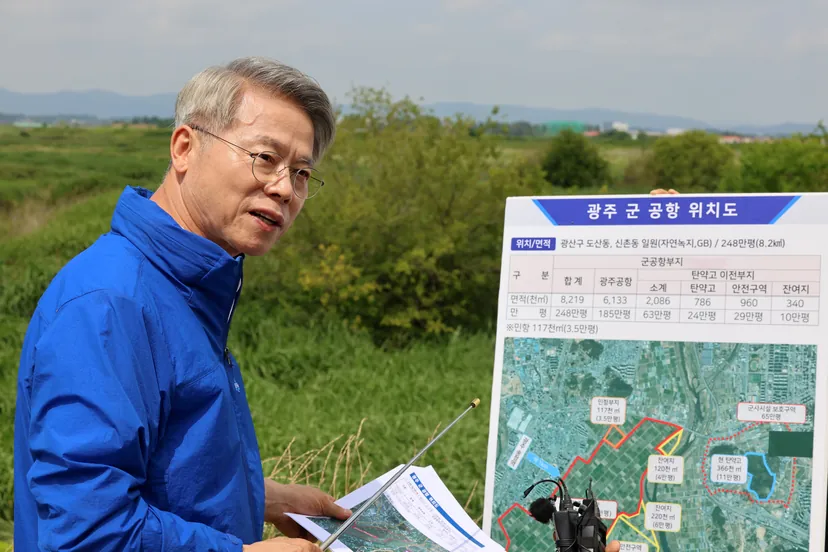
Chief of Staff to the President Kang Hoon-sik stated on the 6th, "Companies have expressed the opinion that Gwangju Military Airport is the most suitable site among the candidates in the Honam region," adding, "The Gwangju Military Airport area allows for the securing of approximately 2.5 million pyeong of land, and because it is already leveled due to its nature as an airport, it has the advantage of minimizing construction time." Chief of Staff Kang continued, "It is adjacent to the Gwangju city center and the KTX station, offering advantages in terms of workforce acquisition and residential conditions, and it has been reviewed as having excellent logistics accessibility connected to roads, airports, and ports. Accordingly, we have decided to establish the Honam semiconductor industrial complex on the Gwangju Military Airport site."
The local business community has welcomed the news. The Gwangju Chamber of Commerce and Industry stated, "We sincerely welcome the government's decision to select the Gwangju Military Airport site as the optimal location for the Honam semiconductor cluster," adding, "We view this decision as a historical turning point for the newly launched Jeonnam-Gwangju Integrated City to leap forward as a new hub for South Korea's semiconductor industry, and as a key national project to realize balanced regional development and strengthen the competitiveness of high-tech industries."
However, there are still issues to resolve to build a semiconductor complex at the Gwangju Military Airport site. First, a site must be found to replace the current military airport, which has been somewhat agreed upon to be in Muan-gun. In April, the Ministry of National Defense stated, "In accordance with the Special Act on the Relocation and Support of Military Airports, we have selected the area around Mangun-myeon, Muan-gun, as a preliminary candidate site for the relocation of Gwangju Military Airport," adding, "We plan to quickly finalize the candidate site by forming a relocation site selection committee composed of relevant agencies and experts."
The variable is the attitude of Muan-gun, the planned relocation site. Muan County Governor Kim San stated in a press release, "While I greatly welcome the government's decision to use the Gwangju Military Airport site for the Honam semiconductor cluster, I hope that concrete implementation plans for the three key demands that Muan-gun has consistently presented—the prior relocation of Gwangju’s civilian airport to Muan International Airport, 1 trillion won in support from the Jeonnam-Gwangju City and the government, and the provision of groundbreaking state-level incentives—will be made visible as soon as possible."
Gwangju International Airport currently serves as both a military and civilian airport. The civilian terminal at Gwangju International Airport does not currently operate international flights, offering only Gwangju-Gimpo and Gwangju-Jeju routes. This is because international routes were transferred to Muan International Airport when it opened in 2007. Muan-gun is now demanding that the domestic routes from Gwangju International Airport also be transferred to them.
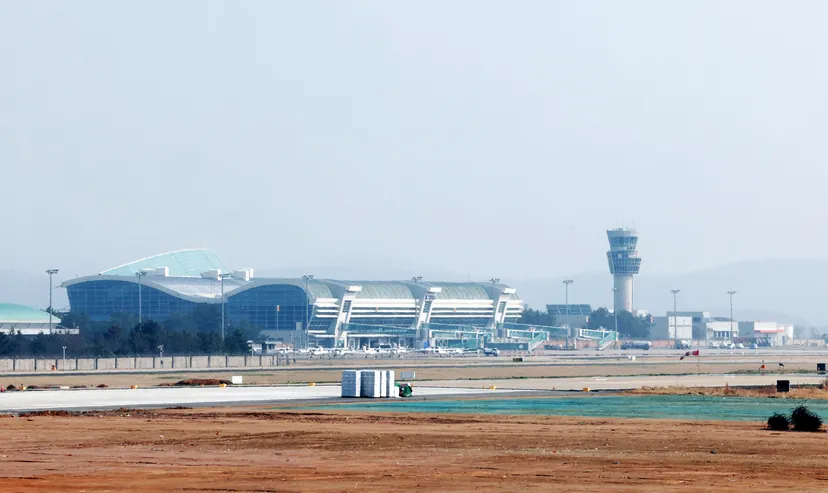
If the three major demands set by Governor Kim San are not met, the relocation of the Gwangju Military Airport is expected to face difficulties. On July 2, Governor Kim emphasized, "If these (three demands) become tangible, we will faithfully participate in follow-up discussions, including meetings for the Ministry of National Defense’s site selection, with an open mind without delay," but added, "I clearly state that if unilateral progress continues without sufficient guarantees for the rights and interests of our residents and the future of our region, we will have no choice but to demand a fundamental re-examination of the entire process."
However, if all domestic routes from Gwangju International Airport are transferred to Muan International Airport, residents of the former Gwangju Metropolitan City may express dissatisfaction, as they would have to travel to Muan International Airport to reach Jeju Island. There is a significant population difference between the former Gwangju area and Muan-gun. Given that the distance between Gwangju International Airport and Muan International Airport is about 50km, it could be a burden for travelers. Moreover, the Gwangju-Jeju route has considerable demand in the Honam region.
There is also no clear conclusion yet on the 1 trillion won in support and the groundbreaking state-level incentives demanded by Muan-gun. While the government maintains that it intends to support Muan-gun, the county is demanding more specific details. Governor Kim San pointed out as recently as June that "discussions on the military airport relocation are focused on administrative procedures rather than preparing practical support measures to increase resident acceptance."
Another issue is the "Jeju Air Flight 2216 runway excursion accident" that occurred at Muan International Airport in December 2024. A related investigation is still underway to determine the truth, and it is difficult to predict when it will conclude. Scheduled operations at Muan International Airport remain fully suspended, and no date for reopening has been set. It is impossible to forcibly relocate the civilian and military airports of Gwangju International Airport in such an atmosphere. Furthermore, if the cause of the accident is determined to be issues with the airport's embankments or runway, major construction to alter the airport's structure would be required. This would likely take a considerable amount of time to relocate Gwangju International Airport.
The Presidential Office is accelerating the construction of the semiconductor complex. However, it has made no significant comments regarding the inconvenience to Gwangju International Airport users or the investigation into the Muan International Airport disaster. Families of the disaster victims are still calling for the truth and the punishment of those responsible. If discussions on the airport relocation proceed while the accident case remains unresolved, criticism will be difficult to avoid.