

[비즈한국] The race for Canada’s next-generation submarine contract drew significant attention in South Korea. Ultimately, Germany’s ThyssenKrupp Marine Systems (TKMS) was selected as the preferred bidder, while South Korea’s Hanwha Ocean remained as a reserve supplier. The Canadian government announced in July 2026 that it would begin negotiations with TKMS to acquire up to 12 submarines for the Canadian Patrol Submarine Project (CPSP). Should those negotiations fail, the door remains open for Hanwha Ocean to become the preferred bidder.
This contract race was not merely a competition of submarine performance. Since the war in Ukraine, defense has once again emerged at the center of global industrial policy. As countries purchase weapons, they simultaneously aim to foster their domestic production bases, maintenance capabilities, software, artificial intelligence, space, sensors, and cybersecurity ecosystems. The Canadian submarine bid is a case study of how rapidly this shift is occurring. Defense exports are no longer just about "selling good weapons"; they have become about proposing a technology ecosystem capable of operating and upgrading those weapons for decades.
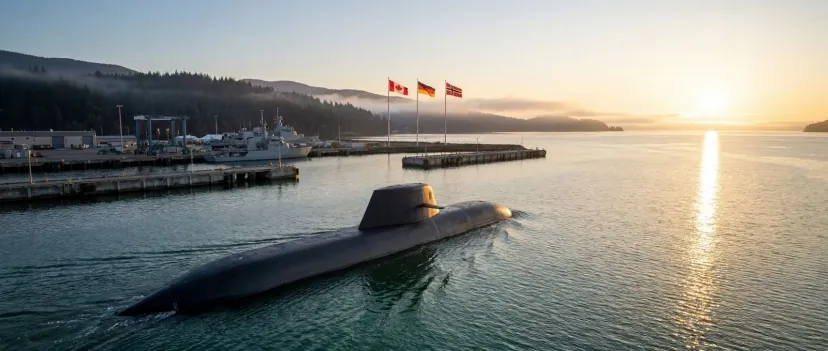
The Ecosystem Proposed by Germany: A NATO-standard Joint Platform
The core card TKMS played for Canada was "Team 212CD." Team 212CD is a vision that binds Germany, Norway, and Canada into a single submarine partnership. At its center is the HDW Class 212CD (Howaldtswerke-Deutsche Werft Class 212 Common Design). This submarine is a conventional model co-developed by Germany and Norway, featuring a larger hull based on the existing 212A platform, stealth-optimized design, and Air Independent Propulsion (AIP) based on hydrogen fuel cells.
Germany’s proposal was not a simple pitch to "sell German submarines to Canada." Instead, it proposed that Canada join a submarine program already underway between Germany and Norway, allowing it to share training, maintenance, logistics, and upgrade systems with NATO partners using the same platform. For a country like Canada, which must simultaneously monitor the Arctic, the Atlantic, and the Pacific, this was critical. Once a submarine is acquired, it remains in service for decades.
Canadian technology firms were integrated into this ecosystem. Seaspan Shipyards, a company operating primarily in Vancouver and Victoria, British Columbia, is a Canadian ship repair and maintenance specialist. Already involved in maintaining the Canadian Navy’s Victoria-class submarines, it was presented alongside TKMS as a partner to build long-term maintenance capabilities within Canada. This sent a message that Canada would not be left in a position of perpetual dependence on Germany, but would instead retain a foundation to operate the submarines domestically for a long time.
Marmen is a precision manufacturing firm based in Trois-Rivières, Quebec. Founded in 1972, the company produces high-precision structures and complex assemblies for the wind energy, aerospace, nuclear, defense, and heavy industrial sectors. TKMS pursued a collaboration with Marmen to manufacture certain sections and complex components of the 212CD submarine in Canada. This demonstrates that even firms outside the traditional defense sector can enter the naval defense supply chain if they possess precision manufacturing capabilities.
CAE (formerly Canadian Aviation Electronics) is a prominent Canadian training and simulation company founded in Montreal in 1947. While famous for its aircraft flight simulators, it also provides crew training, mission rehearsal, and digital learning systems for the defense sector. TKMS pursued a partnership with CAE for submarine crew training and simulation. Modern submarine power is not just about the hull and weaponry; it requires crews to train repeatedly for complex scenarios and simulate missions before actual operations.

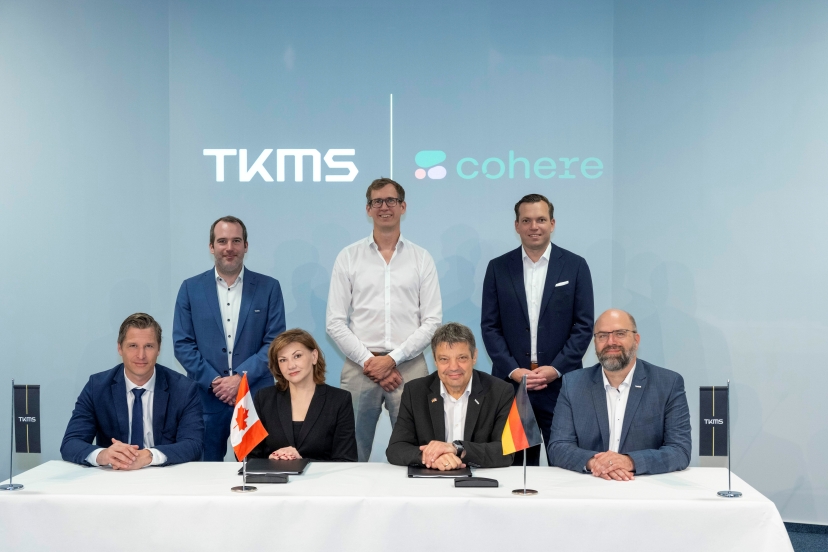
The most symbolic technology firm is Cohere. Cohere is a corporate AI startup founded in Toronto in 2019. It has grown by focusing on large-scale LLMs and Retrieval-Augmented Generation (RAG) technology, which can be used in corporate and government environments where security is more critical than it is for consumer chatbots. TKMS announced a collaboration with Cohere for AI-based decision support, onboard information management, training environments, and secure naval interfaces for submarine operations. The role of AI inside the submarine is not to replace the crew, but to organize vast amounts of sensor and operational data to assist in decision-making.
OSI Maritime Systems is also noteworthy. OSI is a British Columbia-based naval navigation and tactical systems company that has provided electronic charting, integrated bridges, and underwater navigation solutions to NATO and allied navies. Norway’s Kongsberg, a partner that provides the ORCCA Combat System (the 212CD’s combat system) alongside TKMS, collaborated with OSI to create a framework for integrating Canadian navigation technology into a NATO-standard combat system.
Ultimately, the German proposal can be summarized in one sentence: rather than just selling submarines to Canada, it was an invitation for Canada to join a NATO-style submarine ecosystem.
The Ecosystem Proposed by South Korea: Industrial Cooperation Centered on KSS-III
South Korea did not just offer a submarine either. The KSS-III Canadian Patrol Submarine (KSS-III CPS) proposed by Hanwha Ocean is a model tailored to Canadian requirements based on the latest family of conventional submarines used by the South Korean Navy. The KSS-III features lithium-ion batteries, AIP, long-range operational capabilities, and anti-submarine, anti-surface, and Intelligence, Surveillance, and Reconnaissance (ISR) capabilities. Since its founding in 1973, Hanwha Ocean has grown based at the Okpo Shipyard in Geoje and is Korea’s leading shipbuilding and naval defense firm, holding extensive experience in building submarines and surface ships for the South Korean Navy.
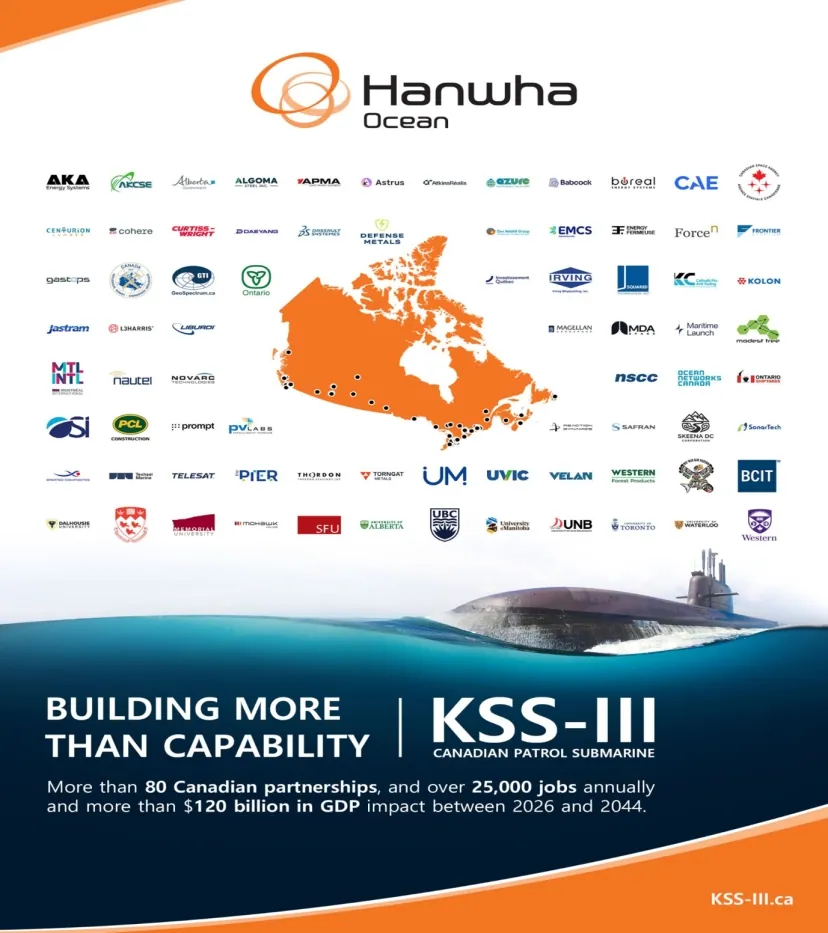
Hanwha’s strategy was also clear. It centered on the KSS-III platform while linking Canadian steel, space, satellite communication, AI, and sensor firms. This showed that South Korean defense is now attempting to offer packages that include local technology ecosystems, rather than just exporting finished products.
A key partner is Algoma Steel. Based in Sault Ste. Marie, Ontario, Algoma is one of the major players in the North American steel industry with over 120 years of history. Hanwha Ocean pursued a steel supply collaboration with Algoma. The message was that it would connect the steel needed for submarine construction and maintenance infrastructure with Canadian local industry. In defense procurement, steel is not just a material; it symbolizes regional jobs, supply chain resilience, and industrial sovereignty.
In the space and communications sector, Telesat and MDA Space were brought in. Telesat is a satellite communications company founded by the Canadian Parliament in 1969, currently developing the Telesat Lightspeed low-earth orbit satellite network. MDA is a representative Canadian space firm known for space robotics—symbolized by the Canadarm—satellites, and space infrastructure. Hanwha Systems pursued collaborations with them in secure low-earth orbit satellite communication, defense space technology, data resilience, and command and control capabilities.
In the sensor field, PV Labs participated. PV is an Electro-Optical/Infrared (EO/IR) sensor company based in Burlington, Ontario. Having developed stabilized optical systems for aviation and mobile platforms, they discussed with Hanwha Systems the development of tactical EO systems, local integration, production, technology transfer, and global export collaborations.
Interestingly, Cohere also appeared on the South Korean side. Hanwha Ocean and Hanwha Systems signed an MOU with Cohere for AI cooperation. The scope of collaboration included not only submarine operations but also smart shipyards and the optimization of design, production, and operation. The fact that the same AI firm appeared in both the German and South Korean proposals is symbolic. In modern defense, AI scale-up is no longer a peripheral technology provider but a key partner that makes large platforms appear as future-ready assets.
South Korea’s proposal had a different logic than Germany’s. While Germany presented an alliance-type ecosystem based on a NATO common platform, South Korea proposed an expansive ecosystem that connects Canadian technology companies and industries centered on the KSS-III. Ultimately, Canada chose Germany. However, South Korea did not rely solely on the submarine’s performance, price, or delivery schedule. Together with Canadian technology firms, Hanwha sent the message that "South Korean defense can grow alongside Canadian industry."
Why Collaboration Ecosystems are Becoming Critical in Defense Technology
The core of this contract race is not just the fact that South Korea lost to Germany. More importantly, the formula for defense exports has changed. Defense is now an industry that sells weapons while simultaneously selling a technology ecosystem.
Consider a single submarine. The hull, propulsion system, and weaponry are important. But actual combat power is not created by those alone. Simulation firms that train crews, AI firms that organize operational data, software firms that integrate navigation and combat systems, space firms that provide satellite communication, optical firms that make sensors, shipyards that handle maintenance for decades, and precision manufacturers that produce core components must all act in concert.
Germany demonstrated this well. TKMS bundled Seaspan, Marmen, CAE, Cohere, OSI, and Kongsberg around the 212CD platform. And it explained this as an ecosystem combining a NATO common platform with long-term maintenance, training, combat systems, AI, and navigation technology. For Canada, choosing this was not just buying a submarine; it was choosing to enter a security ecosystem that it could operate alongside Germany and Norway.
South Korea also made meaningful progress. By collaborating with Algoma, Telesat, MDA Space, Cohere, and PV Labs, Hanwha presented a vision where the KSS-III could foster Canadian industry and technology firms. While it did not break through the NATO barrier, the way it promoted a technology ecosystem and formed a defense package with local firms was far more sophisticated than before.
The message for South Korea is clear: a good platform is only a starting point. Future defense exports will not be decided solely by product performance, price, and delivery. Customer nations look at what remains for their own industry, which technology companies are participating, whether maintenance and upgrade capabilities are being built domestically, and how easily the platform can be operated alongside allies.
The Canadian submarine race was a disappointing result, but it was also a case study that revealed the next strategy. If South Korean defense is to penetrate deeper into European and North American strategic procurement markets, it must design ecosystems beyond just weapons. More important than the number of MOUs is demonstrating the actual roles those companies will play in operation, maintenance, training, data, supply chains, and upgrade structures.
In this bidding war, Germany invited Canada into a NATO-style submarine ecosystem. South Korea demonstrated an industrial cooperation ecosystem that could go hand-in-hand with Canadian technology firms centered on the KSS-III. Canada chose Germany, but South Korea’s direction was not wrong. Next time, however, a deeper alliance structure, more sophisticated local technical cooperation, and a more persuasive long-term operational ecosystem will be necessary. Defense competition has now moved beyond a competition of weapons into a competition of technology ecosystems.