

[비즈한국] As Tesla's "Full Self-Driving (FSD) Supervised V14 Lite" is released in Korea, interest is growing among owners regarding the eligible vehicles.
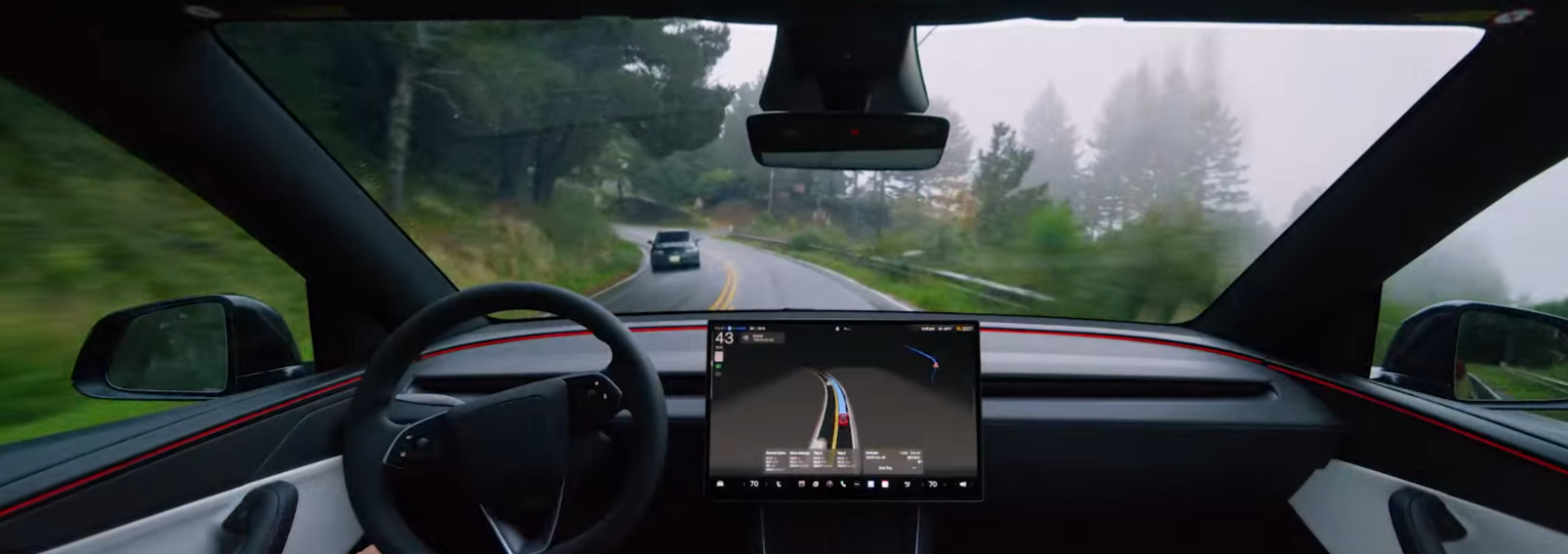
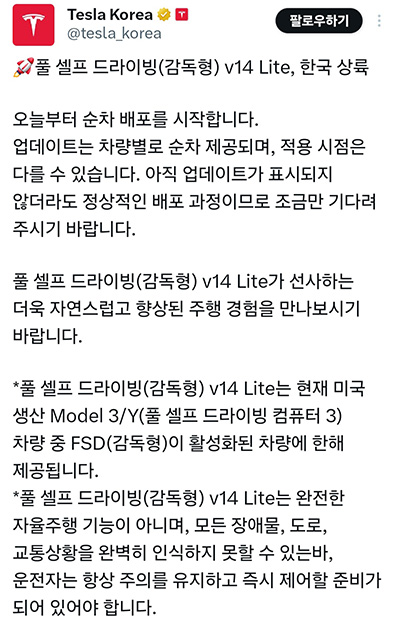
Tesla Korea announced on the 10th that it would begin distributing FSD V14 Lite in Korea. Korea is the second market after North America where FSD V14 Lite has been officially provided. The target vehicles are Model 3 and Model Y units produced in the United States that are equipped with FSD computers and have the FSD Supervised feature activated. Updates are being provided sequentially by vehicle. With this release, the range of models capable of using FSD in Korea has expanded from the existing "Model S," "Model X," and "Cybertruck" to include the "Model 3" and "Model Y."
FSD V14 Lite is a streamlined version of the latest FSD V14, optimized to run on older autonomous driving computers. The software has been adjusted so that FSD features can be used on HW3 vehicles, which have lower computational performance than the AI4 chips used in the latest models. HW3 is the autonomous driving assistance computer that Tesla has been applying since 2019.
A key criterion for this distribution is the country of manufacture. Even for the same model, vehicles produced in the U.S. are included, while those produced in China are excluded. Essentially, even if hardware and software requirements are met, eligibility varies depending on the country of production.
The reason U.S.-made vehicles are prioritized is due to the Korea-U.S. Free Trade Agreement (FTA). Under the agreement, vehicles that meet U.S. automotive safety standards are recognized as meeting domestic safety standards as well. Industry insiders believe that U.S.-made Teslas have secured the room for FSD introduction within this framework.
On the other hand, Chinese-made vehicles are not subject to the Korea-U.S. FTA, so they must undergo separate domestic automotive safety standards and regulatory procedures. Even if they have the hardware capacity to run FSD, they have been excluded from this FSD V14 Lite distribution.
According to these criteria, the primary targets for this update are U.S.-made Model 3 and Model Y vehicles sold early in the Korean market. Among these, vehicles equipped with FSD computers and the FSD Supervised feature are eligible to receive V14 Lite.
However, the Model 3 and Model Y currently sold in Korea are not part of this distribution. This is because Model Y vehicles have been imported from the Shanghai factory since 2023, and Model 3 vehicles since 2024. The timing of application is expected to be determined based on domestic safety standards and related regulatory procedures.
For Model S and Model X, owners need to check their onboard computer. U.S.-made HW3 vehicles produced between the spring of 2019 and March 2023 are eligible for V14 Lite if they have the FSD Supervised feature activated.
Vehicles produced before April 2019 are generally not eligible as they are equipped with older autonomous driving computers based on HW2 or HW2.5; however, vehicles that were upgraded to HW3 after purchasing FSD are included.
Newer Model S and Model X vehicles delivered after March 2023 are classified as part of the AI4 chip-equipped fleet. As they are already eligible for the latest FSD version, they are not the target group for V14 Lite, which is a lightweight version specifically for HW3 vehicles.
The domestic release of Tesla's FSD V14 Lite marks an opportunity to broaden the scope of functionality for older U.S.-made vehicles. However, since Chinese-made Model 3 and Model Y units still require domestic safety standards and regulatory procedures, the timing for adoption by model will likely remain staggered for the time being.
Despite the name, FSD is not a fully autonomous driving system. It is an autonomous driving assistance feature that requires the driver to monitor driving conditions at all times. Even when the feature is active, drivers must watch road conditions and be prepared to take manual control of the vehicle at any moment.