

[비즈한국] Amid a prolonged slump in the construction industry, it has been confirmed that the ready-mixed concrete (remicon) usage by Korea’s top five construction firms has decreased by approximately 44% over the past two years. The combination of a decline in new project commencements and changes in construction processes at large-scale sites appears to be rapidly shrinking demand for remicon, a staple construction material. This decrease in demand is leading to a nationwide drop in shipments and factory utilization rates, placing an increasing burden on the ready-mixed concrete industry.
Impact of fewer housing starts and shifting construction processes
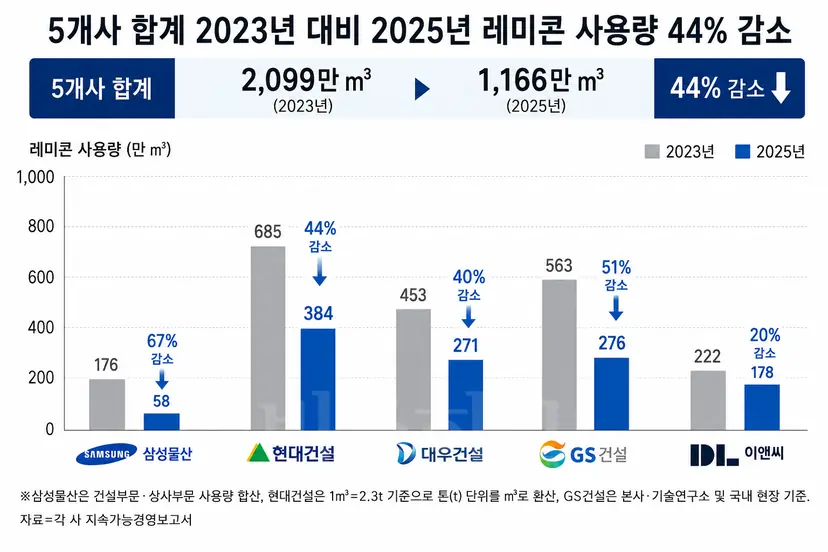
According to an analysis of each company’s 2026 Sustainability Report by BizHankook, the total ready-mixed concrete usage by the top five domestic construction firms last year was 11.66 million cubic meters, a 27% decrease from the 15.87 million cubic meters used the previous year. Compared to 2023, when annual usage reached 20.99 million cubic meters, this represents a decline of approximately 44%. Ready-mixed concrete refers to concrete in an unset state made by mixing cement, water, and aggregates; it is a primary construction material used for building frames, roads, and bridge construction.
The decline in ready-mixed concrete usage was most notable for Samsung C&T. Usage last year was 0.58 million cubic meters, a 67% drop compared to 1.76 million cubic meters in 2023. During the same period, GS E&C saw a 51% decrease from 5.63 million to 2.76 million cubic meters, Hyundai E&C dropped 44% from 6.85 million to 3.84 million cubic meters, Daewoo E&C fell 40% from 4.53 million to 2.71 million cubic meters, and DL E&C saw a 20% decline from 2.22 million to 1.78 million cubic meters. However, there are limitations to a direct comparison as calculation methods differ by company.
The reduction in ready-mixed concrete usage is primarily attributed to a decline in construction output. According to the construction trend survey by the National Data Center, total construction output, which reached 142.776 trillion won in 2023, fell to 136.092 trillion won in 2024 and further to 113.992 trillion won last year, a decrease of approximately 20% over two years. Last year's construction output fell 16.2% year-on-year, with reduced performance in both building (-17.3%) and civil engineering (-13.0%) projects.
An official from a major construction firm explained, "Ready-mixed concrete usage, which is high during the initial phase of site development, has decreased alongside the reduction in new project starts," adding, "Cases of private housing sites, such as redevelopment projects, delaying their start dates are increasing due to rising raw material costs and uncertainty in real estate policy." Another official from a major construction firm added, "Due to the impact of various regulations, housing starts have dwindled, leading to a decrease in ready-mixed concrete usage. The outlook is not positive for this year or next year."
However, it is difficult to explain the entire decline in usage solely through housing starts. Nationwide housing construction starts rose 23% from 246,265 units in 2023 to 303,433 units in 2024, before falling 10% to 272,685 units last year. Considering the increase in 2024, the result appears to reflect changes in non-residential sites and shifts in large-scale construction processes. In fact, Samsung C&T has seen a significant reduction in group-affiliated projects, such as the construction of Samsung Electronics semiconductor factories, since 2023.
Ready-mixed concrete industry burdened by simultaneous drops in shipments and utilization
The decline in on-site ready-mixed concrete usage has led to a decrease in shipments. According to the Korea Ready-Mixed Concrete Industry Association on the 9th, domestic shipments last year totaled 97.66 million cubic meters, a decrease of about 15% from the previous year. After reaching 145.91 million cubic meters in 2021, shipments steadily declined to 141.34 million in 2022, 135.83 million in 2023, and 114.44 million in 2024, finally dropping below the 100 million cubic meter mark last year. This is the lowest figure since 1999, when shipments recorded 95.97 million cubic meters.
The decrease in usage has hit the industry hard. According to data from the Korea Ready-Mixed Concrete Industry Association, the national factory utilization rate last year was 15%, a 3 percentage point drop from the previous year. The utilization rate, which stood at 23% in 2021, has fallen every year, decreasing by 8 percentage points in four years. The number of domestic ready-mixed concrete plants decreased from 1,088 in 2024 to 1,075 last year. Since ready-mixed concrete is difficult to store for long periods, a decrease in site demand is directly linked to the utilization rate.
An official from the ready-mixed concrete industry stated, "The ready-mixed concrete industry is highly sensitive to construction investment and housing market trends," adding, "Because the barriers to entry are relatively low, the number of firms increased rapidly during the construction boom, but as shipments fall due to the recent slowdown, competitive pressures by region and the burden on utilization rates are both intensifying."