

[비즈한국] This week in the cryptocurrency market, infrastructure assets supporting actual blockchain services—such as DAO governance, restaking, oracles, derivatives trading, and Layer 2 solutions—dominated the top of the gainers list. Rather than a market-wide rally, capital appears to have shifted toward projects with clear use cases and supply-demand drivers.
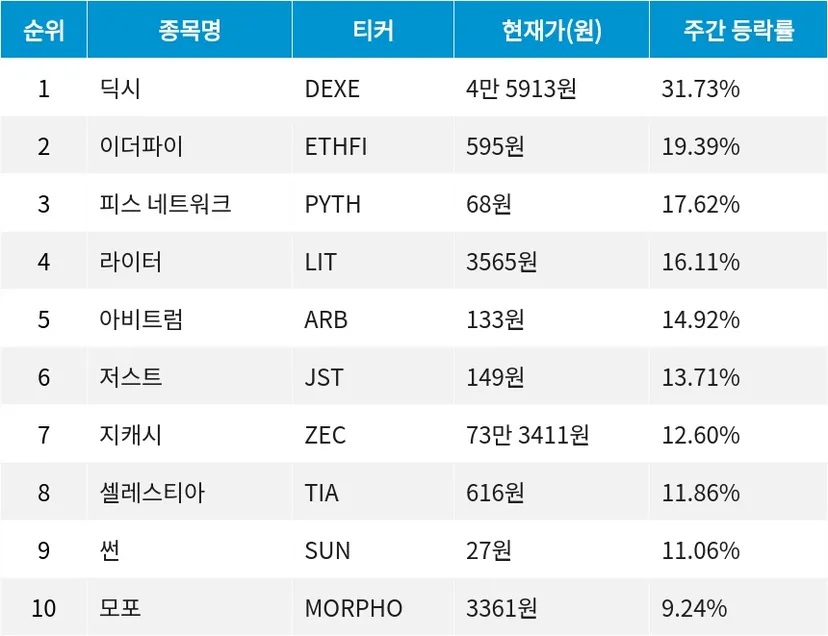
According to global virtual asset market data site CoinMarketCap, DeXe recorded a 31.73% increase from 7:00 AM on July 3 to 7:00 AM on July 10, ranking first among the top 100 cryptocurrencies by market capitalization for the week. The current price is 45,913 KRW, and it has risen by 5.22% over the last 24 hours.

Ether.fi followed in second place with a 19.39% increase to 595 KRW, and Pyth Network took third with a 17.62% rise to 68 KRW. Lyra rose 16.11% to 3,565 KRW, followed by Arbitrum, which climbed 14.92% to 133 KRW. Arbitrum, in particular, showed the strongest short-term momentum toward the end of the reporting period, surging 16.44% in the last 24 hours.
Trailing them, Just rose 13.71% to 149 KRW, and Zcash climbed 12.60% to 733,411 KRW. Celestia rose 11.86% to 616 KRW, Sun increased by 11.06% to 27 KRW, and Morpho recorded a 9.24% rise to 3,361 KRW.
DeXe: Thin Liquidity and Short Squeezes
DeXe is the governance token for the DeXe protocol, which supports DAO establishment, voting, delegation, reward distribution, and treasury management.
This surge is attributed to a concentration of buying pressure in an environment with thin circulating supply, following the breach of key price resistance levels in early July and an increase in transaction volume and on-chain activity. Renewed interest in DeFi governance tokens and the liquidation of short positions appear to have further amplified the gains.
However, projects with low liquidity can see prices reverse quickly if buying pressure wanes, so it is necessary to verify whether trading volume holds up after the surge.
Ether.fi: Expectations for Managing $3 Billion in ETH
Ether.fi is an Ethereum-based protocol that provides non-custodial staking and restaking services.
The rally was influenced by the decision to supply $3 billion worth of ETH to ETHGas as validator liquidity over the next three years. Expectations have grown that additional revenue can be secured by connecting deposited ETH to validator operations, Maximal Extractable Value (MEV), and block space trading.
The market interpreted this as a signal that Ether.fi is expanding from a simple staking platform into a large-scale Ethereum management firm.
Pyth Network: Revaluation of Oracle Utility
Pyth Network is an oracle infrastructure that supplies real-time financial market data to various blockchains. In DeFi lending and derivatives markets, oracle prices serve as the benchmark for collateral liquidation and trade settlement.
Its collaboration with existing partners like Morpho and risk management firm Gauntlet has expanded into actual lending and risk management infrastructure, and the revaluation reflects increased data utilization across multiple chains, including Solana, Ethereum, and Base.
However, it is more accurate to view the Morpho-Gauntlet collaboration as an expansion of an existing partnership rather than a new deal announced this week.
Lyra: Token Burning and Abnormal Trading
Lyra is an Ethereum-based perpetual futures trading platform.
This week, the permanent burning of LIT tokens and the unveiling of a new staking model heightened expectations for reduced supply and long-term holding demand. Increased activity from large-wallet addresses was also cited as a factor driving volatility.
During the price increase, an abnormal on-chain transaction was captured where someone injected approximately $2 million worth of ETH but received only about $14,000 worth of LIT. It is presumed that a routing error or extreme price slippage was the cause, serving as a cautionary tale on the importance of verifying liquidity and slippage in decentralized trading.
Arbitrum: Expectations for DAO Treasury Utilization
Arbitrum is a Layer 2 network that bundles Ethereum transactions for off-chain processing. However, it has faced criticism that the ARB token is not used directly for network fees, leading to a weak correlation between chain growth and token value.
Sentiment improved recently as the Arbitrum DAO discussed ways to utilize its treasury assets to support ecosystem liquidity and protocol growth. There is an expectation that if idle treasury assets are deployed to expand the ecosystem, the economic significance of ARB governance could increase.
The fact that the 24-hour gain exceeded the weekly gain indicates that most of the rise was concentrated toward the end of the counting period. Whether a trend reversal is underway will depend on subsequent trading volume and price retention.
DeFi and Infrastructure Strength
The 6th to 10th positions were also occupied by DeFi assets such as Just, Sun, and Morpho, along with data infrastructure projects like Celestia. Excluding Zcash, most of these projects are linked to practical use cases such as lending, yield, trading, and data.
This trend is closer to a selective market—where buying has spread to mid-sized altcoins with clear use cases and supply-demand drivers—rather than an all-out altcoin rally where the entire market rises in unison.
The top gainers this week were the result of both the revaluation of real-use infrastructure and the supply-demand effects caused by thin liquidity. Next week, the key will be whether prices remain stable after trading volume subsides, and whether the utility of each project translates into actual revenue and demand for tokens.
※ This article was written by BizHankook and MetaVX's generative AI.