

[비즈한국] Gravity is everywhere. It is the most familiar force, yet simultaneously the most mysterious and incomprehensible. Looking at the universe on a large scale, gravity cannot be explained solely by the matter we know. Stars at the edges of galaxies rotate far too fast than expected. The same applies to galaxies within galaxy clusters. If they were rotating at such high speeds, the stars and galaxies should have scattered in all directions long ago, yet the structure of the universe remains stable. It appears as if the universe is held together by heavier matter than what we see, and by a stronger gravitational force.
From Aristotle to Galileo, Newton, and Einstein, the great physicists and philosophers in history have all challenged the secrets of gravity. And yet, we still do not fully understand gravity with 100% certainty.
This is precisely where the greatest debate in modern cosmology takes place. For a long time, astronomers have postulated "dark matter" to explain a "heavier universe than meets the eye." Dark matter contributes to gravity but does not emit any light. It is not simply dark; it neither emits nor absorbs light. Because it does not interact with light in any way, it cannot be seen with conventional telescopes. We can only feel it vaguely through the gravitational effects that dark matter leaves behind. Dark matter acts like an invisible hand or a framework that holds galaxies and galaxy clusters together.
However, we have still not been able to figure out exactly what dark matter is. Ultimately, an alternative hypothesis emerged: MOND (Modified Newtonian Dynamics). Physicists who advocate for MOND argue that there is no need to assume the existence of invisible matter in the first place. Instead, they attempt a more dramatic assumption: that we should simply modify the laws of gravity themselves. They explain that in areas where gravitational acceleration is extremely weak, especially on a very large scale, gravity might work in a way completely different from what Newton and Einstein described.
The reason MOND has been considered an attractive alternative for so long is clear. It showed remarkable results, particularly with galaxy rotation curves. The outer stars of spiral galaxies rotate too fast if we only consider the visible matter, or baryons. Instead of adding dark matter, MOND argues that the laws of gravity function differently at the edges of galaxies where the gravitational scale is very weak.
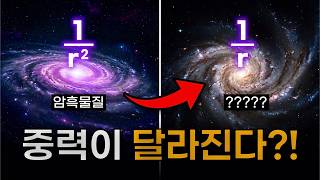
Gravity weakens in inverse proportion to the square of the distance as it gets further away. If you move twice as far, it becomes four times weaker; three times further, nine times weaker. If the distance is r, the strength of gravity decreases in proportion to approximately 1/r². Here, the exponent of 2 for the distance is crucial. MOND suggests that this number could be a value other than 2. For instance, what if it were 1 instead of 2? Gravity would weaken much more slowly as the distance increases. Then, even very distant objects could be held together by a stronger-than-expected gravitational force. This is exactly how MOND explains the movement of fast-moving stars and galaxies without dark matter.
But is that really the case? Does gravity weaken more gently than 1/r² on a massive scale reaching tens or hundreds of millions of light-years? To find this answer, looking at just a single galaxy is insufficient. We must examine how gravity works on a scale larger than galaxy rotation curves—in fact, on the scale of the entire universe. There is an excellent tool for this: the Cosmic Microwave Background (CMB), the oldest light in the universe that has traveled from the furthest distances.
Recently, astronomers used the Atacama Cosmology Telescope (ACT) in Chile’s Atacama Desert to complete a multi-year map of the CMB across the universe. They have announced various analytical results, among which is a surprising finding that closely examines the possibility of MOND on a universal scale. What was the conclusion?
The CMB is light that has traveled from very far away, at the edge of the universe. While traveling, this light passes through various galaxy clusters. Inside these clusters, there are many hot, fast-moving electrons. The CMB photons collide with these free electrons in the galaxy clusters, resulting in a scattering effect.
Depending on the direction in which the galaxy cluster is moving relative to us, the pattern of scattering changes. If the galaxy cluster is moving toward or away from us relative to the CMB, the electrons inside it move as well. Consequently, the CMB photons scattered by these electrons contain a minute Doppler effect that reflects the motion of the galaxy cluster. As a result, CMB light passing through a galaxy cluster moving toward us appears slightly hotter, while light passing through a cluster moving away appears cooler. This effect is called the Kinematic Sunyaev-Zel'dovich (SZ) effect.
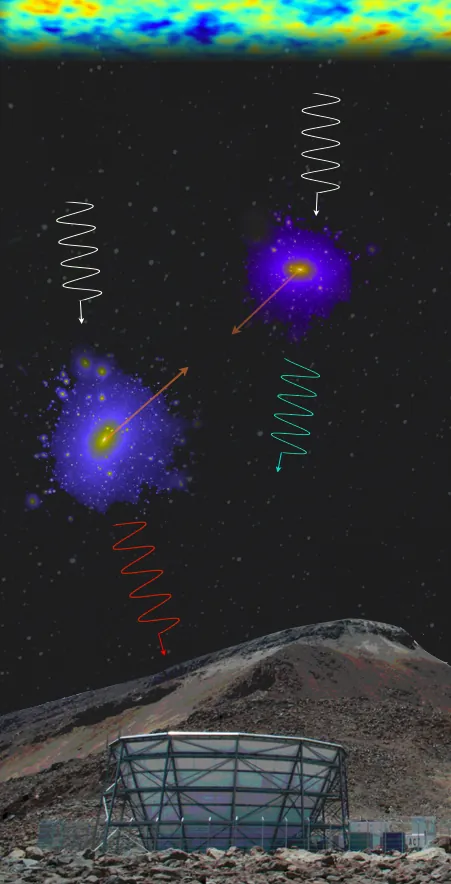
Of course, this signal is so faint that if you consider only one galaxy cluster, it is essentially buried in background noise. However, by collecting and statistically analyzing hundreds of thousands of galaxies and clusters across the universe, we can determine how galaxy clusters move toward us on average. Consider two galaxy clusters in the universe; they do not move completely at random. They pull on each other with gravity, tending to move closer together. That velocity contains clues about how the gravity exchanged between the two clusters functions.
Based on the latest CMB map data completed via ACT, astronomers integrated the vast galaxy map data from the SDSS, which has been compiled over several years. The galaxies used in this study have redshifts between 0.44 and 0.66. This range is significant because the spatial distribution of galaxies does not change significantly in this interval. Therefore, we can exclude the effects of the evolution of the cosmic web over time and clearly analyze solely how gently or steeply gravity weakens according to distance.
The average distance between the two galaxy clusters used in this analysis was approximately 30–230 Mpc. Considering that the diameter of our own galaxy, which is 100,000 light-years across, is only 0.03 Mpc, this study did not just look at gravity within a single galaxy, but tested gravity on a cosmological scale that far exceeds the size of a single galaxy. So, what was the value of the exponent confirming how gravity weakens with distance through this large-scale survey? The result is approximately 2.1±0.3. In today's ΛCDM cosmology, which is based on standard Newtonian laws and Einstein's theory of relativity, n should be 2. Conversely, assuming the simplest MOND model, n would have to be 1.
However, the actual observation yielded a value close to 2. It is certainly not 1. It appears that MOND does not work at all on the scale of the entire universe. Of course, this discovery alone may not be enough for physicists who believe in MOND to completely abandon their hopes. MOND involves many complex elements, such as the effects of gravity from other nearby galaxies and clusters, or the External Field Effect (EFE). Even if an object is in a weak gravitational field on its own, it can be influenced by a larger external gravitational field in the background. However, this study did not systematically analyze EFE.
Nevertheless, the fact that gravity was tested on a cosmological scale spanning tens to hundreds of Mpc is significant. Therefore, even taking the External Field Effect into account, it seems difficult to strongly refute these results.
Reference
https://www.science.org/content/article/newton-s-law-gravity-passes-its-biggest-test-ever
https://iopscience.iop.org/article/10.1088/1475-7516/2025/11/061
https://iopscience.iop.org/article/10.1088/1475-7516/2025/11/062