

[비즈한국] Comics and movies. Not "comic movies." Tucked between them lies a small red bean, like a tiny speck. On the path where a creator who loves red beans travels between these two genres, red beans have been scattered along the way. I met with Lee Dong-eun, a creator who has written and directed 'In Between Seasons,' 'Your Request,' and 'Mi-na and Mi-na' as both a manga writer and a film director, at a specialty red bean shop in Eunpyeong-gu.
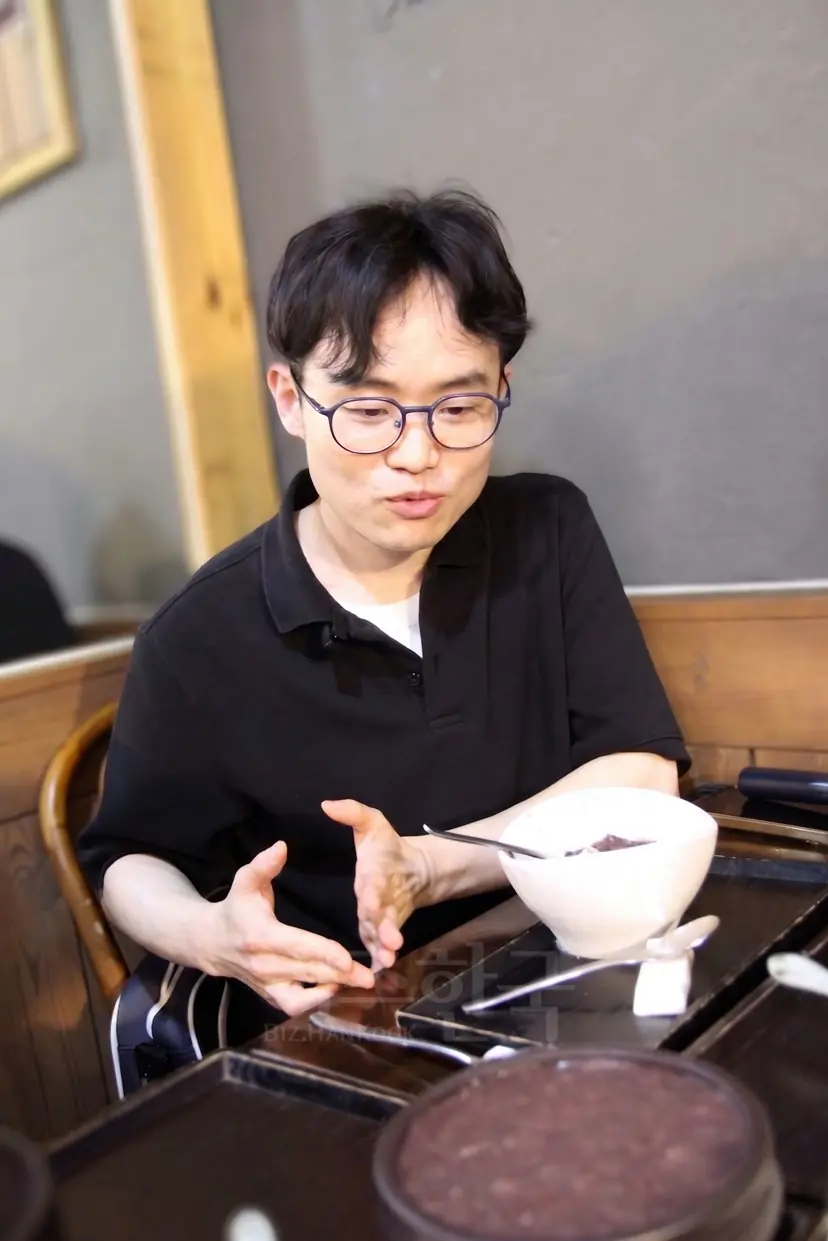
Red Bean Shaved Ice for Dinner!
Sweet red bean bread, red bean porridge, red bean kalguksu, red bean shaved ice... Author Lee Dong-eun, who says he has no picky tastes when it comes to red beans, chose the red bean shaved ice. When I suggested that, since it's dinner time, he might want to have it as a dessert after a meal, he replied that the shaved ice has enough calories to be a meal on its own. He added a story about his childhood, using a Japanese blue ice shaver at home to make shaved ice. I had thought his preference for red beans was just an old-fashioned taste, but having red bean shaved ice for dinner is far from ordinary.
It was only recently, after meeting someone who disliked red beans, that the author realized his love for them was a specific preference and taste; he has been consistently fond of them without wavering. His history is long, starting from his childhood when his parents were both working and he had no one to look after him, leading him to buy "King Sweet Red Bean Bread" at the local supermarket every day—a habit that has evolved into his current "One Red Bean a Day" lifestyle.
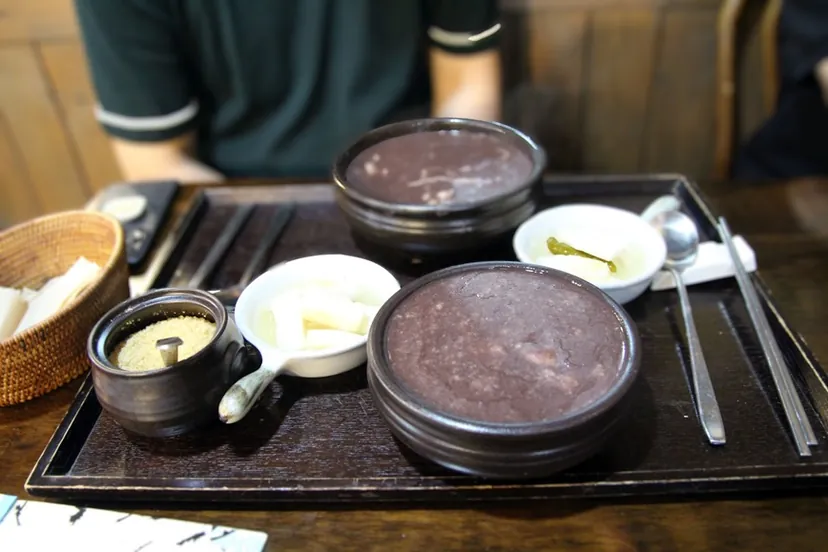
Never Refusing a Single Red Bean Bread
Perhaps because the author's hometown is Busan, the home of the "Seokbinggo Red Bean Ice Bar," his works are often set in regional cities rather than Seoul. This is true for 'In Between Seasons' (Daejeon/Wonju), 'Your Request' (Cheongju), 'One Case' (Wonju), 'Doing My Best to Perish' (Jeungpyeong), and 'Mi-na and Mi-na' (Jinju/Busan/Paju). When I asked him why, he said that stories don't come to him easily in Seoul, but when he goes to smaller cities, he gets the feeling that "someone like this would live in a place like this." Perhaps the nuances of life and relationships that are obscured by the overwhelming scale of a "mega-city" only become visible there.
When asked about episodes from his research trips for story planning, he spoke about the global cuisines one can taste in the provinces. As migrant workers and marriage immigrants have settled down, shops offering diverse foods from their home countries have emerged, showing a much more globalized landscape that might break the prejudices of Seoul residents. He mentioned that setting the mother of the protagonist Ah-young as Thai in his recent work 'Doing My Best to Perish' was related to a Thai restaurant he found in Jeungpyeong.
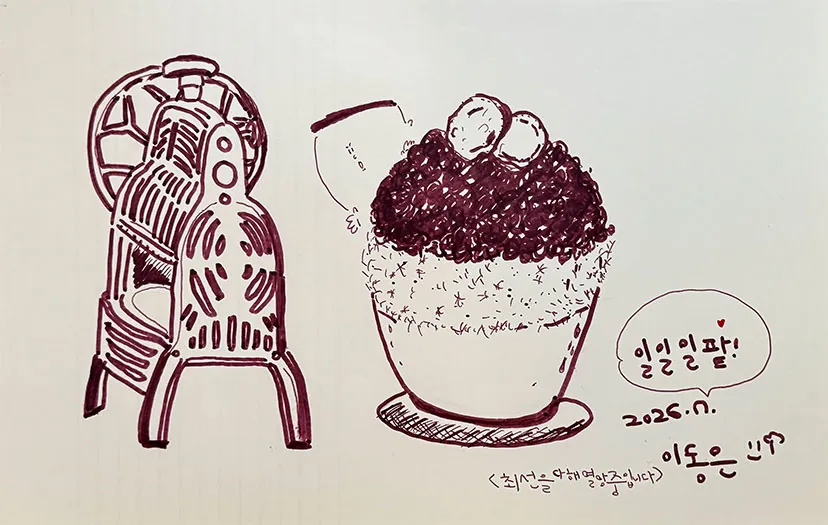
Continuing the conversation about the regions that serve as backdrops for his comics, the author brought up "Jung In-gu Red Bean Bread," which he considers the best red bean bread he found in Daejeon. The beans are round, and round and round, we are back to the red bean story. I took the opportunity to ask if that bread was his "life's best," and after a moment's hesitation, he replied, "Just as the best movie for a cinephile is the movie they are watching today, the best red bean bread is the one I'm eating today." It wasn't a technical evasion of a difficult question, but rather an answer that conveyed his sincere attitude toward red beans.
Since it is known that he likes red beans, he sometimes receives them as gifts. He once realized he was distinguishing between the ones he liked and the ones he didn't, and he vowed not to lose his original intention of simply liking the beans themselves. Did they not say the sea does not reject any water? The sincerity of an author who does not refuse even a single red bean bread touched me.
The Flavor of Red Beans and Comics
"Do you know the pain of having to stand in front of a hot fire for about 3 hours just to get a handful of red bean paste? Soaking the beans all day, 40 minutes on high heat, 1 hour and 30 minutes on medium heat, and 30 minutes to finish."
There is a line in the movie 'Man on the Edge' about the painstaking effort of making red bean paste for snacks. Indeed, red beans are an ingredient that requires a lot of manual labor. The author said that after boiling and handling the beans himself, he realized it was truly difficult. He mentioned that he likes to seek out shops run by owners who show a stubborn, craftsman-like spirit, even if they aren't effortfully kind. He added that the place where we were interviewing was one such shop.
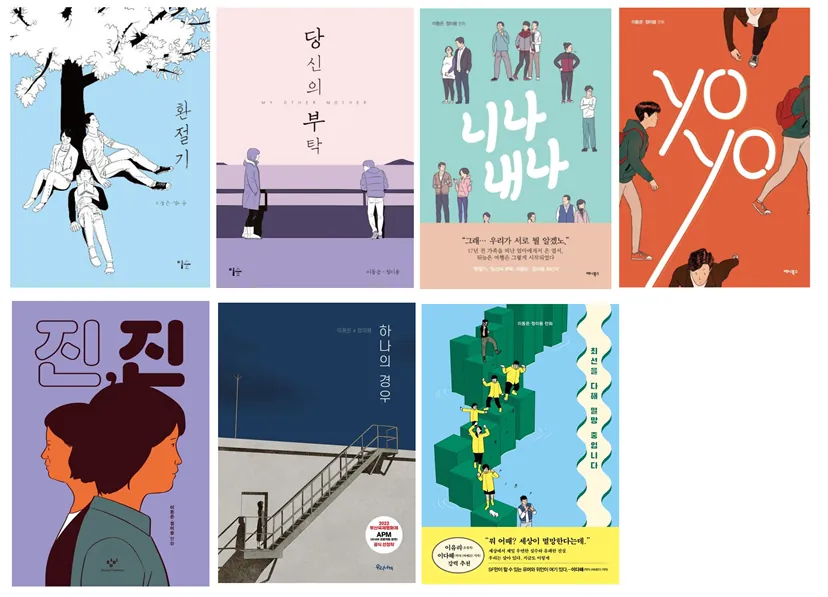
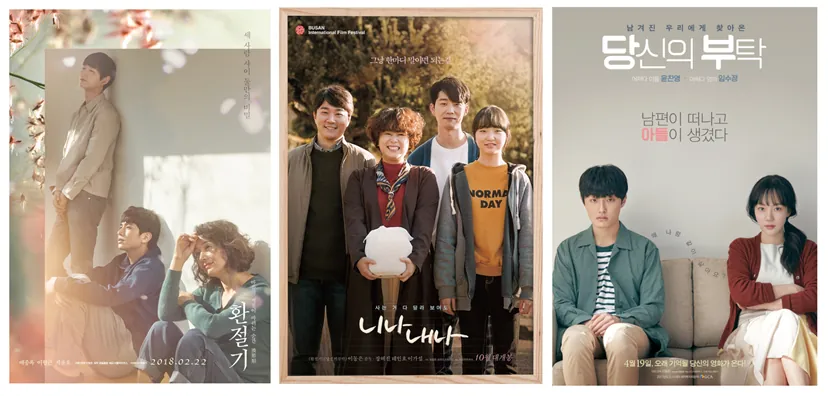
I could see glimpses of his work in the way the author prefers red beans that have been well-boiled to bring out their texture and flavor rather than flashy embellishments. In 'In Between Seasons,' a mother discovers that her son, who had an accident, was in a same-sex relationship with his friend. In 'Your Request,' a 32-year-old mother raising her deceased husband's son meets the boy's biological mother. 'Mi-na and Mi-na' depicts the events that unfold after three siblings receive a postcard saying "I miss you" from their mother, who left home 17 years ago. These are, literally, extraordinary family stories, yet they are never excessive or flashy in revealing the subject matter or discussing emotions. The harmony between Lee Dong-eun, who doesn't attach flashy decorations or forceful justifications to his stories, and Jung Yi-yong, who calmly illustrates them, elevates the quality of the work.
"Separately and Together": Lee Dong-eun and Jung Yi-yong's "Co-creation"
Just as there were Seo Soo-nam and Ha Cheong-il in the music industry, there were Heo Young-man and Kim Se-young in the comics industry, and comparable to that is the Lee Dong-eun and Jung Yi-yong duo. They have already worked on eight titles together and are working on a new one. Last year, following authors Hwang Sok-yong (2018) and Han Kang (2024), they received the 8th Émile Guimet Prize for Asian Literature in France for 'One Case'.
Both are introverted, but Lee Dong-eun, who is slightly less introverted, "digs the well" first. He plans the works and manages the manuscript schedule. It's a process where Lee Dong-eun proposes various ideas and Jung Yi-yong reviews and selects them. The two complement each other to create a perfect "chemistry."
While they are divided into writer and artist for convenience, a look into their workflow reveals it is effectively a co-creation. When Lee Dong-eun writes a screenplay, Jung Yi-yong creates storyboards, and they fiercely debate and coordinate expressions, dialogue, and emotional lines. Once the rough draft is complete, Lee Dong-eun adjusts the dialogue again. Because they go through an organic creative process of "separately and together," the books are credited not as "Written by Lee Dong-eun, Illustrated by Jung Yi-yong," but as "Manga by Lee Dong-eun & Jung Yi-yong."
Interestingly, Lee Dong-eun, who is also a film director, keeps cinematic expression in mind, while manga artist Jung Yi-yong creates cinematic perspectives and compositions in the layout. It is said that Jung Yi-yong even considers camera placement when composing scenes, so the film director writes the manga, and the manga artist draws the movie.
Adapting Kim Young-ha and Working on a New Mime Project
New red beans arrive in the autumn. Just like the beans ripening while enduring the current sweltering heat, I asked if there were any new works in preparation. He said there is work he is proofreading and work in production.
About two years ago, he received a proposal to create a graphic novel based on the work of author Kim Young-ha. After reading all of the author's work, he chose the short story 'I'm Looking for You'. This work, which won the 9th Kim Yu-jeong Literary Award in 2015, shows the ironic hellscape experienced by parents who lost their two-year-old child at a mart, the woman who kidnapped and later committed suicide, and the child who, after being kidnapped and returned to biological parents, fails to adapt and gets into trouble. As expected, Lee Dong-eun wrote the scenario, and Jung Yi-yong drew it.
The work currently in production is a non-verbal project, incorporating Lee Dong-eun's experience at an artist residency in Quebec, Canada, last year. The experience of living in a space with communication limitations led to contemplation on relationships in situations where one cannot communicate through language, resulting in a non-verbal work without dialogue. Initially, he conceived it as a borderless world, but he found that such settings often ended up evoking American or white-centric landscapes, so he decided to set it in an unspecified city in Korea.
Listening to an author who dreams of works that can communicate beyond language and culture without translation, I am reminded of Shaun Tan's 'The Arrival,' which depicts the adjustment period of an Australian immigrant through mime. 'The Arrival' is a graphic novel that depicts the stories of people trying to find their footing in a new space where they don't even speak the language, all while carrying their own histories, without saying a single word. His previous works like 'In Between Seasons,' 'Jin, Jin,' and 'One Case' have been translated and published in France, Poland, and elsewhere, and a new non-verbal work would be even easier to reach more international readers. I am quite looking forward to seeing what kind of empathy Lee Dong-eun and Jung Yi-yong will demonstrate beyond language.
※ About Author Lee Dong-eun
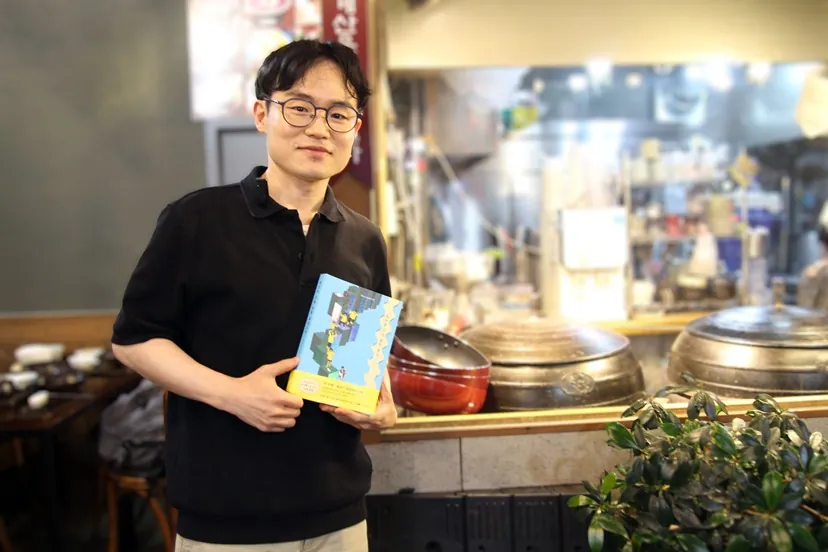
Born in 1978 in Busan. He graduated from Sungkyunkwan University with a degree in Economics. He originally wanted to study film, but it was difficult to enter film or journalism departments at the time because of the atmosphere that pushed students toward law or business schools. Fortunately, he found studying economics interesting, and he was intrigued by the method of analyzing human behavior through supply and demand and mathematical models.
He made short films during college and even won awards at small film festivals, but it didn't lead directly into the film industry. He worked at a regular company for a while, then went through an investment team at a film company and a theater programmer before eventually arriving at screenwriting and creative work. However, he is cautious about introducing this process as a dramatic narrative like "I quit my job and became an author." It's more that he was someone who originally wrote and made films, worked at other things for a living, and returned to his roots.
In 2013, he won the Dong-A Ilbo New Writer's Contest with 'Your Request' (Dangbu), and in the same year, he took his first steps into the manga industry as a story writer with 'In Between Seasons,' created with his long-time acquaintance, artist Jung Yi-yong. In 2015, he became a first-generation student at Myung Film Lab, majoring in feature film directing. Since then, he has written stories including the short comic 'Camp,' 'One Case,' 'Jin, Jin,' 'Yo-yo,' 'Mi-na and Mi-na,' 'Your Request,' and 'Doing My Best to Perish,' and has adapted 'In Between Seasons,' 'Your Request,' and 'Mi-na and Mi-na' into films.
As he has done since his first manga 'In Between Seasons,' he does not emphasize dramatic devices to reveal genre identity. Instead, he sets his characters as ordinary people in their everyday lives, making the reader look closely at them. That is why ordinary daily routines—walking, eating, and looking ahead side-by-side in a car—are important in his comics.
Lee Dong-eun introduces himself as "a person who steadily and quietly creates what he wants." It perfectly reflects the creative philosophy of an author who has kept his gaze on the small, trivial things one might pass by on the street. His hobby of taking pictures of signboards he happens to encounter while walking for over twenty years and archiving thousands of them on his blog is an extension of that same attitude.
![[Cartoonist’s Soul Food] The Cream Bread of That Dawn, Sustained by Dreams](https://s.bizhankook.com/attachments_thumb/2026/05/98392_thumb.webp)
![[Cartoonist's Soul Food] Art is in the 'Hand-taste', Food is in the Joy of Eating Together](https://s.bizhankook.com/attachments_thumb/2026/05/98652_thumb.webp)
![[Cartoonist's Soul Food] 'Kkadegi' author Lee Jong-cheol's 'Mother's Kimchi Jjigae'](https://s.bizhankook.com/attachments_thumb/2026/06/106516_thumb_1a338228.webp)
![[Cartoonist's Soul Food] 'Ghost Teacher' Author Nam Dong-yoon: "Undoubtedly, Sundae-guk"](https://s.bizhankook.com/attachments/2026/07/e57a933e6fe0_36ef77a3.jpg)
![[Cartoonist's Soul Food] Artist Park Kun-woong, Whose Knife-Cut Noodles Soothe the Knots of History](https://s.bizhankook.com/attachments/2026/07/9f3485391c47_2d2281a7.jpg)
![[Cartoonist's Soul Food] "A Red Bean a Day": A Visit with Manga Writer and Film Director Lee Dong-eun](https://s.bizhankook.com/attachments_webp_no_wm/2026/07/134567_no_wm_0b8d2928.webp)