

[비즈한국] The landscape of vacancy in knowledge industry centers located in Namyangju's new towns is shifting. Once plagued by oversupply and poor occupancy, the factory and office spaces are seeing their vacancy rates shrink due to the expansion of eligible business types and improved transportation conditions. However, ground-floor retail shops and associated commercial facilities remain stuck in a cycle of long-term vacancies.
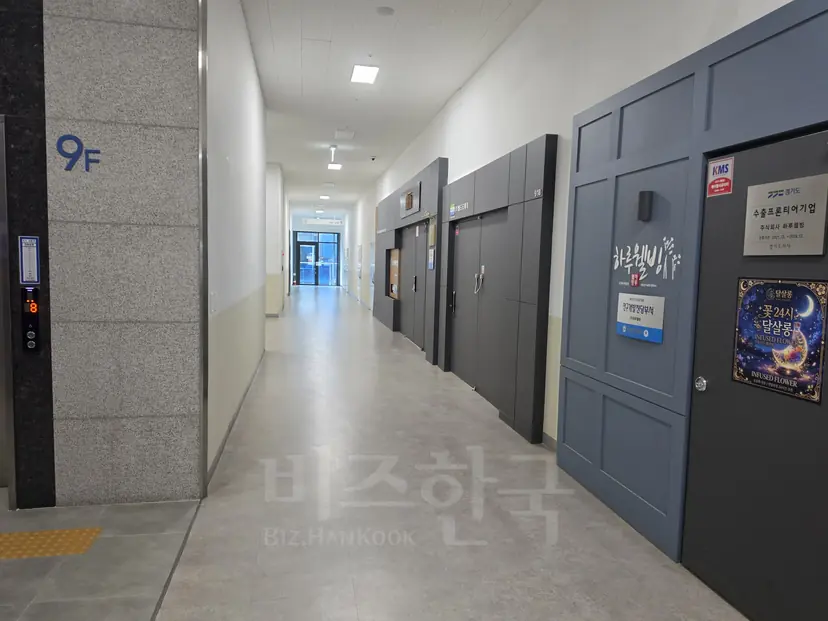
On the 7th, I visited a knowledge industry center in Dasan-dong, Namyangju, Gyeonggi Province. Although issues of oversupply and poor move-in rates were once raised, the factory and office spaces on the upper floors were largely filled. The hallways were lined with units displaying the names of tenant companies, and people could be seen coming and going for work.
“I believe there are almost no vacancies now,” said Mr. A, who works there. “Even units without signs on the doors are actually mostly occupied.”
Unlike the upper floors, where people were frequently seen, the ground-floor retail area was quiet. Empty shops with ‘Leasing Inquiries’ signs remained throughout the center, and vacancies were also visible in shops facing the street on the first floor. Some stores had closed, leaving only traces of their former operations. According to a source from the knowledge industry center, 26 out of 70 total retail units are empty, resulting in a vacancy rate of approximately 37%.
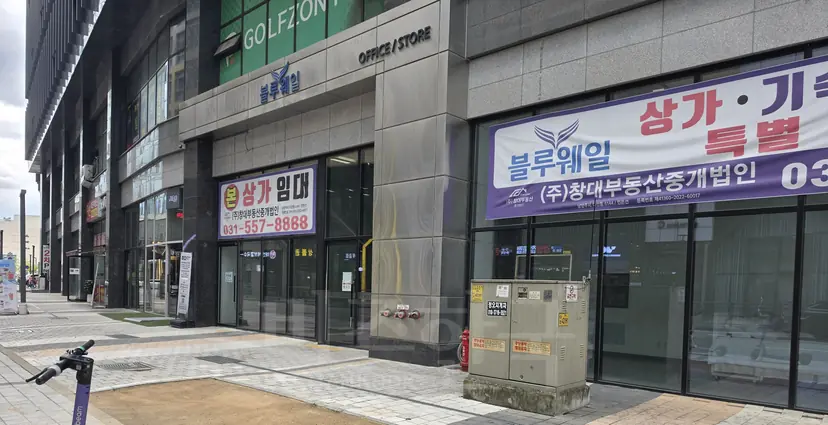
The situation was similar in Byeollae-dong, another new town in Namyangju. When I visited the knowledge industry center area in Byeollae-dong the following day, most factory and office spaces appeared to be occupied. In contrast, there were quite a few empty or non-operational stores in the low-level retail sections.
Byeollae Station’s P Square is where this disparity is most pronounced. It is a mixed-use complex consisting of two buildings: P Square, a low-rise commercial facility, and P Tower, a high-rise knowledge industry center. The space from the basement level 1 to the 2nd floor comprises commercial facilities, while the 3rd floor and above house the knowledge industry center. The structure is such that the low-rise commercial facilities effectively function as retail space linked to the knowledge industry center.
Around 11 a.m. on the 8th, the basement level 1 of P Square was so empty that there were no people in sight. Unlit, vacant units lined both sides of the corridor. Even the shops adjacent to the pedestrian walkway and those with views of the river were largely empty.
The first floor was not much different. While some stores were open for business, vacancies continued just a few steps away in the inner arcade. The second floor appeared to have fewer vacancies than the basement and first floors, but empty spaces still seemed to outnumber operational ones.
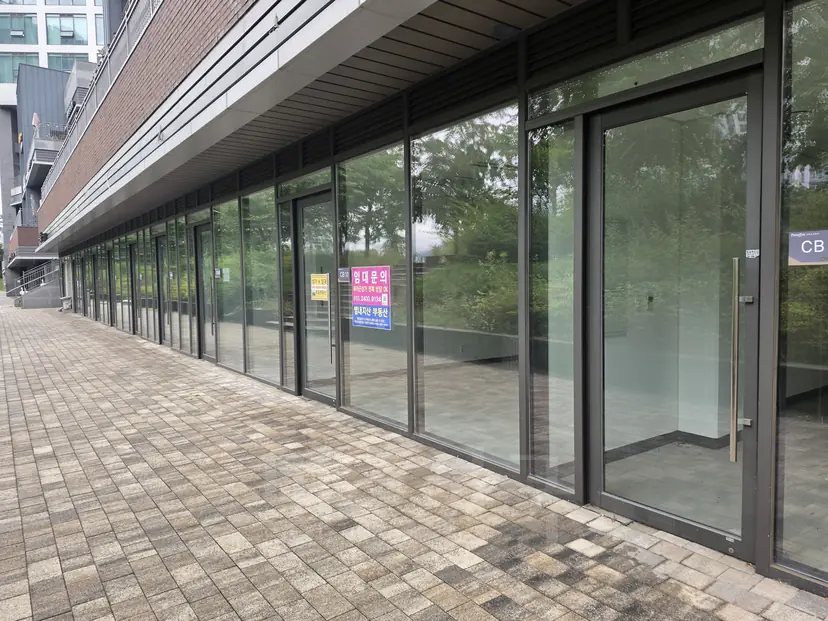
Mr. B, who runs a real estate agency at P Square, said, “There is almost no foot traffic here except for the employees, so businesses don't do well. There aren't many new tenants looking to move in, and as vacancies drag on, shop owners are lowering rents to find tenants.”
Although some owners are lowering rents as vacancies persist, it is not easy for knowledge industry center retail units and linked commercial facilities to adjust prices like factory or office spaces due to high initial sale prices. In fact, according to a real estate broker near a knowledge industry center in Byeollae-dong, while factory and office spaces with sale prices around 250 million won have monthly rents of 600,000 to 700,000 won, retail units with sale prices of 450 million won have monthly rents that are similar or only slightly higher. While owners need higher rents to make a profit, they are forced to accept lower rents to reduce vacancies.
Knowledge industry centers are collective buildings where companies in manufacturing, knowledge-based industries, and information technology sectors, along with support facilities, can be co-located. The rapid increase in the supply of these centers across the Seoul metropolitan area over the past few years has brought the vacancy issue to the forefront. While supply expanded in line with investment demand during the low-interest-rate era, subsequent high interest rates and the economic slowdown caused poor occupancy and vacancy issues in some regions.
Namyangju City has been expanding the list of eligible tenant industries to resolve vacancies. In April last year, the city expanded the list of eligible industries for knowledge industry centers from 513 to 577, adding businesses such as OEM manufacturing, smart farm vertical farms, shared kitchen operations, construction, and electrical, information/communication, and fire facility installation businesses. A city official stated, "The vacancy problem is gradually improving through efforts such as expanding the range of eligible industries."
In fact, as a result of checking the Dasan and Byeollae knowledge industry centers over two days on the 7th and 8th, the factory and office spaces were found to be mostly filled. Officials at nearby real estate agencies also explained that the occupancy rate is close to 90%.
Price drops due to long-term vacancies are also considered a background factor for the increased occupancy of factory and office spaces. Brokers in the Dasan and Byeollae areas explained that companies are moving in as the market price for factory and office spaces has fallen 20–25% below the original purchase price. A real estate broker remarked, "As vacancies lengthened, landlords desperate for any rent began offering lower prices, which triggered occupancy. It’s a situation where occupancy is gradually taking place as prices have come down."
On the other hand, ground-floor retail and linked commercial facilities showed a different trend from the office spaces. While corporate occupancy can increase in office spaces due to industry expansion and price adjustments, retail stores do not automatically fill up just because the number of tenant companies increases. Tenants need to generate monthly revenue to survive, and it is difficult to find new tenants in places with low foot traffic and weak consumer demand.
Experts analyze that even if the vacancy problem for factory and office spaces is resolved, it is difficult for the retail problem to be solved immediately. Shin Bo-yeon, a professor of Real Estate AI Convergence at Sejong University, mentioned that online consumption has increased since COVID-19 and demand for non-essential local retail has decreased. "Even if the number of employees in the building increases, it is hard to lead to consumption in those shops if they just work and then return to their residences or move to downtown areas," she said. She added, "Shops would only move in if the rent goes down, but considering the high initial sale prices, that does not seem easy."