

[비즈한국] TMAP Mobility has unveiled its new service, 'TMAP Short-form.' It is a service that allows users to watch short videos within the app, check information about a place, and immediately start navigation all at once. This combination is somewhat unfamiliar, as video content has been incorporated into a navigation app mainly used for searching locations and during driving. The company explains this as a pillar of its "Mobility Life Platform" strategy, which encompasses everything from searching for places to movement, recording, and sharing. They also plan to accumulate user experience data to connect it to future artificial intelligence (AI) recommendations and agent service competitiveness.
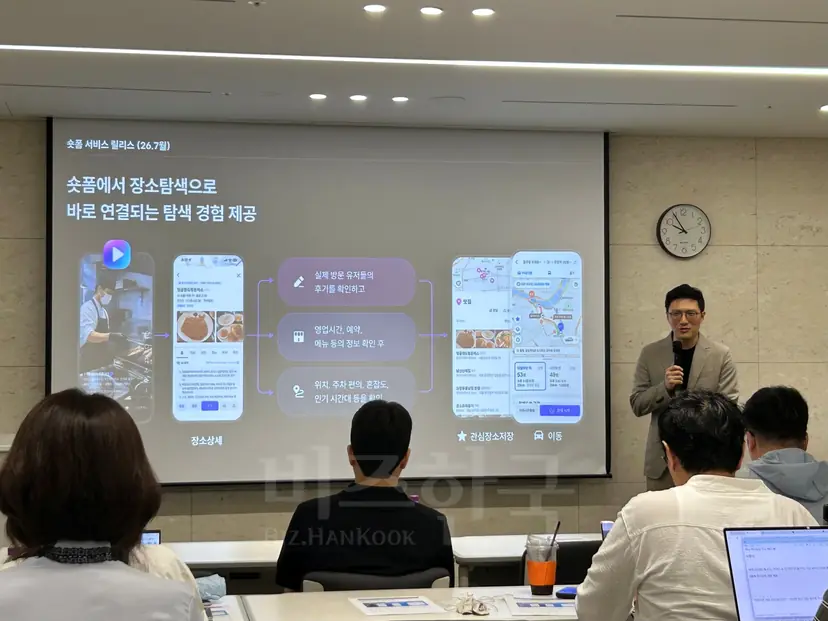
"Beyond Navigation": "Embracing pre-trip exploration"
Jeon Chang-geun, CPO of TMAP Mobility, said at a media conference held on the 9th, "TMAP intends to evolve beyond the perception of just a 'navigation' app into a platform that covers the entire journey," adding, "Under our 'Beyond TMAP' strategy, we will create an experience that connects movement, places, and content." The short-form service will be applied sequentially to the latest version of TMAP starting as early as the 13th.
The backdrop to TMAP’s adoption of short-form content is the belief that user behavior in searching for locations has changed. The intention is to streamline the user flow, where users previously had to open a separate map app to check operating hours, parking availability, or routes even after encountering location information on YouTube or Instagram.
TMAP Short-form is structured so that location information is immediately displayed at the bottom of the viewing screen. Videos featuring multiple locations are bundled in a list format, and up to 10 or more locations can be linked to a single video. While watching a video, users can move directly to the location's detail page to check reviews and menus, save it as a favorite, or start navigation.
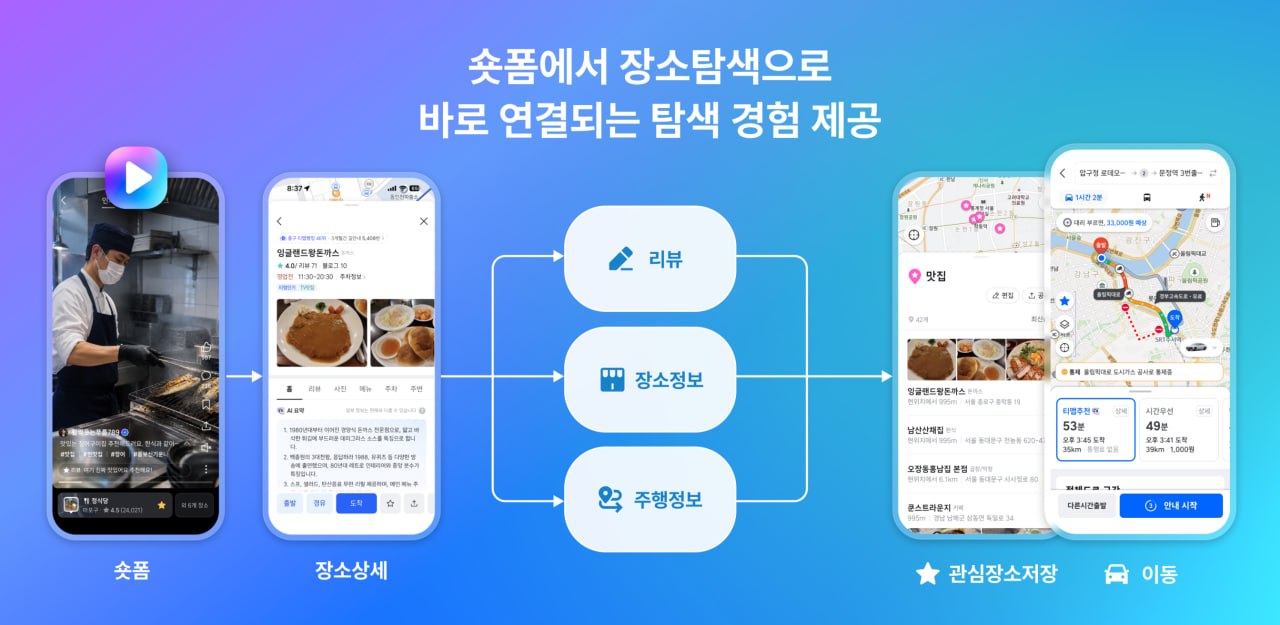
Short-form content consists of 'Places' like restaurants, cafes, and travel destinations; 'Driving' tips such as beginner driving advice, vehicle maintenance, and dashcam accident cases; and 'Life' content focusing on pop-up stores and lifestyle information. The videos are under 90 seconds long. The service is designed on the premise that it should be used at the stage of searching or exploring locations before driving, not during actual operation.
Park Yoon-ho, TMAP Mobility’s Intelligence Leader, explained, "We designed it so that users can utilize information while watching short-form videos and lead directly into movement in one step," adding, "The difference from existing short-form services is that it doesn't just end with content consumption, but actually connects to physical travel."
CPO Jeon said, "Places are high-involvement services," noting that "often, people don't just go somewhere because an AI recommends it, but instead choose after seeing the experiences of those who have actually been there." He added, "We will upgrade the service in a direction that allows users to understand why a place was recommended and accumulates not just movement data, but experience data as well."
Addressing concerns about the app becoming "heavy": "Usability stays the same as much as possible"
However, there are concerns about user fatigue regarding the attempt to graft short-form content onto a navigation app. As various services like messengers and shopping platforms have introduced short-form features one after another, there is no small amount of criticism that they are becoming more focused on content consumption than their original functions. In particular, some point out that given the nature of navigation apps, which are often used for long durations, issues like increased app size, overheating, or performance degradation could occur.
TMAP Mobility emphasized that they put the most effort into ensuring that the core usability of the navigation remains unaffected. They explained that the design ensures short-form content doesn't trap users at the forefront of the app, but rather connects naturally during the process of searching for and checking details about places, and that they conducted repeated user testing (UT) and A/B testing before the official launch.
CPO Jeon stated, "Navigation is a sensitive service where even a slight error in guidance leads to a high volume of voice-of-customer (VOC) feedback," adding, "We agonized over the structure until the very end to ensure it wouldn't interfere with existing navigation usability." He continued, "We optimized it by not loading all videos when the app starts, but only showing some thumbnails in advance or pre-loading only portions of the next video, and we secured stability by restricting functions on low-end devices."
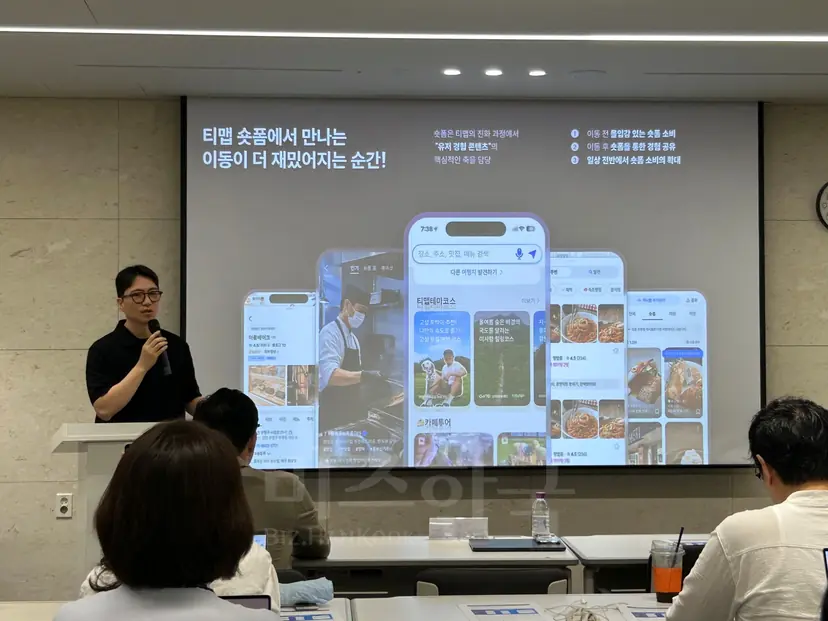
TMAP Short-form content is populated by both 'TMAP Certified Creators' and regular users. Even before the launch, the company met with regular users and creators who showed potential to share the service's direction and secure content. They explained that they prepared thousands of pieces of base content by the time of launch so that users would not feel a lack of content.
The company is in no rush to monetize. The stance is to prioritize the accumulation of user experience before reviewing ads and business models, rather than forcing an increase in promotional content. CPO Jeon stated, "Even if ads are included, we are considering ways to implement them in the form of content that is helpful to users, rather than simple advertisements."
Initially, they plan to provide rewards such as certification badges and home screen exposure to participating creators, and in the future, they plan to expand the content ecosystem by operating a creator fund.
What TMAP is particularly focusing on is the experience data accumulated through short-form videos. Following the recent launch of a travel log function, the company plans to sequentially expand social features such as open profiles, follow/following, and user-to-user Q&A.
Although they already possessed a vast amount of movement data, the expectation is that if user experience content such as short-form videos, reviews, and travel logs are also accumulated, the grounding data for AI recommendations will become much richer. Accordingly, the plan is to enhance the accuracy of personalized recommendations by accumulating various experience content, including travel records, reviews, and short-form videos, within a single service.
This will also connect to future AI services. TMAP plans to introduce a conversational place recommendation feature linked with SK Telecom's AI agent 'A.' (Adot) in the second half of this year, and in the long term, they plan to expand the service into a voice-based AI agent by linking it with the in-vehicle infotainment system 'TMAP Auto.'
CPO Jeon said, "Search-oriented usability will expand into agent-oriented usability in the future," adding, "Since it is difficult to differentiate based solely on information found on the web, content derived from actual movement and experience will become a competitive advantage."