

[비즈한국] Every summer, South Korea faces the fear of a large-scale blackout due to a shortage in power supply reserves. As the frequency and intensity of heatwaves increase due to the worsening climate crisis, demand for summer cooling, including air conditioning, spikes simultaneously. Until now, whenever such crises emerged, the government and power authorities have mainly relied on methods of increasing supply—such as building additional power generation facilities—or appealing to the public to save electricity in a piecemeal fashion.
However, an ‘Energy Vacation’ system, which suggests regulating power demand itself by extending collective summer vacations for workers, has recently emerged as a new climate-labor integration agenda. The concept involves extending vacation schedules for large factories that consume significant amounts of electricity to reduce power usage, while simultaneously guaranteeing the health rights of workers against extreme heatwaves. It is regarded as an alternative that combines greenhouse gas reduction, power grid stability, and the right of workers to rest.
The Effectiveness of ‘Energy Vacation’ Proven by Data
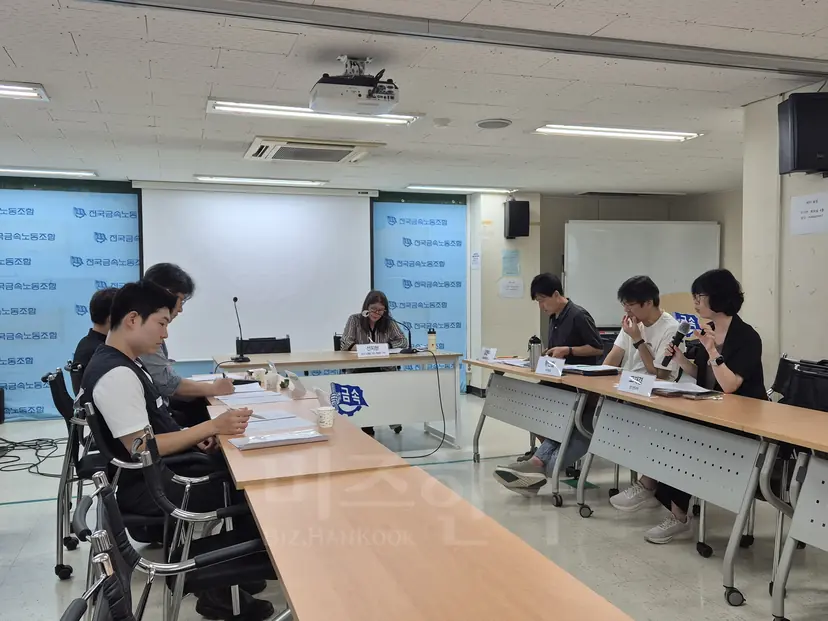
At the Energy Vacation System Seminar held by the Korean Metal Workers' Union and the Korea Federation for Environmental Movements on July 8 at the Metal Workers' Union conference room in Jung-gu, Seoul, the effectiveness of the energy vacation was demonstrated through data. It is easy to assume that power supply and demand reach their limits during the first week of August, when temperatures are typically at their highest, but a paradoxical pattern actually showed that power supply reserves were noticeably more ample during this time. This is because major domestic manufacturing companies enter their summer vacations intensively during this period, causing factory operating rates to plummet.
In South Korea, the share of power consumed for industrial purposes, such as factories, is close to half of the total, with large manufacturing industries like automotive and shipbuilding accounting for a significant portion. Therefore, when large business sites with massive power consumption shut down and take breaks all at once, it leads to a noticeable reduction in national power demand.
The power demand graphs for late July and mid-August of 2018, which recorded historic heat, clearly demonstrate this effect. At the end of July, despite heatwaves nearing 40 degrees, power supply reserves were more ample compared to the previous week. Conversely, on August 13, after Hyundai Heavy Industries returned from vacation, the temperature dropped, but reserve power fell below 10%. This shows the impact of large-scale industrial power load shedding caused by collective vacations.
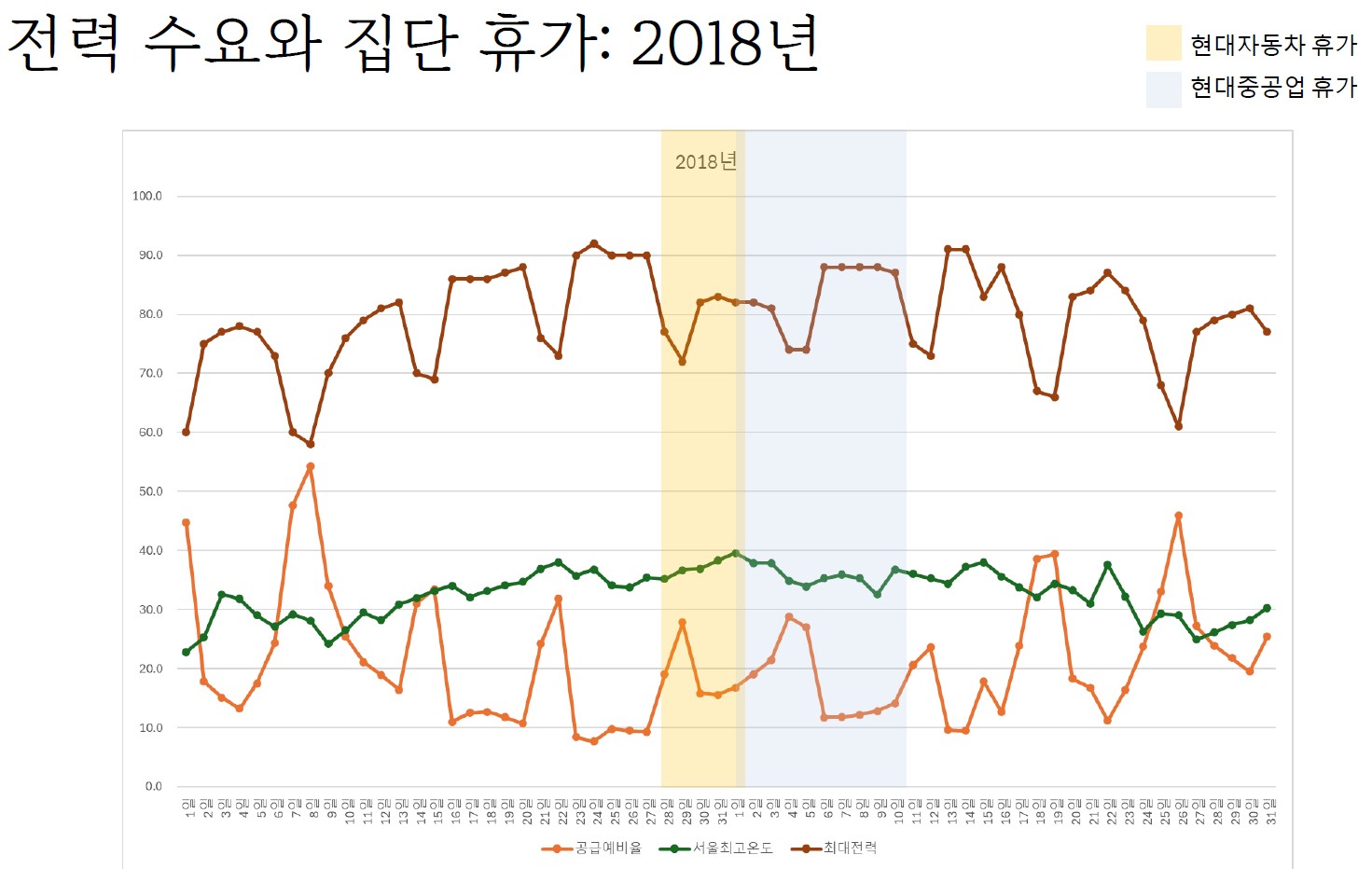
Kim Hyun-woo, Director of the Degrowth and Alternatives Research Institute, estimated that by having these large business sites and their associated subcontractors take simultaneous vacations, an additional power reserve of approximately 5GW was secured during peak hours. This is equivalent to the power generation capacity of several nuclear power plants, meaning the government could achieve power grid stability and greenhouse gas reduction simply by coordinating vacation schedules without increasing power facilities.
Director Kim explained, "Data already shows that collective vacations by large manufacturers contribute significantly to stabilizing the power grid," and added, "From a corporate perspective, there is also the advantage of being able to earn vacation settlement money through the Demand Response (DR) system."
Discussions and practices regarding similar forms of climate leave are also taking shape overseas. The Taiwanese government is pushing for the legislation of a ‘High-Temperature Leave System,’ benchmarking the leave system previously implemented during typhoons, to reduce total power consumption and protect workers in the event of extreme high-temperature phenomena. In the UK, the Trades Union Congress (TUC) and environmental groups have also collaborated to campaign for a ‘Heat Strike’ to protect workers amid heatwaves, demanding a climate leave system.
Agreement in Principle… Addressing ‘Polarization of Rest’ and Wage Issues
However, there are non-negligible practical issues and challenges to fully implementing the energy vacation system in the field. According to a survey of Korean Metal Workers' Union delegates conducted by the Energy & Climate Policy Institute, over 80% of respondents deeply sympathized with the necessity of introducing an energy vacation system. In addition to the macro-level justification of reducing carbon emissions, workers expressed high expectations for the intuitive benefits of securing personal and family leisure time to improve their quality of life. However, practical concerns that hinder the actual settlement of the system were also raised.
The biggest cause for anxiety is the ‘polarization of rest’ between large corporations and small, low-tier subcontractors. It is pointed out that while large corporate sites with organization and financial capacity find it relatively easy to expand vacations or adjust operations, workers at small subcontractor sites with poor business conditions and weak bargaining power could be excluded from the system, potentially widening the gap.
Another issue is the unique wage system and job insecurity in manufacturing sites. In the Korean manufacturing sector, base salaries are relatively low, and compensation is centered on overtime and special shift allowances, so a reduction in working hours leads directly to a decrease in total pay. In a situation where many workers choose to give up vacations and take on special shifts to preserve their income, expanding vacations without wage compensation measures could provoke resistance in the field.
At the seminar, Lee Sang-seop, Vice President of the Pohang branch of the Metal Workers' Union, stated, "As automation, electrification, and digitalization proceed, workers fear that their positions might be replaced or filled by unstable labor while they are away," adding, "For the system to make substantial progress, it must be accompanied by social discussion and consensus, or political and institutional pressure, beyond just labor-management negotiations."
Therefore, voices are calling for the energy vacation system to be accompanied by detailed structural policy designs from the government and society, beyond a simple labor-management agreement to increase vacations. Experts emphasize that the government should provide support to small and medium-sized enterprises and develop social solidarity collective agreement models that allow prime contractors and subcontractors to cease operations together and rest safely. For industries where 24-hour continuous processes are inevitable, such as semiconductor or petrochemical plants, and where it is difficult to take breaks simultaneously, customized designs per industry—such as concentrating regular maintenance schedules during summer peak power periods and adjusting operations sequentially—are also required.
Yeo Hyeong-beom, a senior researcher at the Chungnam Institute, stated, "If the energy vacation system is presented only as a contribution to power demand management, it may be difficult to secure worker participation motivation and social legitimacy," and added, "We need the imagination to expand it into a ‘Worker Climate Week,’ where various activities linked to workplace greening and local community climate actions are intensively planned and implemented during the vacation period."