

[비즈한국] The government has officially announced its "3 Major Mega Projects," aiming to overcome the trend of declining potential growth rates and secure future growth engines. However, regarding the plan to construct massive artificial intelligence data centers, which serve as a core pillar of the infrastructure, concerns are being raised about whether the government is providing excessive amounts of resources, such as water and electricity, to global Big Tech firms.
In particular, while advanced nations like the United States are increasingly putting the brakes on data center construction due to environmental destruction and excessive resource consumption, critics argue that South Korea's aggressive policy to attract these facilities goes against the global trend.
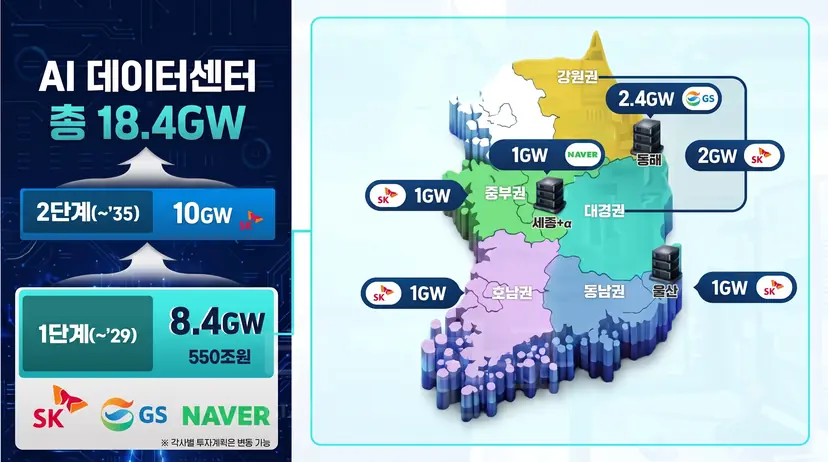
According to the government's press release, South Korea plans to build 8.4GW of ultra-large AI data centers by 2029 as the first phase. It plans to add another 10GW by 2035, eventually expanding the infrastructure to a total of 18.4GW.
By company, it was announced that in the first phase, SK will push for the construction of a 1GW center in Ulsan, GS a 2.4GW center in Donghae, Gangwon, and Naver a 1GW center in Sejong. In the second phase, SK is expected to take a leading role while reviewing additional sites by region. The data center industry welcomes the government's policy stance, which recognizes the importance of data centers and promises maximum support.
A breakdown of the power metrics provided by the government reveals just how massive this expansion plan is. Currently, the total power capacity of all data centers operating across South Korea barely reaches the 2GW level. Even Naver’s "Gak Sejong" data center, which is considered the largest single facility in the country, currently has a capacity of 47MW. In effect, the government has declared that it will build new infrastructure more than four times the capacity of all data centers currently operating nationwide within a span of just over three years by 2029.
Lack of Domestic Services, Fears of Becoming a Rental Base for Big Tech
Does South Korea actually have a demand for such massive AI data centers? Experts point out that most major AI services used by domestic citizens and businesses are already supplied by US-based global Big Tech firms. Furthermore, companies like SK and GS, which are leading this mega project, are not companies that deploy their own large-scale AI services to the public. The analysis suggests that the data centers they intend to build are likely to become rental-style bases that lease space and power rather than facilities to meet their own internal demand.
In fact, the 100MW data center currently being pushed by SK in the Ulsan Mipo Industrial Complex is a project conducted in conjunction with Amazon Web Services (AWS) of the United States. Climate, Energy and Environment Minister Kim Sung-hwan also appeared on MBC’s "Focus" and fueled such observations by stating, "Companies in the US that want to urgently build AI data centers are coming to Korea because they cannot get power supply," adding, "Many US companies are inquiring, saying they will come if power is available in Korea."
US Avoidance vs. Korea’s Aggressive Attraction
This aggressive stance on attraction is criticized for running counter to the recent growing opposition to data center construction in the United States. In the US, as data centers have increased explosively due to the development of AI technology, local governments and residents concerned about resource depletion are conducting strong anti-construction campaigns. There have also been successive cases of state governments declaring a moratorium on data center construction.
According to a public opinion poll conducted by Gallup among US adults, 71% of Americans responded that they opposed the entry of AI data centers into their residential areas. In particular, 50% of those opposed pointed to the excessive resource consumption of data centers, citing massive electricity usage and the depletion of water resources for cooling as the biggest causes for concern.
In Korea, too, such large-scale attraction is highly likely to cause power and water shortages. Since building nuclear power plants takes over 10 years, there are concerns that this will ultimately provide justification for increasing the utilization rate of carbon-emitting fossil fuel power plants to supply gigawatt (GW)-level power in the short term.
Kim Byung-kwon, director of the Green Transition Institute, pointed out, "The construction of 8.4GW of data centers within 3 years proposed in the 3 Major Mega Projects is a sudden plan made without consideration for power and water usage, and it was not even reflected in the 12th Basic Plan for Electricity Supply and Demand discussed until last May." He added, "It is worth questioning whether we should provide low electricity rates, land, and water supply for data centers that will be used by overseas Big Tech firms, without directly helping Korea's AI development."
As such, questions are also being raised about the perspective of domestic politicians and local governments that see the attraction of data centers as a measure to revitalize the local economy. Because data centers are structured to operate 24 hours a day around server machinery, they belong to an industry with low job creation effects required for constant operation. The tax revenue effect that contributes to local finance is also negligible.
As a result of an administrative investigation conducted by the Goyang City Council on three data centers operating within its jurisdiction, the total annual tax contribution they pay to the local government amounted to only about 770 million won. This is why there is criticism that while residents have to endure noise, heat island phenomena, and conflicts over power line construction, the actual contribution to the local economy is low.
Defenses for ‘National Strategic Perspective’ Amidst Low Employment Contribution Controversy
On the other hand, there are strong counterarguments that the attraction of AI data centers is an inevitable choice for synergy with the Korean semiconductor industry and for the advancement of the AI technology ecosystem. The government evaluated that AI data centers have a strong connection to the semiconductor industry.
Minister Kim Sung-hwan stated after the "World Plastic Bag-Free Day" event held in Yeongdeungpo-gu, Seoul, on the 3rd, "If you look only at the issue of job creation for AI data centers, one might feel that we shouldn't necessarily attract them because machines are moving and not many people are employed." However, he emphasized, "AI data centers are core infrastructure that act as the brains of the massive artificial intelligence era, and Korea's semiconductor chips go into those brains."
He continued, "It is not a matter of giving up because we sell semiconductor chips as export products and data centers have low job creation," adding, "It is correct to see semiconductor chips and AI data centers as essentially one body, and we must judge while looking at how to supply water and electricity well to face the era of the AI revolution."
Furthermore, there is a perspective that attracting AI data centers goes beyond simply hosting buildings and servers, and can contribute to the advancement of the front-end and back-end industrial ecosystem and exports. The logic is that building large-scale AI data centers domestically will lead to the growth of not only IT technologies such as servers, networks, and storage, but also advanced power and cooling solution equipment technologies. There is also a rebuttal that by placing data centers within Korean territory, we can secure control and preempt the physical environment for citizens and companies to research and develop AI.
Experts say that establishing "Green Data Center Principles" that can ensure climate crisis response and resident acceptance is important in the process of expanding AI infrastructure in the future. Lee Heon-seok, a policy committee member of Energy Justice Actions, pointed out, "Major European countries such as Germany have already established strict standards requiring data centers to be supplied with 100% renewable energy starting in 2027." He added, "Korea also needs to move away from the simple 'handout' style of attracting power and urgently establish institutional guidelines such as mandatory use of renewable energy, energy efficiency regulations, and environmental impact assessment and resident consent procedures to prevent national resource depletion and grid chaos."