

[비즈한국] "We came as a group, but it was inconvenient because we had to buy tickets one by one."
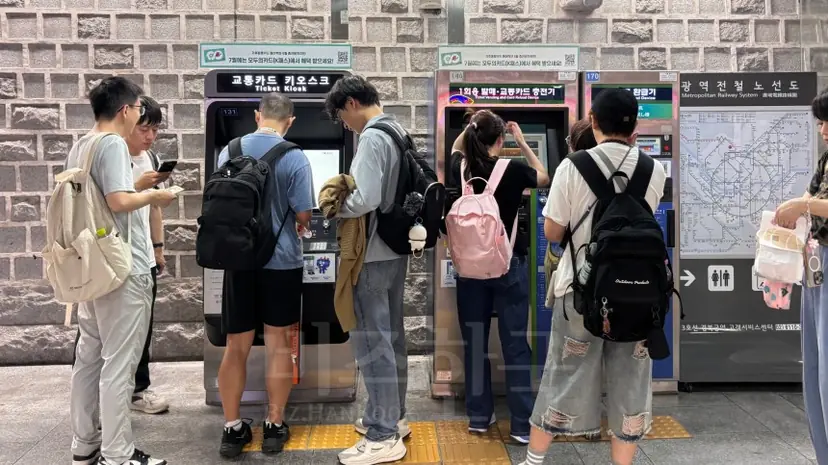
On the 6th, in front of the ticket gates at Gyeongbokgung Station on Seoul Subway Line 3. A tourist from Taiwan in their 20s, surnamed A, who was visiting Korea with friends, pressed the screen of a transportation card kiosk several times. After discussing payment methods with their group while pointing at the screen, A inserted an internationally issued card, but after an error appeared, they returned to the home screen. They then switched to a contactless payment method and tried the purchase again. Once the payment for one person was finished, the next member of the group repeated the same process. It took about 7 minutes for A's entire group to purchase their cards that day.
Confusing card types and ticket machines: "Which one should I buy?"
Although the number of foreign tourists visiting Korea in the first half of the year exceeded 10 million, reaching an all-time high, the inconveniences they face while using the subway remain. Credit cards issued overseas cannot be used directly at ticket gates, and the kiosks vary depending on the type of ticket. In particular, for the Climate Card, users must repeat the selection and payment process for each card, which inevitably lengthens the ticketing time for group tourists.
On the same day, a group of Indonesian tourists wearing backpacks also hesitated for a while near the ticket gates at Gwanghwamun Station on Seoul Subway Line 5. They looked around and asked a passing citizen where the ticket vending machines were. After being guided by the citizen to the machine, they gathered in front of the screen to check their destination and payment methods before purchasing single-use tickets.
A man in his 40s, surnamed B, said, "I don't know what a Climate Card is," adding, "I saw the ticket menu, searched for where I wanted to go, and bought a ticket." His companion added, "There are so many types of transportation cards that it's hard to know right away which one to buy. I wish we could just use our overseas cards to take the subway."
There are three main ways for foreign tourists to buy public transportation tickets in Korea: buying a prepaid transportation card like T-money at a convenience store, buying single-use tickets each time they ride the subway, or purchasing a Climate Card. However, single-use tickets must be bought at subway station kiosks by selecting a destination, and prepaid cards like T-money must be purchased at convenience stores or retail outlets and then separately topped up with cash. There is a short-term Climate Card for foreigners visiting Seoul, but this also requires purchasing a physical card and topping it up.
Climate Cards must be purchased and topped up individually
Since last March, the Seoul Metropolitan Government has been installing new transportation card kiosks at stations on Seoul Subway Lines 1–8 that support payments with credit and debit cards issued overseas. In the month immediately following their installation, the machines were used by an average of 9,000 passengers per day.
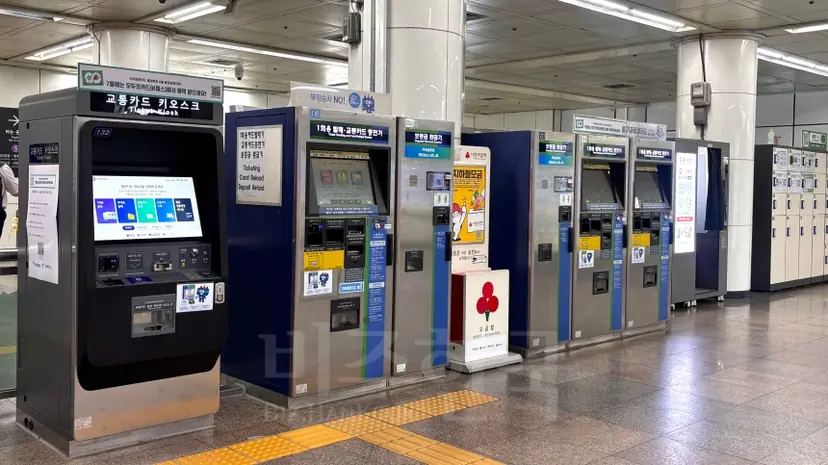
Indeed, a tour of Seoul Station, Gangnam Station, Gwanghwamun Station, Gyeongbokgung Station, and Yeouinaru Station—all of which have high volumes of foreign passengers—revealed that one new kiosk capable of handling international card payments was installed at each station. However, because older machines with different functions and payment methods were also located nearby, it did not appear easy for foreign tourists to quickly identify the machine that suited their needs.
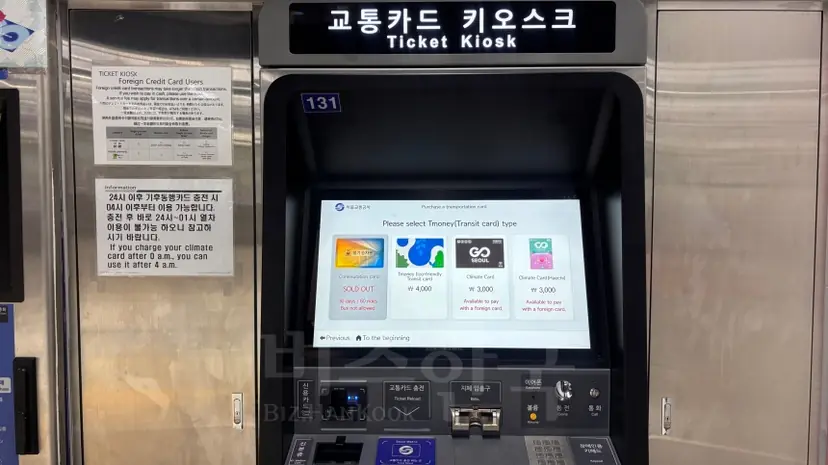
The screen of the newly installed kiosks displays options such as: single-use ticket issuance, preferential ticket issuance, transportation card top-up, and transportation card purchase. When selecting "transportation card purchase," users can choose between a regular pass, a T-money card, and a Climate Card. While international card payments are supported for the Climate Card, this purchase is not possible on the older machines.
Users must first select the desired product, set the destination or usage period, and then proceed to the payment step. While multiple single-use tickets can be purchased at once, the Climate Card requires the purchase and payment process to be completed for each card individually. For groups traveling together, this means repeating the process for every single person.
Overseas, you just tap 'your own card'... Open-loop service to be introduced gradually
Major cities overseas have already adopted EMV contactless-based open-loop systems for public transportation. "Open-loop" refers to a method where users pay for fares by tapping their credit card or smartphone at the gate without needing a separate transportation card or ticket. EMV is a near-field communication (NFC) payment standard created by companies like Visa, Mastercard, and Europay.
In contrast, foreign tourists cannot pass through subway ticket gates in Korea using cards issued abroad, as the "RF chip" that functions as a local transportation card is only embedded in cards used by domestic residents. Even if a card has a Visa or Mastercard logo, it cannot be used for public transportation in Korea.
To reduce confusion for foreign tourists, the Seoul Metropolitan Government will gradually introduce an open-loop transportation payment system by 2030. However, the service will not be available immediately upon the completion of terminal replacements. Because Seoul's public transportation is tied to the metropolitan integrated transfer system with Gyeonggi-do and Incheon, discussions with the central government, Gyeonggi Provincial Office, Incheon City, and KORAIL are required to actually launch the open-loop service.
An official from the Seoul Metropolitan Government's Transportation Policy Division stated, "We are building the infrastructure, such as terminals and servers, according to our existing roadmap," and added, "We plan to replace terminals on Subway Lines 1–8 with those capable of open-loop payments by December of next year, in line with the durability period of existing equipment." They continued, "If only Seoul starts the service first, it could actually cause more confusion for foreign users, so it can only be implemented if the metropolitan transportation agencies move in sync."