

[비즈한국] The Seoul residential real estate market has once again sent a clear signal. A cautious attitude among buyers persists across the market. Price burdens remain high, and the pressure from loan regulations and financing costs is significant. However, strong buying interest is still being confirmed for properties that combine prime locations, the appeal of new construction, and scarcity.
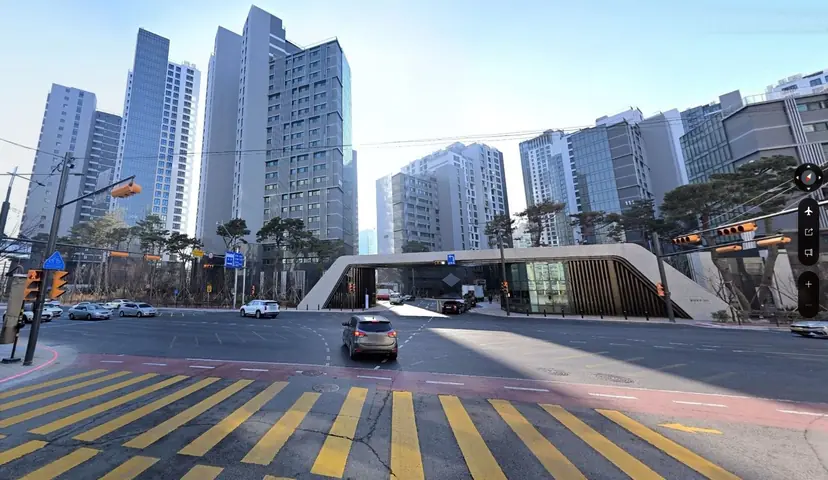
According to the Seoul Real Estate Information Plaza, the highest transaction price for a residential property in Seoul between June 29 and July 3 came from Jamsil Raemian I-Park in Sincheon-dong, Songpa-gu. A 30th-floor unit with an exclusive area of 84.96㎡ was sold for 4.32 billion won, ranking first in weekly transactions.
The reason this transaction stands out is not just the high price. Jamsil Raemian I-Park is a large complex being built through the reconstruction of Jamsil Jinju Apartment, a complex where demand for new apartments in the Jamsil area has been concentrated. Coupled with the conditions of an 84㎡ unit, a high floor, and a prime location, strong demand was confirmed regardless of the overall market wait-and-see stance. This transaction demonstrates that even for the same 84㎡ unit, price standards can vary significantly based on location, floor, and the future value of the complex.
Second place went to Maple Jai in Jamwon-dong, Seocho-gu. A 23rd-floor unit with an exclusive area of 84.253㎡ was sold for 3.3 billion won. Maple Jai is a new complex supplied through large-scale reconstruction projects in the Jamwon-dong area, showing a trend where the new-construction premium is reflected in prices ahead of full-scale move-ins. Jamwon-dong is particularly popular for large new complexes because it borders the luxury residential axis connecting Banpo, Apgujeong, and Hannam. This transaction shows that a "new apartment" remains a powerful price-determining factor in the Gangnam area.
Third place was not an apartment but an officetel. A 12th-floor unit with an exclusive area of 154.44㎡ at Yeouido the# Island Park in Yeouido-dong, Yeongdeungpo-gu, was sold for 2.95 billion won. This can be interpreted as a result of the combination of a location near the Yeouido central business district, large square footage, and demand for luxury housing. Yeouido is a region where demand for proximity to work and residential demand near the Han River and parks function simultaneously. Even if it is not an apartment, it is a notable case among the top transactions this week in that high-priced deals are possible if supported by location and product quality.
Fourth place was a house in Seongbuk-dong, Seongbuk-gu. A property with an exclusive area of 66.45㎡ was sold for 2.5 billion won. Seongbuk-dong is a traditional luxury residential area with a different buyer base than the apartment market. While the area itself is not large, the scarcity of the location, the residential environment, and the land value can be seen as having been reflected in the price. The fact that not only apartments but also officetels and houses were named in the top tier this week shows that the demand for high-end housing in Seoul is not limited to a specific product group.
Fifth place was Dansan Central I-Park in Dangsan-dong 5-ga, Yeongdeungpo-gu. A 17th-floor unit with an exclusive area of 84.98㎡ was sold for 2.435 billion won. While Dangsan is not in the Gangnam area, it has good accessibility to Yeouido, Mapo, and Mok-dong, and is equipped with both a Han River living environment and a subway network. One of the notable trends in the recent Seoul market is that mid-2 billion won transactions are naturally appearing in residential preference areas outside of the three Gangnam districts. The transaction at Dansan Central I-Park illustrates this trend well.
Following this, a 106.829㎡ unit at Doosan We've 2-danji in Nonhyeon-dong, Gangnam-gu, was sold for 2.42 billion won. An 84.97㎡ unit at e-Pyeonhansesang Sangdo Nobility in Sangdo-dong, Dongjak-gu, was sold for 2.27 billion won, and a 59.99㎡ unit at Gongdeok Jai in Ahyeon-dong, Mapo-gu, was sold for 2.25 billion won. An 84.69㎡ unit at Garak Ssangyong Apartment in Garak-dong, Songpa-gu, was sold for 2.19 billion won, and an 84.993㎡ unit at Doosan We've 1-danji in Nonhyeon-dong, Gangnam-gu, was sold for 2.12 billion won.
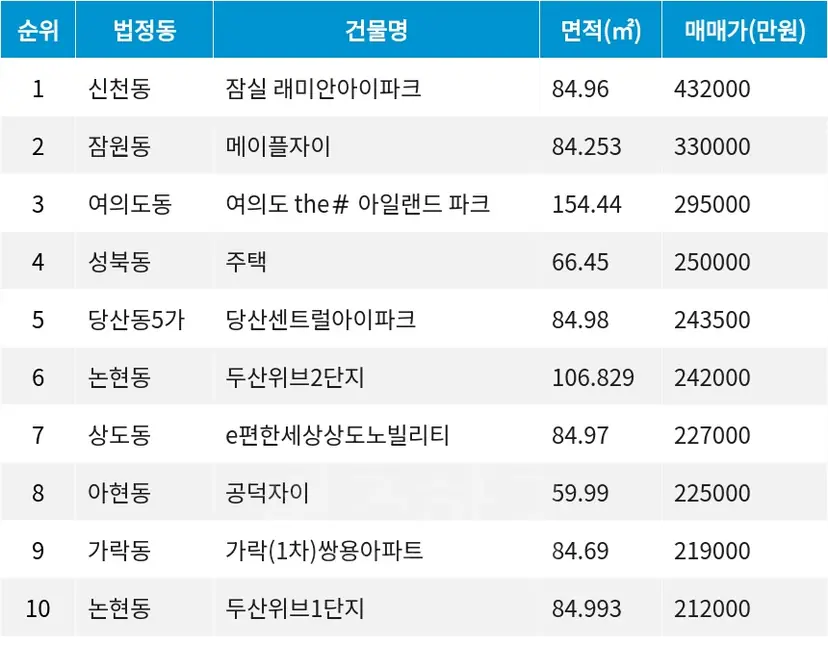
When this week's transactions are converted into price per pyeong, the temperature difference in the market becomes even clearer. Jamsil Raemian I-Park, which recorded the highest weekly price, was traded at approximately 168.09 million won per pyeong. Compared to the average Seoul apartment sale price of 59.259 million won per pyeong last December announced by KB Real Estate, this is nearly triple the level. Jamwon-dong's Maple Jai also significantly exceeded the Seoul average at approximately 129.48 million won per pyeong. On the other hand, Yeouido the# Island Park was recorded at approximately 63.14 million won per pyeong, showing a different price structure than the new Jamsil and Jamwon apartments, despite being in the top tier in terms of total price.
The common thread among the top 10 transactions is clear. It is difficult to explain this trend simply by saying "Seoul house prices have risen." Rather, the current market has become more discerning. Buyers are not choosing just any property. Instead, they are selectively investing capital into properties that are new, scarce, or have expectations of future value appreciation in verified areas such as Jamsil, Jamwon, Yeouido, Dangsan, and Ahyeon.
This also aligns with the recent wait-and-see stance in the real estate market. In a phase where loan capacity is limited and financing burdens are increasing, buying interest for mid-to-low priced properties or less preferred locations is easily weakened. Conversely, buyers with cash-generating ability are moving to assets that are judged to have a low possibility of price correction and high long-term holding value. This is the background for the renewed preference for the so-called "one smart house."
A point to note in this week's transactions is that high-priced deals cannot be explained solely by a Gangnam-run. The highest price came from Jamsil, Songpa, and the second place was Jamwon, Seocho. However, the Yeouido officetel, Seongbuk-dong house, new-class Dangsan complex, and popular residential complexes in Sangdo and Ahyeon were also included in the top tier. While the center of gravity for Seoul's high-end residential market remains in the Gangnam area, the range of high-priced transactions is expanding to areas that combine proximity to work, convenience, transportation networks, and a preference for new construction.
However, it is difficult to interpret this trend as an upward trend across all of Seoul. This week's top transactions are closer to examples showing where buyers with capital are concentrating rather than the average atmosphere of the entire market. In a situation where transaction volume has not fully recovered, it is difficult to conclude the direction of the overall market based only on a few high-priced transactions. Nevertheless, it is clear that quality properties in prime locations are maintaining price defensiveness amidst policy variables and a wait-and-see stance.
Ultimately, the message of the Seoul real estate market for the first week of July 2026 is simple. The market is quiet, but good properties are being sold quietly. Even while loan regulations and price burdens are suppressing buyer sentiment, record-high level transactions are continuing in prime locations like Jamsil, Jamwon, and Yeouido. The Seoul housing market no longer moves in one direction. A "selective market" where price gaps widen based on location, product quality, and scarcity is becoming more pronounced.
※ This article was written together by Bizhankook and MetaVX's generative AI.