

[비즈한국] There are only two types of people in the South Korean asset market today: those who study and those who do not. The second half of 2026 will determine the fate of these two groups. This is not an exaggeration. I will present the reasons for this one by one starting now.
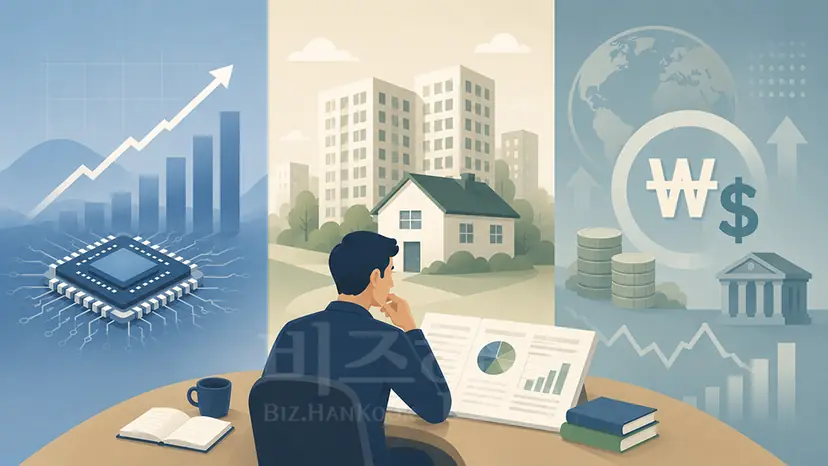
Three foundations are shaking at the same time
Let's look back. In the first half of this year, South Korea's asset market went through three tectonic shifts at once.
First, the stock market. Driven by semiconductors, the KOSPI experienced an unprecedented bull market, surging over 28% in just one month and climbing into the world's top five by market capitalization. This has never happened in the history of the South Korean stock market. However, there is a shadow behind the celebration. Analysts have begun to suggest that the peak of the semiconductor profit cycle could form around this coming August. This isn't just talk from a seminar, but analysis from securities firm research departments. It is not about whether profits are growing, but whether the pace of that growth is slowing. Investors who can read this subtle inflection point versus those who cannot will see completely different numbers in their accounts by the end of the year.
Second, real estate. On July 1, Dongtan, Giheung, and Guri were simultaneously designated as regulated areas. However, history of regulation proves one truth: regulations cannot eliminate demand. They only displace it. The data already speaks for itself. In the previous regulatory phase, transactions in regulated areas plummeted by 76%, but transactions in non-regulated areas actually increased by 22%. It is a game of whack-a-mole. If you hit one spot, another pops up. The question is where the next mole will pop up. Those who know seize the opportunity, while those who don't watch the news, chase after it late, and end up buying at the top.
Third, the macroeconomic environment. The won-dollar exchange rate is hovering around the 1,550 won mark. The belief that "interest rates will go down soon," which dominated the market throughout the first half of the year, crumbled in the face of the Bank of Korea's hawkish shift. There are even forecasts that the Bank of Korea may raise rates in the second half. The US is holding steady, while Korea is considering a hike—a combination that would have been unimaginable just half a year ago. A phase where the correct answer from the first half becomes the wrong answer in the second. This is where we stand today.
The real danger is the inability to see the 'connections'
There is something more important than the fact that these three foundations are shaking: the fact that they are interconnected.
Follow the path. The exchange rate rises. The Bank of Korea contemplates interest rates. When rates rise, loans tighten. When loans tighten, sales are blocked. Demand blocked from buying shifts to the *jeonse* (long-term deposit rental) market. When *jeonse* demand surges, *jeonse* prices rise. Rising *jeonse* prices support sales prices from below. That is why home prices do not easily fall despite regulations. Meanwhile, liquidity that has lost its place in real estate flows into the stock market, which is at an all-time high. The fate of that stock market depends on US monetary policy and exchange rates again. And if the exchange rate rises, this cycle begins all over again.
The asset market is already a circulatory system. Yet, our study remains trapped in silos. People who trade stocks only look at charts. People who want to buy houses only look at regulations. People who bought dollars only look at exchange rates. It is impossible for judgments made while looking at only one facet of a circulatory system to be sound. It is the same principle as not being able to entrust your whole body to a doctor who only knows about the heart.
Someone buying a house without knowing why *jeonse* prices are rising, someone buying semiconductor stocks without knowing why the exchange rate is at 1,550 won, someone selling dollars without knowing why the Bank of Korea turned hawkish—all of these people have one thing in common: they have not learned the grammar of the market where their own money is at stake. The market in the second half of the year will surely send a bill for this negligence.
The supply cliff is a predicted future
In real estate, the second hand of a time bomb is already ticking. The number of apartment move-ins in Seoul this year is about 9,600 units. This is a quarter of last year's 37,000 units. And starting in 2027, new move-ins in Seoul will fall to less than half of the past average. Even if you decide on reconstruction or redevelopment today, it takes 10 years until move-in. Supply does not lie. The lack of new apartments does not just mean a lack of items for sale. It means a lack of *jeonse* units as well. When *jeonse* becomes scarce, *jeonse* prices rise, and *jeonse* prices create a floor for sales prices. This is not a forecast; it is basic arithmetic.
Those who understand this arithmetic are not swayed by regulatory news. They know that regulations only buy time and cannot change supply and demand. On the other hand, those who do not understand this arithmetic suffer from daily motion sickness between headlines saying "house prices are being contained" and "prices are still rising." It is as if one person is holding a map while the other has their eyes closed while looking at the same market.
The purpose of study is not prediction, but survival
Some might retort: what is the point of studying if even experts get it wrong? That is only half true. The purpose of study is not to guess the future. It is to prepare scenarios.
What will you do if interest rates rise? Where will you look if regulations expand to neighboring areas? What will you sell if the semiconductor profit growth rate peaks in August? How will you move if the exchange rate breaks 1,600 won versus if it drops back to the 1,400 won range? People with scenarios do not panic regardless of which direction the market goes. Only those without scenarios are surprised by the news, sell out of fear, buy out of greed, and lose sleep at night. The regrets over numerous transactions in the first half came not from a lack of knowledge, but from a lack of scenarios.
And you cannot create scenarios alone. The eye that reads the stock cycle, the eye that reads real estate supply and demand, the eye that reads the macroeconomic current—only by overlapping these three lenses does the picture for the second half become clear. This is why you must learn across all three fields, one by one, from masters in each.
We live in a strange era. We spend millions of won a month on English and math for our children, yet as adults, we are stingy with the cost of a few cups of coffee to learn the grammar of the market where our entire life savings are at stake. In an era where it has become common knowledge that you cannot plan for retirement solely on earned income, financial literacy is not an elective, but a survival subject.
Fortunately, the door to learning is open. There are lectures and seminars everywhere where experts at the forefront of each field stand before the public, and there are even opportunities to gain a holistic view of stocks, real estate, and macroeconomics in one sitting if you invest just one day. In an era where the cost of a single misjudgment is in the tens of millions or hundreds of millions of won, there is no calculation more uneconomical than weighing a few tens of thousands of won in tuition.
The first half has already become history. The second half is still a blank slate. The August semiconductor inflection point, the balloon effect after regulations, the Bank of Korea's interest rate decisions—the schedule for these major exam questions has already been released. What do we call a student who knows the exam date but does not study?
Only the studying investor survives. Now is the time to sit at your desk and in the lecture hall.
※ Kim Hak-ryeol, the head of the Smart Tube Real Estate Research Institute, famous by the pen name "Pashong," served as the team leader of the Real Estate Research Division at Gallup Korea. He operates and hosts the Naver blog "Pashong's World Exploration" and the YouTube channel "Stew TV." His books include "3040 Beginner's First Real Estate Investment (2026)," "Rewriting the South Korea Real Estate Manual (2025)," "The Power of Gyeonggi Real Estate (2024)," "Absolute Principles of Seoul Real Estate (2023)," "The Future of Incheon Real Estate (2022)," "Kim Hak-ryeol's Absolute Principles of Real Estate Investment (2022)," "South Korea Real Estate Future Map (2021)," and "From Now On, Only Places That Rise Will Rise (2020)."