

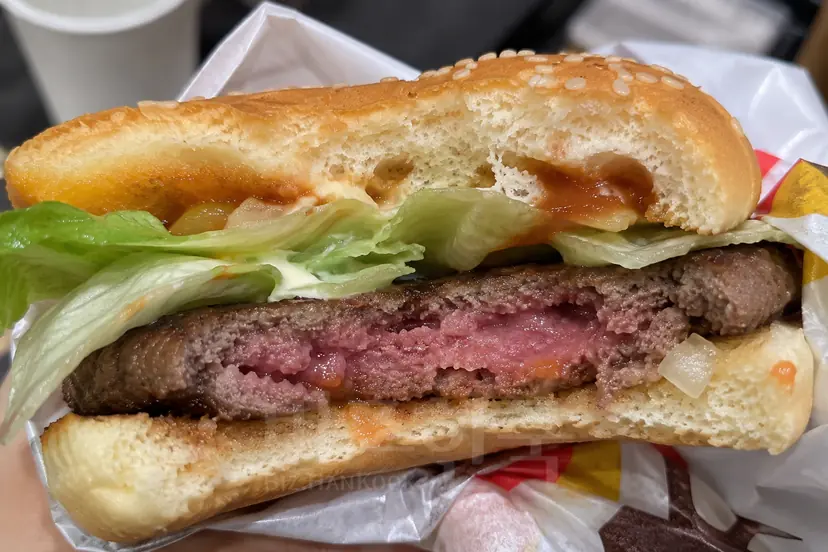
[비즈한국] A hamburger patty that looks half-eaten. At a glance, it appears to be undercooked due to poor preparation, but it is actually an image created using generative AI. Recently, anxiety among self-employed business owners has been growing as cases of customers demanding refunds based on AI-manipulated food photos are being reported on online delivery platforms.
According to the National Statistical Portal of the National Data Agency on the 3rd, the transaction volume of online food services increased from 17.3371 trillion won in 2020 to 41.5889 trillion won last year. As non-face-to-face food consumption, which surged following the COVID-19 pandemic, has become a part of daily life, the transaction volume of delivery platforms is breaking records every year.
As the market grows, a new term called 'delivery beggar' has emerged. It refers to malicious consumers who make false complaints by picking flaws after eating all the food to get a refund. This has become a social issue not only because it leads to losses for business owners but also because it casts doubt on the legitimate complaints of consumers who have actually been harmed.
Recently, the spread of generative AI has intensified these concerns. In communities for self-employed business owners, posts are being shared about how one can demand a refund by compositing foreign substances like hair or bugs into food photos, or by manipulating the cross-sections of meat or fried foods to make them look undercooked. Since delivery refunds are requested after the food has already been delivered to the customer, it is difficult to verify whether there was an actual defect.
Major delivery platforms such as Baedal Minjok and Coupang Eats typically decide whether to issue a refund based on photos when a customer complaint is filed. It is known that cases where consumer damage is clear, such as the inclusion of foreign substances or poor preparation, are compensated quickly.
In fact, looking at the refund policy of Baedal Minjok, refunds are possible in cases where: food is spoiled or contains foreign substances; there is poor packaging or cooking delays; the food provided is visibly different from what was ordered; order details are missing; or there is a serious delivery delay due to the store's circumstances.
Business owners complain that if the verification process is not sufficiently guaranteed during the refund process, the store may have to bear the losses caused by false complaints. A self-employed business owner in their 50s, surnamed A, said, “I’ve heard from people around me that you can get a refund with an AI photo,” adding, “I don’t think this is just a simple complaint; it should be punished as fraud. Delivery apps also need to develop technology that can distinguish AI-manipulated photos.”
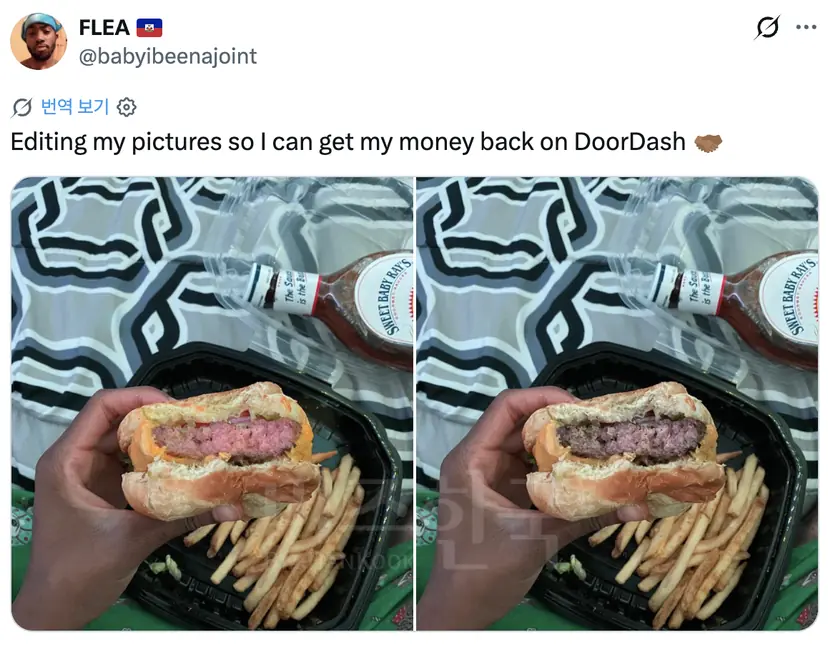
Similar cases are occurring overseas as well. On X, posts went viral claiming that users created and used images for reviews and refund requests that made properly cooked hamburger patties look undercooked or simulated mold on food. Images have also appeared that make a cake look as if it melted during delivery or that show a fly inside a dessert box.
Demands for refunds through false reporting have existed before. However, with the spread of AI, it has become easier to composite foreign substances into food photos or make them look undercooked without any special editing skills, raising concerns. It is pointed out that because it is difficult for business owners to immediately determine whether an image has been manipulated, and because the photos submitted by customers are used as primary evidence in the platform’s refund review process, businesses are vulnerable to malicious complaints.
Regarding this, an official from a delivery platform explained, “When a cancellation is requested due to a problem with food quality, the customer must submit objective evidence, and generally, we proceed with the cancellation after obtaining consent from the store,” adding, “If the business owner does not accept it, our company pays out points equivalent to the menu price.”