

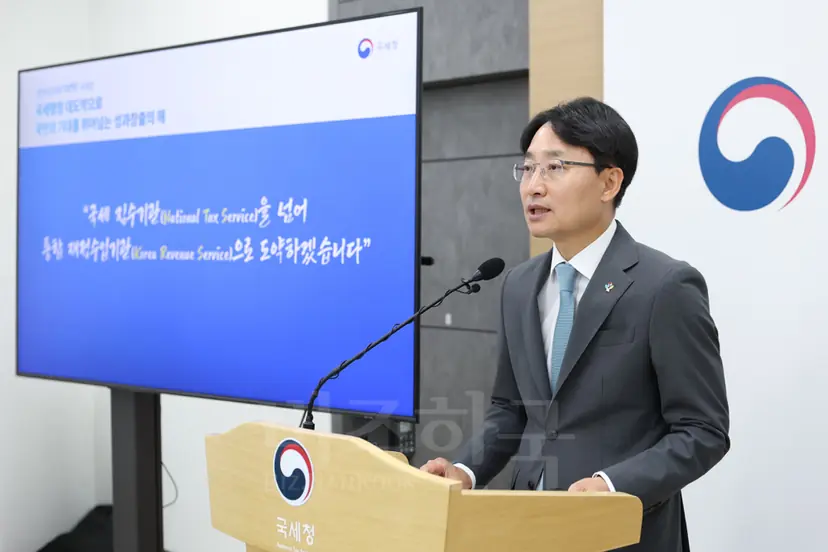
The 'National Tax Administration AI Great Transformation,' which Commissioner of the National Tax Service Lim Gwang-hyun has consistently emphasized since taking office, has moved beyond the conceptual stage and into the procedures for actual system construction. Following the establishment of an Information Strategy Plan (ISP) to map out an AI blueprint for the entire national tax administration last year, the NTS has begun responding to preliminary feasibility studies this year to connect this vision to concrete projects. The work of redesigning the entire national tax administration—from taxpayer services to tax audits and internal operations—centered on AI is now in full swing.

Finishing ISP and Moving to Feasibility Studies… Is AI National Tax Administration Becoming Reality?
The National Tax Service completed its Information Strategy Plan (ISP), which lays the foundation for the AI transformation of national tax administration, last year, and based on this, announced the 'National Tax Administration AI Great Transformation Promotion Plan' in March of this year. It is a roadmap that confirms 65 tasks across three major areas: △Innovation in taxpayer services, △Strengthening of fair taxation, and △Efficiency in tax administration, with services set to be launched in phases starting in 2028. It serves as a mid-to-long-term plan to design AI infrastructure, work systems, and a phased implementation roadmap.
Commissioner Lim Gwang-hyun expressed his commitment to an 'AI-leading department' even before taking office in July last year. During his parliamentary confirmation hearing, he presented visions such as automated tax evasion analysis and free tax consulting through automation, responding that “AI could require a budget of around 130 billion won.”
The ISP, for which approximately 500 million won was invested in the second half of last year, widely encompasses the establishment of NTS-dedicated AI infrastructure, the creation of a system based on small language models (sLLM) and Retrieval-Augmented Generation (RAG) specialized for tax administration, the establishment of AI usage and security guidelines, and plans to introduce Explainable AI (XAI). It also includes 65 core AI tasks, such as providing tax consulting services to all citizens using generative AI, enhancing capacity for clearing and tracing tax arrears, and establishing dedicated AI organizations and securing professional talent, with a plan to implement these in phases.
The key hurdle to supporting this roadmap is the preliminary feasibility study currently underway. The National Tax Service recently commissioned a 265 million won project for 'Support for the Preliminary Feasibility Study of the NTS AI System Construction Project.' Aiming for AI system construction next year, this is a connecting phase to materialize the strategy prepared in the ISP into an actual national project, performing tasks such as technical, policy, and economic reviews and Cost-Benefit (B/C) analysis required for the feasibility study.
According to the Request for Proposal (RFP), it also pushes for work to quantitatively prove the effects of reducing work processing time and increasing public convenience through AI introduction. An NTS official explained, “Because the project scale is large, we are going through the feasibility study procedure,” adding, “We began in April this year and expect the project duration to be about 6 months.”
If the feasibility study is passed, an Information System Master Plan (ISMP), which is a concrete development execution plan, is expected to follow by next year.
Alongside this, a 400 million won ISP project to incorporate 'Agentic AI' into the National Tax Administration Support System is also being promoted, placing weight on advancing services at the point of citizen contact. This project seeks to upgrade the overall national tax administration service by reviewing customized taxpayer support using Agentic AI, an AI business collaboration platform, field investigation support systems, and the assetization of unstructured documents into AI learning data.
Furthermore, the NTS recently signed a Memorandum of Understanding (MOU) with Seoul National University’s AI Research Institute to begin cooperation on AI promotion strategies for tax administration, secure AI operation systems, and training to strengthen AI development capabilities.
AI phone consultations are also expected to expand. Through an IVR interface license expansion project, the NTS plans to improve response rates and wait times during peak reporting periods where consultation demand is concentrated. AI has been applied to consultation tasks since 2024, and the plan is to expand the system where AI handles simple inquiries while staff handle complex consultations, thereby increasing both service quality and work efficiency.
Sensitive Tax Information… Refining Usage Standards
The NTS's AI transformation is being driven by the Information Management Bureau. Earlier this year, the 'AI Innovation Task Force (TF),' which had been operating as a temporary organization, was regularized to launch the 'AI Innovation Division.' With a total of 31 people across 7 teams, it performs AI service planning, development, verification, and data quality management. The overall related projects are managed by the Information Management Bureau, with the Information Planning Officer, Big Data Center, Information Operation Officer, Hometax 1 & 2 Officers, Information Security Officer, and AI Innovation Officer under the bureau handling the tasks.
Discussions on how to safely utilize tax information have also begun. As tax information handled by the NTS is quintessential sensitive information containing individual taxpayers' income and asset details, establishing safety devices before expanding AI usage is considered a critical factor.
Last month, the NTS commissioned a study on 'Plans to Expand the Utilization of Tax Information Based on Ensuring Safety' and began related discussions. The core of this is to survey demand for tax information from public and private sectors while examining legal and institutional risks expected upon expanded utilization and seeking safety devices by referencing overseas management system cases. It is still in the early stages before selecting a project operator. Although the NTS Big Data Center has acquired ISO 42001 (Artificial Intelligence Management System) certification, this is limited to the big data domain, and separate certifications are expected to be secured once AI projects get into full swing.
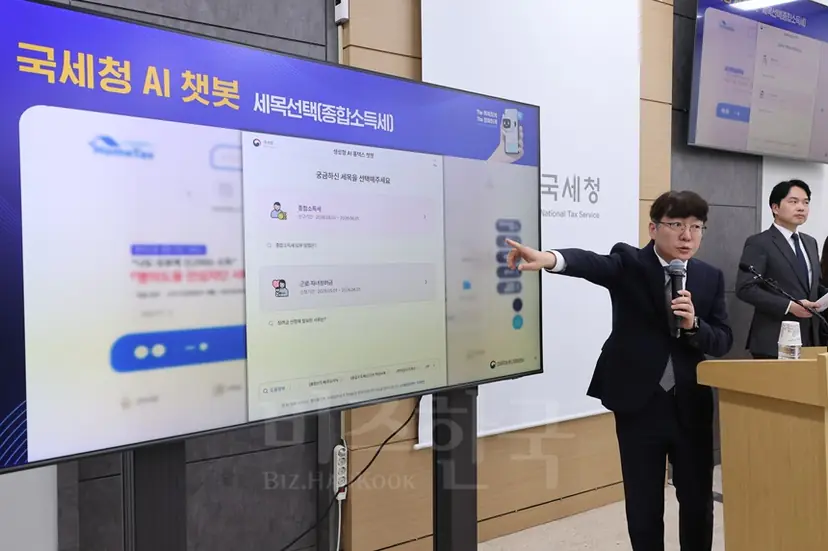
There are also concerns raised at service sites. For instance, questions arise regarding where the responsibility lies if a taxpayer receives disadvantages, such as additional taxes, due to errors after following AI chatbot guidance.
Even in such cases, since reporting and payment are ultimately the taxpayer's responsibility under the tax law system, disadvantages due to errors must also be verified by the taxpayer. Yang Cheol-ho, Director of the Information Management Bureau, said at a related briefing in April, “We are continuously monitoring and supplementing issues such as hallucinations and failures to reflect the latest updates.” Some point out that since the current pilot service is at the level of providing information on tax law and ruling revisions, it does not yet sufficiently answer questions taxpayers might actually have, such as whether expenses are deductible or how to deal with missing supporting documents.
The key is whether safety assurance measures can keep pace with the speed of the AI transformation. An NTS official stated, “In collaboration with Seoul National University, we are preparing an AI-based safety management system, including information security and personal data protection, along with cutting-edge AI technology that can effectively link, analyze, and provide guidance on tax information,” and added, “Cultivating AI competency among staff is also an important issue; we conducted capability-enhancement training for 2,000 people last year in connection with KAIST, and this year, we are also cultivating experts who will lead the AI great transformation through practice-oriented education.”
![[Law Enforcement AI Report] ① Is a Competent and Fair 'AI Cop' Possible?](https://s.bizhankook.com/attachments/2026/07/7985a02444ff_3f2b5028.jpg)
![[AI Report on Supervisory Agencies] ② [Exclusive] Prosecution to Introduce Generative AI for Digital Evidence Analysis](https://s.bizhankook.com/attachments/2026/07/2c4f2e1d1d74_e7fcd687.jpg)
![[Administrative Agency AI Report] ③ “Convenient Tax Payment, Fair Collection”: The National Tax Service’s AI Great Transformation Takes Off](https://s.bizhankook.com/attachments_webp_no_wm/2026/07/134365_no_wm_e3e2934a.webp)