

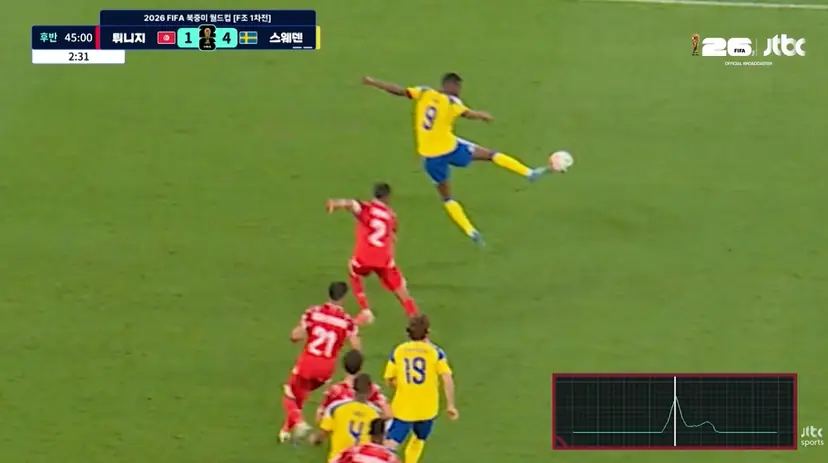
[비즈한국] During the first match of Group F in the World Cup between Sweden and Tunisia, held in Monterrey, Mexico, on the 14th of last month. In the second half, with Sweden leading Tunisia 4-1, substitute Mattias Svanberg scored with his very first touch just 18 seconds after stepping onto the pitch. It was the second-fastest goal by a substitute in World Cup history.
However, the linesman’s flag went up. From the camera angle, it looked as if he had received the free kick directly, which would have been a clear offside. But video review confirmed the ball had grazed the toe of Swedish striker Alexander Isak before reaching Svanberg, and the goal was ultimately allowed.
It was the sensor embedded inside the soccer ball that caught this subtle contact. This chip, which reads the ball's movement 500 times per second, detected the minute change in movement the instant it touched Isak’s toe.
This sensor, which has been officially applied since the 2022 World Cup in Qatar, was developed by students at the Technical University of Munich (TUM) in Germany.
From handwriting records to sensors
The story goes back to 2010. Oliver Trinchera and Alexander Hüttenbrink, who were PhD candidates at the Technical University of Munich, went to watch a match at the Allianz Arena, the home stadium of FC Bayern Munich, and witnessed an 'inconvenient scene.' Club staff were manually recording match performance data, such as pass counts and shot totals, by hand while watching the game. They found it strange that this was still happening in the 21st century, especially in Germany.
Trinchera recalled, “I thought that in a country with advanced technology like Germany, we should be able to collect data faster and more efficiently.”
They wrote their doctoral theses during the day and refined their ideas at night. That was how a startup called KINEXON was born in 2012.
They didn't intend to put sensors in the ball from the very beginning. What they initially conceived was focused on the players. They used small sensors placed in vests or waistbands of shorts to capture individual player movements in real-time. The sensors use Ultra-Wideband (UWB) signals to track where a player is on the pitch with sub-10cm precision, and accelerometers to read how fast they run, stop, and change direction.
By gathering data such as distance covered, top speed, number of sprints, acceleration/deceleration, and jumps, they can manage player workloads to prevent injuries and turn subjective conditioning assessments into numbers. Data can even confirm whether a player returning from injury has truly regained their form.
KINEXON partnered with Bundesliga club FC Augsburg in 2015 to introduce its first real-time player tracking solution. The start wasn't smooth. Although the solution captured 100% of the on-pitch data in real-time, the coaches and analysts in the field didn't know how to use it. KINEXON had to spend a long time teaching them how to use the technology while selling it. This is a common hurdle for early-stage startups whose technology is ahead of the market.
The breakthrough came unexpectedly from across the Atlantic. In 2016, KINEXON entered the US market. The National Basketball Association's (NBA) interest in live data was intense. Starting with about 10 teams, approximately 80% of NBA franchises now use KINEXON’s technology. In effect, a small startup from Munich, Germany, has dominated the data infrastructure of American professional basketball.
From the player’s body to the ball
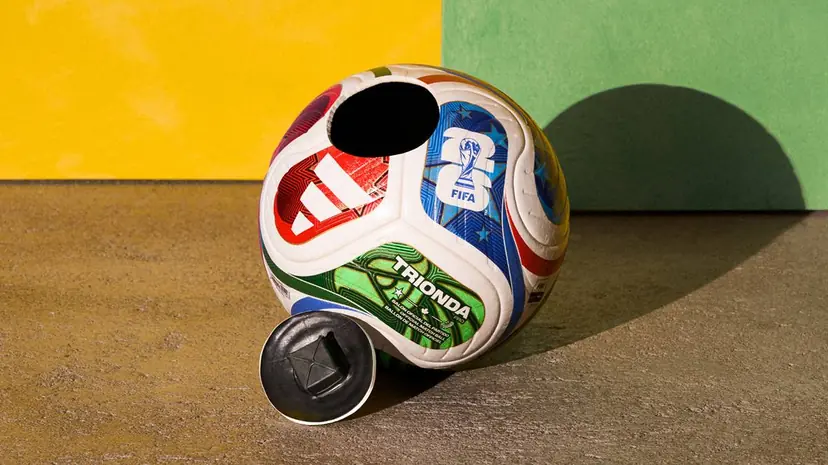
The transition of the sensor from the player’s body to the ball happened in 2018. At the time, KINEXON partnered with Derbystar, a Bundesliga official ball supplier, to create the first connected ball with an embedded sensor. It was the world's first attempt to place a position and motion sensor inside an official match ball.
The sensor inside the ball captures its speed, rotation, and above all, 'when and where contact occurred' 500 times per second. This data is transmitted to a server via an antenna and processed within 1/100th of a second into a format usable for officiating.
This sensor ball was first officially used in the Portuguese league’s relegation playoffs that year. The following year, KINEXON signed a cooperation agreement with FIFA in the field of live tracking and embedded sensors into 'Al Rihla,' the 2022 Qatar World Cup official match ball, and 'Tylonda,' this year's official ball.
Without special cameras, using only broadcast footage
In addition to KINEXON, other European startups with various technologies to analyze player data or determine offsides are attracting attention.
SkillCorner, a startup founded in Paris, France in 2016, extracts data on player and ball movements using only TV broadcast footage, without needing to install special cameras at the stadium.
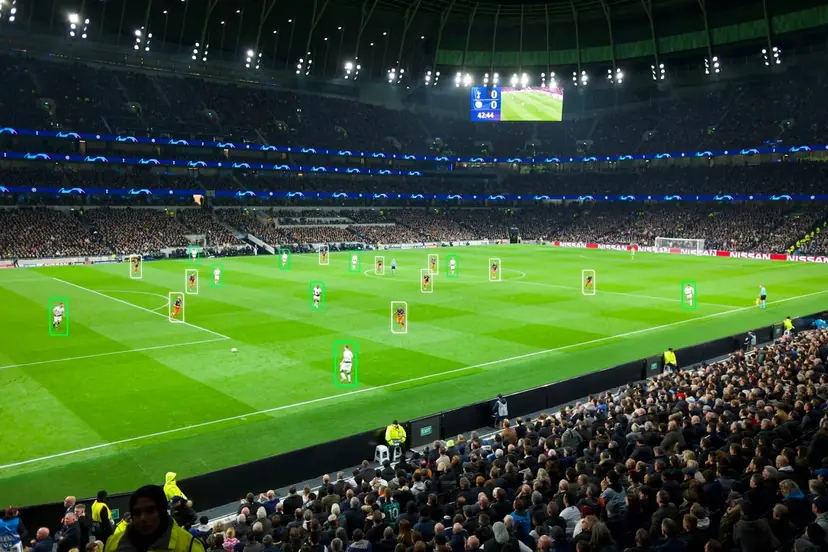
The Semi-Automated Offside Technology (SAOT) used in this World Cup tracks player movements with about a dozen special cameras. This requires a full-body scan of 1,248 players from 48 countries, and the cost is not insignificant. On the other hand, since SkillCorner’s technology can collect data using only broadcast footage, it is accessible even for clubs with tight budgets. According to SkillCorner, more than 300 organizations across over 180 competitions currently use this software.
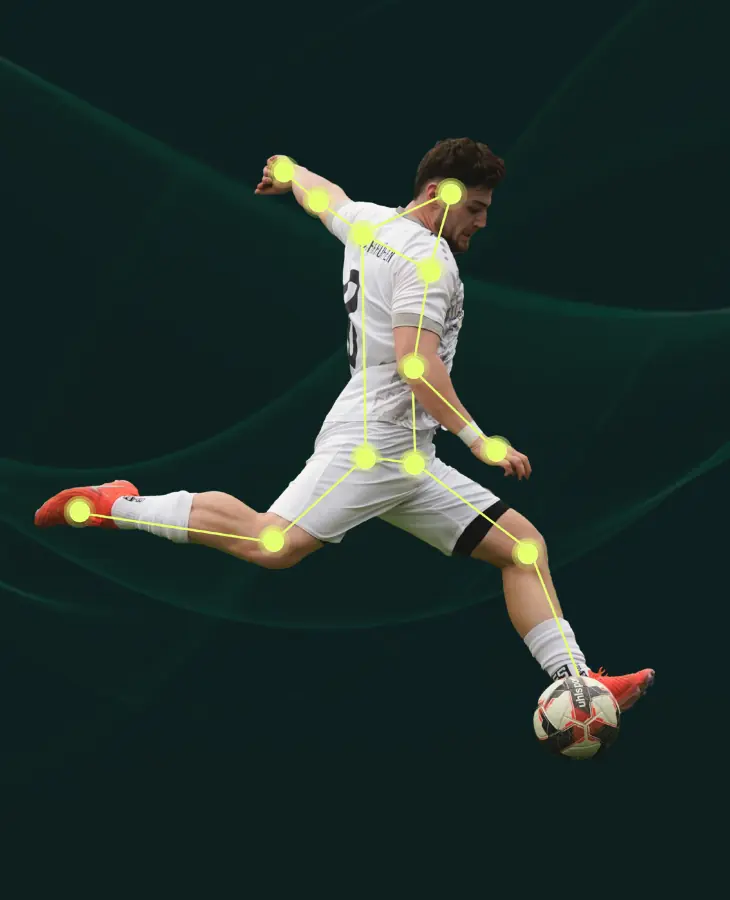
ReSpo.Vision, founded in 2020 in Warsaw, Poland, uses the same broadcast video-based approach as SkillCorner but goes a step further. This company extracts over 50 body points per player from a single-camera flat broadcast view and reconstructs them in 3D with centimeter-level accuracy.
This technology goes beyond just aiding officiating. By reconstructing a player’s 3D movement, it enables 'digital twin' broadcasts, where fans can re-watch goals from a specific player's point of view.
ReSpo.Vision has already obtained FIFA’s data quality certification and counts the 2024 Copa América and the Polish and Danish Football Associations among its clients. It raised 4.2 million euros last June, drawing attention because Polish national team defender Jan Bednarek was listed as an investor. Deep-tech figures like Snowflake co-founder Marcin Zukowski and autonomous driving startup Wave co-founder Amar Shah also participated as investors.
The World Cup is a global festival. However, it is no exaggeration to say that the center of gravity for the sport of soccer remains in Europe. The world’s best leagues, the most intense tactical competitions, and the vast match data left behind by those competitions are all concentrated in Europe. This is why the attempt to read soccer through numbers is particularly active in Europe.
Munich’s KINEXON, which made the sensor inside the ball, and Paris’s SkillCorner and Warsaw’s ReSpo.Vision, which turn players into data using only broadcast screens, are at the forefront of this. The names that will change the pitch of the next World Cup are likely being written right now in a small office in some European city.
The author Lee Jung-woo has worked for 17 years as a journalist covering various fields including major industries like automobiles, secondary batteries, and heavy industry, as well as defense, diplomacy, environment, education, and health and welfare. He particularly covered changes in industrial structures centered on mobility, energy transition, and sustainability on-site. He currently lives in Berlin, Germany, and works as a partner at the startup accelerator ‘123 Factory’.